

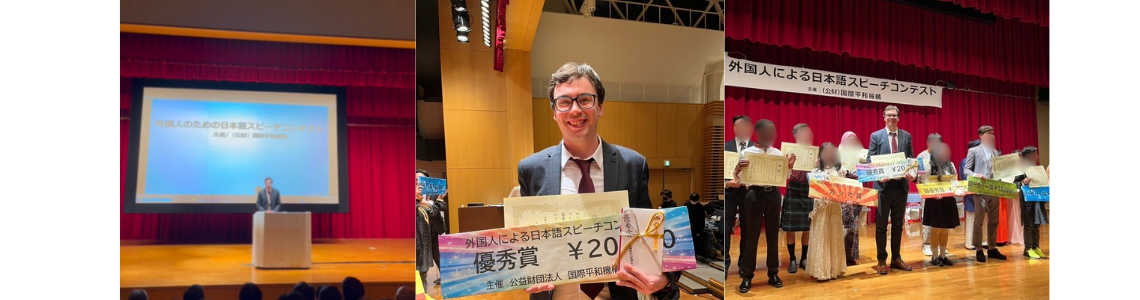
Last week I came second in a Japanese language speech contest.
Today, I want to talk to you all about how I prepared for giving a speech in a foreign language, explain my approach to writing and practicing speeches and presentations, and hopefully give you some useful advice on public speaking in English!
Listen Here!
 Apple Podcasts
 Spotify
 YouTube
Interactive Transcript!
You Can Now Read and Listen at the Same Time With an Interactive Transcript!

Vocabulary
- Recount (Verb): To tell or narrate the details of an event or story.
- The speaker recounted his journey to becoming fluent in French.
- Stumble (Verb): To make a mistake or hesitate while speaking.
- She stumbled over her words during the presentation.
- Intonation (Noun): The rise and fall of pitch in a person’s voice while speaking.
- Proper intonation can make your speech sound more engaging and natural.
- Project (Verb): To speak loudly and clearly so that one’s voice carries to a larger space or audience.
- The actor projected his voice so that everyone in the theatre could hear him.
- Hesitate (Verb): To pause briefly, often due to uncertainty or nervousness.
- He hesitated before answering the difficult question.
- Composure (Noun): A calm and controlled state of mind.
- Despite the pressure of the competition, she maintained her composure and delivered an excellent presentation.
I Entered a Speech Contest
In early December, I participated in the Fukushima Prefecture Japanese speech contest for foreign residents.
I stood in front of an audience of over one hundred people and spoke in Japanese about local Japanese history and my desire to become a tour guide.
And I came second overall!
I was the highest placed adult (a very talented high school student came first) and I also won a second award given by local students for their favourite speech.
If you had told me 8 years ago that I would be able to give a speech in a foreign language, I would not have believed you.
Since studying Japanese, however, I am now a big believer in the power of giving speeches as a way of improving your language. I competed twice in the Ehime prefecture, Niihama city, speech contest when I lived there between 2016 and 2018, took a public speaking course in Tokyo while a graduate student, and now I am actively participating in speech contests in Fukushima.
Today, I want to recount my preparation for the speech contest in this episode. Along the way, I’ll try give you tips and advice on how to improve your English public speaking!


The Important of Public Speaking?
I entered a speech contest.
This is an organised competition in which participants write a speech (usually on a certain topic or theme) and then perform the speech in front of judges. The speech is then graded and a winner announced.
I like to challenge myself and challenge my Japanese language ability. I was very nervous before stepping on the stage, but I wanted to see if I could confidently speak in front of an audience of people.
While speech contests are a manufactured place to give a speech, they do force us to practice a vital language skill: public speaking.
Whether it is a work presentation, a speech at your child’s wedding, or you decide to compete in a speech competition, public speaking is an important but difficult language skill.
The ability to speak clearly and engagingly, as well as display confident body language, is something I think we should all be focusing on improving.
I want to tell you all about my efforts to improve my Japanese public speaking!

Writing the Speech
Before I could start practicing and perfecting my speech, I had to write it first!
The speech contest was specifically for foreign residents of Japan’s Fukushima prefecture, and the theme was about my life in the region. While many of the other competitors discussed their culture shocks from living in Japan or recounted funny experiences while learning Japanese, I decided to write about becoming a tour guide.
I have been attending volunteer tour guide training sessions over the past year, and next year I hope to have the opportunity to actually qualify as a tour guide. I love the history of this region of Japan and really want to introduce the stories from here to the wider world.
When public speaking, I find it is much easier to be confident and fluent in your speech when you like the content you are talking about. I love history, so talking about history on the stage was not too challenging for me.
Of course, not everyone is so lucky. I’m sure many of you have had to give boring presentations about work topics. In this case, the key is to be confident in what you are talking about (by deeply learning and understanding the content).
This was one of the big differences between the speech contest I entered 7 years ago and the one I entered this year. It was so much easier to learn my speech this year because my Japanese is much better – I understood the content far better which made it easier to learn!
Another key thing that I tried to stick to, and I recommend to all of you thinking about speaking publicly, is to carefully choose the language, vocabulary, and grammar you use.
I made sure to only use vocabulary and grammar that I fully understood. I changed my draft speech numerous times to simplify grammar and sentence structure, to make it more suitable to my Japanese level.
This is something you should also consider. If you are giving a presentation at work or university in English, try to sketch out your notes in language you are used to using.
Of course, sometimes you will need to use new or unfamiliar vocabulary but keep the grammar to your current English level. As you get better, you will be able to use more advanced grammar.
At the same time, you should try to avoid pronunciation traps. Sometimes, certain sentences or phrases can make you stumble over your words. If you stumble over the words, you will lose you flow and concentration.
For example, in my original draft speech I used a simple Japanese verb (similar to the English “to visit”). This is a word I fully understand and know how to use. However, when I read through the speech, I noticed I couldn’t smoothly pronounce it due to the preceding words (there were too many similar sounds, and it became a tongue twister).
Changing it to a different verb was easy to do and made the sentence far easier to pronounce.
Just to recap, when writing a speech or presentation, focus on something you are confident in, use language you fully understand and are familiar with, and consider pronunciation and speaking while you are writing.

Remembering and Practicing the Speech
Once the speech was written, I then I had to learn and practice it. I needed to be able to stand in front of an audience of people, and then recite my speech confidently and clearly from memory (with no notes or prompts).
I like to split practice into two different stages.
First is learning the speech.
Second is practicing the speech.
Learning the Speech
In the first stage, it was simple matter of rote memorisation. Rote learning is a technique that involves repeating information until it is memorized.
I first wrote my speech on a piece of paper with spaces between each sentence. Then I read each section aloud multiple times until I could recall it without looking.
Gradually, I added and combined sentences and sections together, practicing from the start each time.
Eventually, I could remember the entire speech without looking at the piece of paper. As my speech was only three minutes long, it took me a few hours to remember it entirely and maybe a day to be really confident in my understanding of the speech.

Practicing the Speech
Learning the words of a speech, however, is the easy part in my opinion. Giving a speech is a much more complex process than simply recalling the words you wrote down on a piece of paper from memory.
Pronunciation, intonation, sentence pacing and delivery, tone of voice, facial expressions, body language, and probably some other things that I have forgotten, are of vital importance in delivering a speech.
Hopefully, once I get a high-quality recording of my speech, I’m planning to make a video comparing my final speech at the contest and an earlier practice version I did at my local Japanese class.
The difference is striking.
Before the practice speech at my Japanese class, I just focused on learning the content of the speech. You can tell in the recording that I wasn’t confident enough – I kept using filler words in the middle of the speech which was a clear sign of not being prepared.
I also looked miserable, my eyes kept looking upwards (a sign of trying to remember), my speech was a little flat in delivery and I made a few mistakes, and my intonation and stress was incorrect on quite a few words.
In my final speech, I was so much better.
There were no filler words, I looked out at the audience with confident body language and projected my voice clearly. Even though I made two mistakes (I stumbled over a few past tense verbs), I didn’t stop or panic or lose my rhythm.

How Did I Improve?
There was one week between my practice performance and the speech contest. How did I improve and change my approach to practicing?
First, I made sure than I knew the speech completely without the need to “remember.” In my practice speech, I was clearly and obviously trying to remember my speech. By putting in a few more hours of practice, I was able to deliver the speech confidently.
In fact, I could do my entire speech without thinking. I also practiced a few different varieties of my speech. I noticed that if I made a mistake, it tended to happen in the same parts of the speech, usually between the sections/chunks of information that I had learned.
Therefore, I made sure that I was comfortable in making changes to the speech if I made a mistake (for example saying the wrong place name or getting the order of a certain sentence wrong).
Actually, I also edited my speech based on feedback from the practice speech. One person in the audience told me that I was saying the name of town incorrectly (I called it a village instead of a town), another told me I was mispronouncing the name of an organisation, and I was also told that I was stressing some words incorrectly.
Once I was confident in my speech, I started practicing in three ways.
First, I practiced in front of the mirror. I made sure to stand up (I realised that I had been practicing sitting down, but during the speech I would standing up) and look at myself while speaking. This trained my body language and facial expressions.
Second, I used the record and review method.
This works by recording a video of the speech being delivered. Then you review it.
First, I reviewed it without watching the video. This allowed me to concentrate on the sound of voice, the tone and pronunciation, and the rhythm of the speech.
Next, I reviewed the video with no sound. This allowed me to review my body language.
Then I transcribed the audio using an editing app. This showed me where and when I was using filler words.
By recording and reviewing yourself in this way, you can identify your strengths and weaknesses quickly and easily. I kept repeating until I was happy with my delivery.
The most important practice method was to get feedback. I annoyed my wife all week by reciting my speech in front of her every day. As a native Japanese speaker, she helped correct small mistakes I was making and told me how to change my intonation and rhythm to be more natural.
If you don’t have a native speaking partner, ask friends, classmates, or use an application like ELSA Speaks for immediate feedback on your pronunciation!

Delivering the Speech
After all of the learning and practicing, it was time to deliver my speech in front of an audience and the judges.
Nerves are a real problem when it comes to public speaking. However, I believe the more confident you are in your understanding of your speech or presentation, the less nervous you will be.
As I said before, I got to the point where I could deliver my speech without even thinking about it. It became almost automatic. Once I got on the stage and started speaking, all my nerves disappeared, and I could just keep speaking.
I also focused on my body language. I tried to smile (or at least not look miserable), look out at the audience, and stand up straight.
The result was second place overall and the best placed person in the adult categories!

Lessons Learned
What lessons did I learn from my experience? And what lessons can I communicate to you all to help you speak publicly?
Choose Familiar and Manageable Language
When speaking publicly, use vocabulary, grammar, and phrases that you fully understand and are comfortable with. Avoid overly complex structures that may cause mistakes or make you hesitate.
Simplify Pronunciation Challenges
Identify and adjust difficult-to-pronounce words or phrases in your speech or presentation to maintain fluency and avoid stumbling over tricky sections.
Master the Speech Through Repetition
Divide your speech or presentation into sections, memorise each part through repetition, and gradually combine them. Once you’ve memorised it, practice delivering it until it feels natural and automatic.
Review and Refine Through Feedback
Practice in front of others, record yourself, and seek feedback. Use this feedback to refine pronunciation, body language, and overall delivery. Keep practicing until you are happy with the result!
Focus on Confident Delivery
Nervousness decreases with preparation. When presenting, focus on confident body language (e.g., smiling, standing tall, and making eye contact) and a steady, clear voice. Mistakes happen, but maintaining your rhythm and composure is key.

Final Thought
Today I have recounted my experience of participating in a Japanese language speech contest. Hopefully it has inspired some of you to try speaking English in public and given you some useful tips and advice for planning your own speeches and presentations.
I love challenging myself and my Japanese ability. Whether it is through giving speeches, taking proficiency tests, or joining local groups and events, I want to constantly improve.
How about you? Have you ever given a speech or presentation in English?
Extended Vocabulary List
Become a Patreon Subscriber to Access the Extended Vocabulary List!


Vocabulary Games and Activities!
Learn and practice vocabulary from this Thinking in English episode.
Practice using 5 different study games and activities – including writing, listening, and memorisation techniques!
Flashcards
Matching Game
Learning Game
Test Yourself
Listening and Spelling
Do you want to Think in English?
I’m so excited that you found my blog and podcast!! If you don’t want to miss an article or an episode, you can subscribe to my page!
