

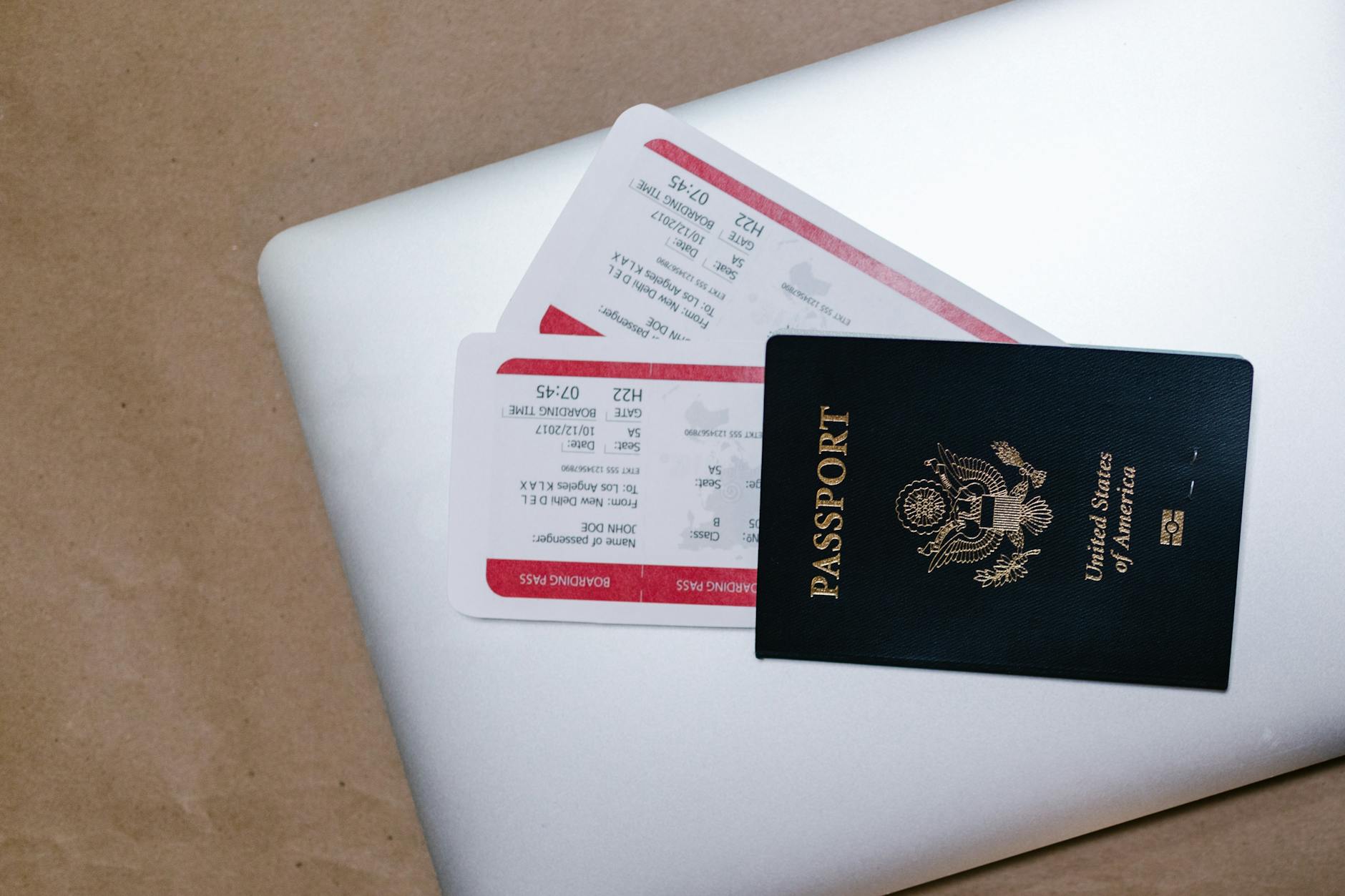
I have lived abroad for about 5 of the past 8 or 9 years. I have lived in Japan as a worker, a student, and now a spouse (and also in Taiwan as a student too).
People often ask me how I moved overseas, so today I want to talk about this topic. I’ll discuss the state of migration, some of the common visa types or methods of moving overseas, and a few steps you need to take to move abroad.
At the same time, I will share my own immigration experiences!
Listen Here!
 Apple Podcasts
 Spotify
 YouTube
Interactive Transcript!
You Can Now Read and Listen at the Same Time With an Interactive Transcript!

Vocabulary
- Abroad (Adverb): In or to a foreign country.
- She has always dreamed of studying abroad.
- Migration (Noun): The movement of people from one place to another, especially to live or work in a different country or region.
- The migration of workers from rural areas to big cities has increased in recent years.
- Sponsor (Verb): To support or be responsible for someone, often financially or legally.
- The university sponsored several international students for their study visas.
- Visa (Noun): An official document or stamp in a passport that allows a person to enter, stay, or leave a country for a specific period and purpose.
- He applied for a student visa to study in Canada for two years.
- Spouse (Noun): A person legally married to another.
- After getting married, she applied for a spouse visa to join her husband in the UK.
- Residency (Noun): The state of living in a particular place.
- He applied for permanent residency in Australia after living there for five years.
- Temporary (Adjective): Lasting for only a limited period; not permanent.
- She moved to France on a temporary work visa, valid for one year
Introduction
Over the years, I’ve had the privilege of living in a few different countries. I have moved overseas as a student, as a worker, and now as a spouse.
Recently, I’ve become aware of a common theme among some of my friends and family in the UK, in the US, and in other countries. They also want to move abroad.
It seems like many people feel unsatisfied with their lives in their home countries. Whether it’s due to political instability, high taxes, difficult weather conditions, a lack of career opportunities, or the desire for a new challenge, moving abroad can seem like a potential solution to many of these issues.
I’m sure many of you have thought about leaving your country too. But how do you make this happen? What steps do you need to take?
Today, we’re going to explore all of that. I’ll talk from my experience as an immigrant to Japan, and also my knowledge as someone who studied migration, immigration, and citizenship at graduate school.
Of course, everything we talk about today is situation dependent. Every person’s path to moving abroad will be different based on their personal circumstances, skills, and connections.


How Has Migration Changed?
Migration, the movement of people across borders, is not a new phenomenon. For centuries, people have moved for a variety of reasons, including for economic opportunities, escaping war or persecution, or seeking better living conditions.
In the past 500 years alone, trade took Chinese and Arab traders all across Asia. Persecution drove Jews in Spain and Portugal and the Huguenots in France to find new homes.
Colonialism took European settlers to the Americas, along with millions of African slaves. Once slavery was made illegal, the European empires took indentured workers (mainly from India and China) all across the world.
The industrialisation of the Americas, and also Australia and New Zealand, in the 19th and early 20th centuries led to the migration of massive numbers of people. Around 50 million people left Europe during this period, moving in search of a better life.
After World War 2, Western Europe needed labour, and they turned to their former colonies. Millions of workers from the Caribbean and South Asia settled in Britain, while France imported labour from their African colonies and Germany from Turkey.
At the same, Australia was offering British people the opportunity to move across the world for just £10 (at the time Australia only accepted white immigrants).
Places like the USA and Australia were considered countries of “immigration” (meaning they accepted new immigrants), while places like Italy and Spain were considered countries of “emigration” (meaning many Italian and Spanish people moved overseas).
Since the 1970s, some of the traditional countries of emigration have also become countries of immigration, while the traditional countries of immigration have become much stricter in allowing people to move.
The development of the Middle East has opened opportunities for massive immigration, as well as newly developed Asian countries like Thailand and Malaysia attracting immigrants from other parts of Asia.
In recent decades, much of the world has seen a shift towards more restrictive immigration policies. Many countries that were once known for their openness have become more selective about who they allow in.
Many governments have implemented points-based systems or have specific categories that determine who can migrate based on skills, education, and work experience.
Countries like Japan (where I live), the UK, Canada, Australia, and New Zealand prioritise skilled workers. They want people with degrees, years of experience, and skills that are in shortage.
If you are wealthy, high skilled, or highly educated there are still many options to move around the world. The UK, for example, has a specific visa for graduates of a world top 50 university. Some European countries have investor visas or digital nomad visas for remote workers that have a certain income level.
At the same time, opportunities for permanent low-skilled migration are decreasing. Some countries have temporary visas for low skilled work, but these often give no opportunity to permanently settle somewhere.

Main Ways to Move Abroad
I’d now like to talk about some of the different ways to move abroad that are common around the world right now.
These are the main methods, but I’m sure there are many ways that I won’t mention. For example, some countries have reciprocal work agreements, while others have working holiday or youth mobility treaties.
I think the following methods are the main ways to move overseas.
Ancestry or Citizenship by Descent
Let’s start with one of the easiest and most direct ways to move abroad – through ancestry or citizenship by descent. This option is available if you can trace your family lineage back to a country that offers citizenship to descendants of nationals.
Countries like Ireland, Italy, Poland, and Germany, have laws that allow you to apply for citizenship if you can prove that you have parents, grandparents, or sometimes even great-grandparents from that country.
Other countries offer special visas for descendants of citizens.
I’ve put this as the easiest method to move abroad because it is faster, cheaper, and more straightforward than other methods. If you have a German ancestor, for example, you can potentially gain German citizenship and the right to move, live, and work around the European Union (without needing a degree or job etc).

Marriage or Family Reunification
If you marry a citizen of a country, or if you are the immediate family member (spouse, children, parents) of someone living in a foreign country, you may be able to apply for family reunification visas or spouse visas.
Marriage is one of the most common ways people move abroad, and many countries have relatively straightforward ways for married couples to immigrate. This is how I am in Japan.
It took one month from being married to receiving my Japanese spouse visa, and after 3 years of being married I become eligible for permanent residence. In other countries it can be more challenging – I know the USA has very long wait times and the UK process is now very expensive. However, if you have the resources and you are happy to wait, spousal visas allow you move overseas relatively easily.
Of course, this opportunity is only available to a small group of people (but for those people it is a relatively easy way to move abroad). This is the only way I could continue working on Thinking in English in Japan – as a spouse I have no work restrictions.
Study Visas
Student visas are typically one of the easier routes for foreign nationals to enter a country, particularly if you’ve been accepted to an accredited school or university.
Most countries offer study visas to foreign students who have been accepted to a full-time academic program.
The catch here is that a student visa is temporary, and while it allows you to stay for the length of your course, it usually won’t automatically lead to permanent residency. So, if you intend to stay after graduation, you’ll likely need to transition to another type of visa, such as a work visa or post-graduation visa.

Work Visa
The work visa is one of the more common and accessible paths for people who want to live abroad long-term. If you’ve been offered a job in a foreign country, you may be able to apply for a work visa.
Work visas generally require a sponsorship from your employer, meaning the company has to apply for your visa on your behalf.
In some cases, work visas are capped, meaning that only a limited number of applicants are approved each year. Often there are strict requirements to meet.
Digital Nomad Visa
A relatively new type of visa in recent years is the digital nomad visa. This type of visa is designed for people who work remotely and can move to a country without needing to be tied to a specific employer.
The advantage of a digital nomad visa is that it allows you to live abroad while maintaining your job with a company in your home country or working as a freelancer.
However, there are often very strict requirements for this type of visa. You often need proof of employment, to meet income thresholds, purchase health insurance, come from a specific country, and the visas are often temporary.
Investor or Entrepreneur Visas
Often the most difficult and costly route to move abroad is through an investor visa or entrepreneur visa.
This either requires you invest a lot of money into a country’s economy or start a business in that country.

Moving Abroad
Now, we have to think about the steps of moving abroad.
First thing is to research the country you want to move to. You need to check what visa options are available to you, whether there are job opportunities, the cost of living, and other issues like languages.
You then need to decide how you will (or if you can) move to that country. You will need to see if you qualify for a valid visa.
For example, if you want to work there, you probably need to find a company to sponsor you (which could take months or years). If you want a student visa you will need to gain admission to an institution. If you want an investor visa, do you have enough money to invest in a company or property?
The next step is preparing documents and applying. Often you need a lot of documents.
When I applied for my spousal visa (or technically my Certificate of Entry), I needed passport copies, birth certificates, marriage certificates, my wife’s family history, my resume and work history, copies of my wife’s employment contract, evidence of our marriage being real (photos and letters from her family), copies of my degrees and language qualifications, and probably other stuff.
The method of applying for a visa is different depending on the type of visa and country. I can tell you my experience, but it will be different for you. I have had three visas that allowed me to live in Japan.
- Two of my visas were directly provided by the Japanese government (I worked for the government as a teacher, and I studied as a government scholar). This meant I could skip some steps and just needed to fill in the application form.
- For my spousal visa, my wife had to apply for a certificate for entry for me. Once she received that, she could send it to me, and I could apply for a visa.
Some countries require you to have interviews or provide biometric information like fingerprints.
You also need to pay. Sometimes you pay in advance (like in the UK) and other times you pay if your application is successful (like in Japan).
While this is all going on, you need to be planning your finances. There are a lot of different expenses – visa fees, flights, living expenses for the first few months (or entire time if you are a student), housing deposits and money for furniture etc.
You will also need to think about insurance, if you need it, healthcare, housing, and other arrangements specific for your situation (like preparing for the new job or entering university).
Once you have your visa (if your application is successful), it is time to finalise your flight plans, open bank accounts, set up phone numbers, and start living in your new country!
Importantly, you need to make sure you stay up to date with your visa. If you have a work visa, you need to keep working. If you have a student visa, you will probably need to study a certain number of hours a week.
Once your circumstances change, you will need to apply for a new visa or leave (until you get permanent residence or citizenship).

Final Thought
Millions of people move overseas every year: for work, for marriage, for study, or even to escape from war.
But there are a few misconceptions I think people have about moving abroad.
First, just because you want to move to a country doesn’t mean that country wants you. This might sound harsh, but it is unfortunately true. Many people discover this the hard way, after they’ve invested significant time, money, and effort into the process.
Even if you’ve got the perfect skills, the best education, or a strong desire to live abroad, that doesn’t guarantee that you’ll be able to easily gain access to a foreign country. Many countries have rules that a company can only hire a foreign worker if they cannot find a suitable person already living in the country.
Another point is that it’s often easier to move temporarily than to stay permanently. Short-term visas, like student visas, temporary work visas, or tourist visas, are usually easier to get than permanent residency or citizenship. This means that it’s relatively easy to live in a country for a year or two, especially if you have the money to study abroad.
But the real challenge comes when you try to stay permanently or move beyond the temporary immigration route!
However, it is possible. There are many different routes, opportunities, and roles out there. Once you find that job or opportunity, moving abroad can be one of the best decisions possible.
I enjoy my life immensely in Japan, and I understand how privileged and fortunate I am to have the opportunity to live here!
How about you? Are you interested in moving abroad?
Extended Vocabulary List
Become a Patreon Subscriber to Access the Extended Vocabulary List!


Vocabulary Games and Activities!
Learn and practice vocabulary from this Thinking in English episode.
Practice using 5 different study games and activities – including writing, listening, and memorisation techniques!
Flashcards
Matching Game
Learning Game
Test Yourself
Listening and Spelling
Do you want to Think in English?
I’m so excited that you found my blog and podcast!! If you don’t want to miss an article or an episode, you can subscribe to my page!

Hi Tom. I love your podcast.
I would like pronunciation classes. Could you tell me, how can I do this, please?
I want become a patrón as well but in the payment I have problems. I have tried 3 times.
Hi Adriana, I don’t currently offer pronunciation classes (but I have some plans for later this year). With Patreon, you may need to let your bank know that you are paying in a foreign currency (if you are paying in $,€,£ etc)