

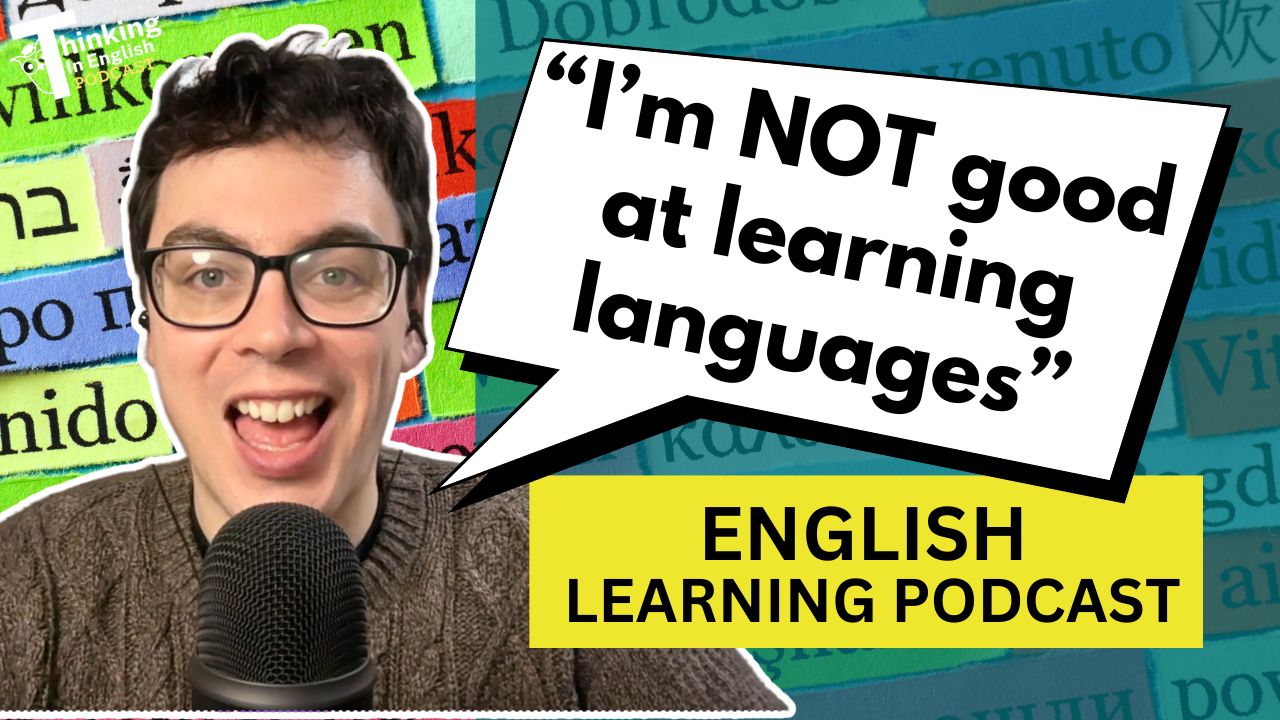
“I’m just not good at learning languages.”
I’m sure many of you listening right now have thought this before. And I’m sure you’ve thought the opposite about people you have met in the past: “Wow, she’s so talented at English” or “He has a gift for languages.”
These kinds of comments are incredibly common. Many people believe that success in language learning depends mostly on talent. Some people are just naturally good at learning English, while others aren’t.
But is this true? Is talent real when it comes to learning languages? And if talent does exist, what exactly is it? Is it the same thing as skill? Is it the same thing as advantage? Is it the same thing as ability?
In today’s episode, we’re going to explore these questions. We’ll look at what talent really means, how it is different from ability, advantage, and skill, and what science and neuroscience say about why some people seem to learn languages faster than others.
Then we’ll apply these ideas directly to English learning and hopefully give you all some motivation!
Listen Here!
 Apple Podcasts
 Spotify
 YouTube
Interactive Transcript!
You Can Now Read and Listen at the Same Time With an Interactive Transcript!

Vocabulary
- Ability (Noun): The potential or capacity to do something.
- She has the ability to understand new grammar quickly.
- Genetic (Adjective): Related to genes or inherited traits.
- Some people believe language learning ability is partly genetic.
- Inborn (Adjective): Existing from birth; natural.
- He has an inborn talent for remembering new vocabulary.
- Innate (Adjective): Natural and present from birth.
- Children seem to have an innate ability to learn languages.
- Head start (Noun): An early advantage over others.
- Growing up in a bilingual family gave her a head start in English.
- Effort (Noun): The energy or work put into something.
- Improving your English requires time and effort.
- Invest in (Verb): To spend time or money to improve something.
- He decided to invest in online English classes to improve faster.
Ability vs Performance
Let’s start by clarifying the [00:03:00] difference between ability and performance.
Ability refers to your potential to do something. It’s what you are capable of doing under the right conditions. Performance is what you actually do in a real situation.
So let’s imagine an example.
Imagine you are going to run a marathon. You train really hard, and you now have the ability to run a marathon in under three hours. You have done this in training, so you know you have the ability. You can do it on a treadmill. You know you have the ability to run a marathon in under three hours.
But when it comes to the actual marathon race, the weather is a little bit hot. The course is full of hills, and there’s so many people around. And you don’t finish in under three hours. You had the ability to do it, but your performance on the day was not the [00:04:00] best.
Performance is influenced by many different things.
My ability in Japanese is pretty good, but my performance can vary wildly. If I’m stressed or nervous or tired or talking about a topic I’m not familiar with, my performance in speaking can drop significantly.
This distinction, the difference between ability and performance, is important because we often judge people based on what we see. If someone performs well in front of you, you assume they have a high level of ability. Maybe they’re talented. If someone performs poorly, maybe you assume they have a lower ability. They lack talent.
I see this in my conversation clubs, the Thinking in English speaking practice groups that I run, you should all join. Some of my regular members have been attending for years. And depending on [00:05:00] the topic or the time of day, their performance varies, but their ability is clearly strong and improving over time. But day to day, your performance can be different.
Okay. So when we’re talking about whether someone is a “good language learner” or a “talented student“, what we’re really thinking about, at least most of us, are thinking about “ability“.
We’re thinking about what you are potentially able to do, your capability, your ability.


Breaking Down Ability
A few weeks ago, I was listening to a podcast that talked a little bit about being “good” at something and they made a really useful distinction between different parts of ability.
There’s talent, skill, and advantage. If you combine together these three things, you get your ability. At least a rough approximation of your ability.
So I think maybe we need to think a little bit in more [00:06:00] detail about talent, skill, and advantage.
What Talent Really Means
In my opinion, a good definition of “talent” is inborn potential or your natural ability.
Some people seem to have brains that are slightly better suited to certain types of learning or thinking.
For example, some people just have a better memory than other people. Some people are great at pattern recognition. These are both things that will make learning a language slightly easier. It won’t be a huge difference, but it will have an impact.
It’s obviously debatable whether someone’s ability is natural or learned, and most of the time it is a mix.
Think about an elite sprinter, like Usain Bolt. Sprinters train incredibly hard, but they also seem to share some genetic similarities, like [00:07:00] having a specific type of fiber in their muscles called “fast twitch fibers“. And this genetic similarity gives them an innate talent for sprinting. They have a natural talent for sprinting thanks to their bodies.
Another example of someone just being naturally talented is the American Football Player, the NFL player, Jordan Mailata. If you are not an NFL fan, you probably don’t know who Jordan Mailata is. He plays for the Philadelphia Eagles.
But he’s not from the USA. He grew up in Australia playing a completely different sport. The sport of Rugby League. He got to a decently high level, but it became clear he was never going to become a professional. He just wasn’t at the top level in the sport of Rugby League. He wasn’t going to become a professional.
So around the age of 20, he decided to try out for an NFL team. He [00:08:00] had never played American football in his life, but he was naturally athletic. He was big, strong and quick. He was successful. He joined the Philadelphia Eagles, trained, became a regular player and is now considered one of the best in the entire league in his position.
He didn’t grow up playing the sport. He didn’t practice NFL skills, American football skills for years and years and years. He was simply naturally gifted, naturally talented at being an athlete.
Let’s go back to language learning. There are people out there who have this innate, inborn potential. They have a naturally good memory, or they are naturally good at copying accents.
But, talent is just potential, right? You have to remember this. Talent does not mean you’re going to be skillful or successful. Talent is just [00:09:00] potential.
I was watching the Winter Olympics recently. And yes, everyone was an amazing athlete. The skiers were amazing, the snowboarders were amazing.
But I couldn’t help think that there was someone out there in the world, living in a country with no ski slopes, that could be the most naturally talented skier or snowboarder in history.
They just haven’t had the chance.

Environment and Advantage
And this brings us to the next part of ability: “Advantage“.
An advantage is a condition that gives someone a “head start” when learning or developing a skill. It is a situation that makes learning something easier.
In my understanding, talent is based on your brain and genetics, while advantage comes from your environment.
Let’s go back to the Winter Olympics.
I live in Japan, and a lot of the TV coverage here focused on the [00:10:00] Japanese snowboarders who performed really well. They were clearly very athletic and talented, but watching their interviews, it also became clear they were very advantaged.
All of them came from the snowy and mountainous regions of Japan. That is an advantage. It’s really difficult to become a great skier, an Olympic level skier, if there’s no ski slopes for you to practice. And it’s really difficult to become a great snowboarder if there’s no ski slopes for you to practice.
All of those snowboarders seemed to start skiing or snowboarding from a very early age, sometimes three or four or five years old. And they came from families in which their parents and their siblings also skied and snowboarded. That’s another advantage, coming from a family that takes you skiing early.
Winter sports are also not cheap. It requires [00:11:00] ski passes and lessons and equipment. You need money to go skiing, and you need money to ski regularly, and you need to ski regularly to become an Olympic athlete.
I’m not saying that the Winter Olympians didn’t work hard to become great athletes. Yes, they did. They worked really hard. And I’m sure many of them are naturally talented as well, but they are almost all advantaged as well.
Their advantages help them become an Olympian. The fact they live near a mountain or the fact that their father snowboarded and took them snowboarding every weekend.
So what are advantages when it comes to language learning?
For example, imagine someone who grew up in a bilingual household. From childhood they regularly heard two languages spoken at home, which helps to develop your listening skills and gets people used to switching between languages.
This doesn’t necessarily need to be English and your native language. There is some [00:12:00] evidence that it is easier for bilingual people to learn a third language as well. Because they already have the skills, and the knowledge, and they’re used to learning languages in this way.

Skill Beats Everything
So if you have talent and you have advantage, are you going to be great at something? No.
Perhaps the most important part of ability is “skill“. Skill is the result of training, practice and repetition. Skill is something you develop over time through your effort and experience.
Talent is something in your body. Advantage is something in your environment. Skill is something you build.
We’re talking about language learning, so most of the things that we admire in a fluent speaker, you guys admire in a fluent speaker of English or I admire in a fluent Japanese speaker, are skills.
Clear pronunciation is a skill that most [00:13:00] people improve through listening and practicing sounds. The ability to write clearly and logically in English develops through reading and writing and getting lots of feedback.
Using advanced vocabulary normally comes from repeated exposure to words in context. And speaking fluently is usually the result of many, many hours of conversation and practice.
You can become highly skilled even if you are not naturally talented. If you work hard and you practice consistently for years… yes, you can become a high level speaker.

Language Learning Examples
Let’s think of a few more examples showing the difference between talent, advantage, and skill.
Some English learners seem to have a naturally good accent. They can copy sounds easily and speak in a way that feels quite similar to me, perhaps.
This might come from talent. For example, they might have a strong phonetic memory. Phonetic memory is a memory for [00:14:00] sounds. And it can let someone hear small differences in sounds and then make them accurately. I do not have a strong phonetic memory, right? I’m terrible at reproducing sounds.
There can also be advantage. Maybe people grew up watching English TV or had a foreign teacher as a young child.
But of course there’s a lot of skill required. Most of the time, clear pronunciation comes from practice. A lot of practice. You need to spend a lot of time repeating sounds, shadowing audio, understanding common mistakes.
Another example is with vocabulary. Some people seem to remember new words instantly.
This could be a form of talent, like having strong memory systems. Advantage matters too. Someone who grew up reading a lot, even if it’s in your native language, people who grew up reading tend to have better vocabulary learning ability than someone who’d never read as a child.
And then most [00:15:00] importantly, vocabulary is a skill. It takes practice.

Practical Advice to Improve
So I want to end this episode with some advice.
First, give yourself advantages to help improve your ability. You are all adults now, or most of you listening are adults now, but you can still give yourself advantages.
Maybe you live far away from any English speaking communities, but you can still surround yourself with English. Podcasts or videos. My conversation and speaking groups, the Conversation Club on Patreon. Using social media. If you force yourself to be in an English environment, you have an advantage.
You can invest in classes or invest in textbooks. Give yourself every opportunity, every advantage, to improve.
If you are lucky enough to have a natural strength, some kind of talent, try to build on it. For example, if you have a good memory, use your memory to help you study.
But I’m sure many of [00:16:00] you assume you are not talented language learners. I think I am not a naturally talented language learner. Perhaps you think you are bad at English.
Most of the time though, people just haven’t tried the right study methods or given themselves enough time or shown enough consistency.
Overall, skill is the most important factor. Talent and advantage can help you, but if you study hard and you work hard, you will learn.
Repeat. Practice. Be consistent. Expose yourself to English. Have a great teacher. Join some classes. Join my conversation club. Listen to podcasts. Read books.
Practice, practice, practice. And you can become a high level English speaker.

Final Thought
What is talent?
Well, in my view, talent is one of the components of [00:17:00] ability. It is your natural, innate qualities that give you a head start. When you combine talent with advantage and especially skill, it makes up your overall ability.
The reality is that most of the people you think are “talented language learners” are not necessarily talented in my definition. It’s more likely that they were “advantaged,” given opportunities and motivation to learn languages while young, and that they have built their skills through years of hard work.
If you want to improve your English ability, perhaps think about the following questions:
What are you naturally talented at and how can you use this to learn? What advantages can you give yourself? And how are you working to develop your skills?
Extended Vocabulary List
Become a Patreon Subscriber to Access the Extended Vocabulary List!

Vocabulary Games and Activities!
Learn and practice vocabulary from this Thinking in English episode.
Practice using 5 different study games and activities – including writing, listening, and memorisation techniques!
Flashcards
Matching Game
Learning Game
Test Yourself
Listening and Spelling
Do you want to Think in English?
I’m so excited that you found my blog and podcast!! If you don’t want to miss an article or an episode, you can subscribe to my page!
