

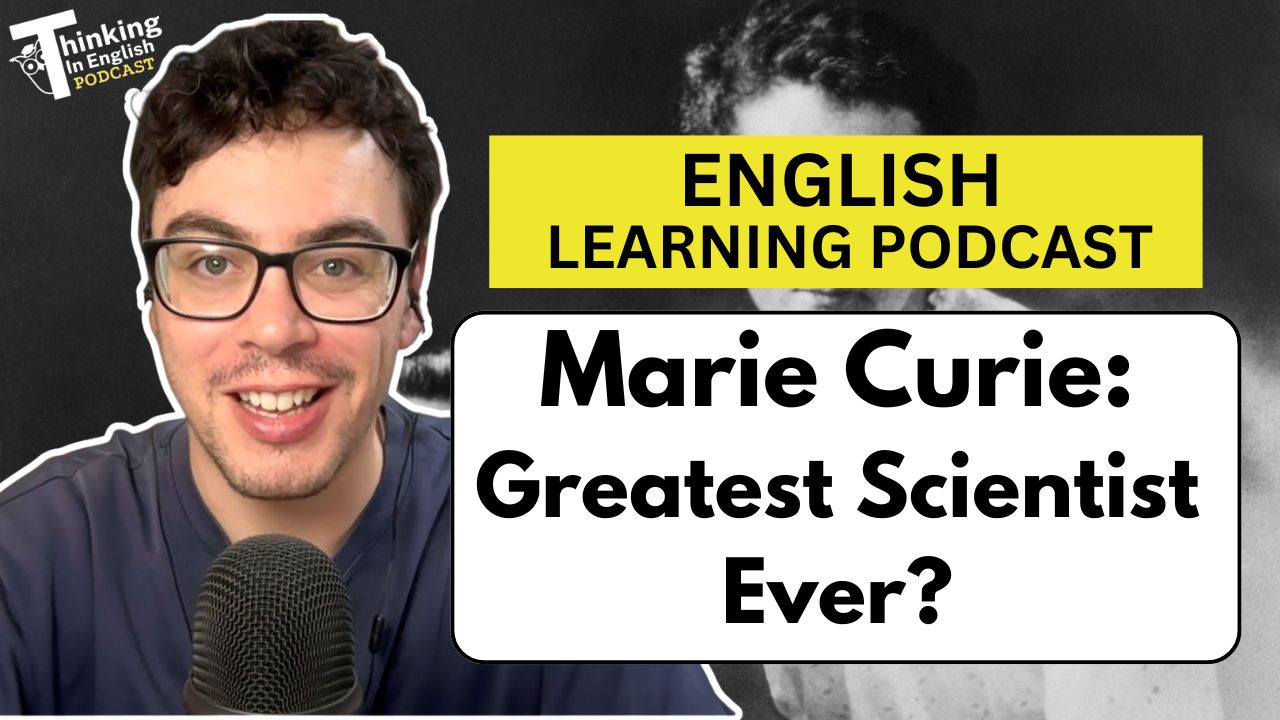
Today, we’re diving into the fascinating life of Marie Skłodowska Curie. Was she the greatest scientist ever?
Well… maybe!
She was the first woman to win a Nobel Prize, the only person to win Nobel Prizes in two different scientific fields, and a true pioneer in the study of radioactivity.
In this episode, we’ll explore her life, achievements, struggles, and lasting legacy of one of the most influential scientists of all time.
Listen Here!
 Apple Podcasts
 Spotify
 YouTube
Interactive Transcript!
You Can Now Read and Listen at the Same Time With an Interactive Transcript!

Vocabulary
- Discover (V): To find something for the first time.
- Marie Curie discovered two new elements, polonium and radium.
- Radioactivity (N): The natural process by which some substances give off energy.
- Marie Curie studied the properties of radioactivity in different materials.
- Research (N / V): Careful study or investigation to learn new information.
- She spent many years researching the effects of radiation.
- Element (N): A basic substance that cannot be broken down into simpler substances.
- Polonium and radium are chemical elements discovered by Curie.
- Nobel Prize (N): A prestigious international award given for achievements in science, literature, or peace.
- Marie Curie was the first woman to win a Nobel Prize.
- Experiment (N / V): A scientific test done to learn or prove something.
- The Curies conducted experiments to measure radiation levels.
- Energy (N): The power that comes from physical or chemical processes and can cause change.
- Radioactive substances release energy in the form of radiation.
Who Was Marie Skłodowska-Curie?
Marie Skłodowska- Curie was born [00:03:00] Maria Skłodowska in 1867 in Warsaw, Poland.
She grew up in a family of teachers who valued education deeply. Her father taught maths and physics and made sure to educate his children in the sciences.
However, the Skłodowska family faced financial struggles, which made life challenging. While Maria showed a strong curiosity and love for learning from a young age, as a woman in the late 19th century, she faced significant barriers.
Women were largely excluded from formal higher education in Poland, and most of the world, at that time. While working as a teacher and tutor, she actually joined a secret, underground school in Warsaw called the Flying University.
The Flying University was set up to educate young Polish people, including women, in a [00:04:00] Polish style education. At the time, Poland was part of the Russian Empire, which wanted to control the education system.
Maria’s experience at the Flying University allowed her to pursue advanced learning despite the restrictions of her society.
In 1891, Maria moved to Paris to study at the Sorbonne, the University of Paris.
She had little money, had to learn French (and became known by the French version of her name, Marie) and struggled with the cold Parisian winters.
In fact, she famously had to wear all her clothes at the same time just to stay warm in the winter. But she remained determined to keep studying, and eventually became one of the top students in her class being awarded multiple degrees.


Nobel Prize in Physics
In Paris Marie met Pierre Curie, a [00:05:00] physicist who shared her deep interest in experimental science. They married in 1895, and their partnership became one of the most famous scientific collaborations in history.
Together they explored the phenomenon of radioactivity, which wasn’t called radioactivity at that time, but had been recently discovered by Henri Becquerel.
Marie’s approach to research involved measuring tiny amounts of radiation emitted by different substances. She developed highly precise instruments to detect and measure radiation levels.
Through countless experiments, often with limited funding and basic equipment, the Curies made extraordinary discoveries.
In 1898, they isolated two new elements. The first was polonium named after Marie’s homeland [00:06:00] of Poland. Later that same year, they discovered radium a substance far more radioactive than uranium.
To isolate radium Marie painstakingly processed massive amounts of a mineral known as pitchblende. Pitchblende was radioactive, and Marie noticed that it was actually more radioactive than uranium. From this mineral, Marie was able to extract tiny amounts of radium.
Her work required a lot of patience, precision, and also courage. She was constantly exposed to radiation without knowing its long-term effects.
Through this research, Marie also coined the term radioactivity. Radioactivity is the property by which certain substances spontaneously emit energy. This concept opened the door to entirely [00:07:00] new fields of physics and chemistry.
The Curies work demonstrated that atoms were not indivisible. In other words, atoms could break down and could release energy.
In recognition of these achievements, Marie and Pierre, along with Henri Becquerel, were awarded the 1903 Nobel Prize in Physics. Marie Skłodowska Curie became the first woman ever to win a Nobel Prize.
Their discoveries transformed the understanding of energy and laid the foundation for nuclear physics, radiology, and cancer treatments.

Nobel Prize in Chemistry
Tragically, Pierre Curie passed away in 1906.
Marie decided to continue their research alone. She took up her husband’s old position as Professor, becoming the first woman to teach at the Sorbonne in Paris.
[00:08:00] In her research, she focused on understanding the nature of radioactivity and investigating the properties of the elements she had discovered. Radium and polonium.
She was able to measure radioactive decay, study half lives, and observe how radiation affected other things, other substances.
For example, she discovered that radium could constantly produce heat even without an external energy source. This showed that atoms could release energy spontaneously, a concept that led to the entire field of nuclear physics.
She also studied the power of different types of radiation to penetrate different objects. This later led to the development of medical imaging, for example x-ray machines, which [00:09:00] use radiation to look at your bones inside your body. And radiology, including cancer treatments, radiotherapy, ways to kill cancer inside your body.
In 1911, Marie Skłodowska- Curie received her second Nobel Prize this time in Chemistry. The prize recognized her discoveries and studies of radium and polonium.
She was the first person to win two prizes in two different fields.

WW1 and X-Ray Machines
During World War I, Marie used her knowledge of radiation to save lives on the battlefield. She recognized that x-ray technology, which had advanced thanks to her studies of radioactivity, could be used to diagnose injuries or locate bullets and shrapnel inside soldiers’ bodies.
X-Ray technology allows you to see inside a body, which is obviously an [00:10:00] incredibly useful thing in the middle of a war.
Marie developed mobile X-ray units, which became known as “Little Curies“. These were small, portable X-ray machines that could be transported to hospitals and even directly to the battlefield.
She trained teams of women, including nurses and students to operate the machines, ensuring that wounded soldiers could be treated quickly and accurately.
By the end of the war, it is estimated that Curie’s mobile units had treated hundreds of thousands of injured soldiers.

Later Years and Legacy
In her later years, Marie Skłodowska- Curie continued her research as well as visiting numerous countries to give speeches. For example, she met the US President Warren G Harding in 1921.
She also established institutions to [00:11:00] continue her work.
In 1914, she helped found the Radium Institute in Paris, which became a leading center for research in physics and chemistry and medicine.
She also worked with the League of Nations, a kind of early attempt at creating an organization similar to the UN.
She founded the Curie Foundation in Paris, and also the Radium Institute in Warsaw, her hometown.
Marie Skłodowska Curie’s influence extended far beyond her research. She was a trailblazer for women in science. She was the first female professor at the Sorbonne and the first woman to win Nobel Prizes.
In fact, her daughter Irene went on also to become a highly respected scientist and actually the discoverer of artificial radioactivity. So the Curie [00:12:00] family were a group of incredibly respected and successful experimental scientists.
Marie Skłodowska- Curie passed away in 1934 from aplastic anemia. Aplastic anemia was almost certainly caused by her years of researching radiation.
At the beginning, the Curies, the scientific community had no idea how dangerous radiation and radioactivity and exposure to elements like radium could be to your health.
Today, Curie is remembered for her extraordinary discoveries, for coining the term radioactivity and also for her humanitarian work in creating x-ray machines and helping during World War I.

Final Thought
Was Marie [00:13:00] Skłodowska Curie the greatest scientist ever?
Her scientific achievements were groundbreaking. She discovered two new elements. She coined the term radioactivity. And she conducted experiments that laid the foundation for nuclear physics, chemistry, and medical treatments.
She did all of this at a time when women were largely excluded from science.
And she also actively wanted to keep using her Polish name, her maiden name we would say in English, which is why in this episode I have tried to say Marie Skłodowska-Curie, instead of just saying Marie Curie, because Marie Skłodowska-Curie wanted her name to be remembered as Skłodowska-Curie.
When we compare Marie with other great scientists like Isaac Newton, Albert Einstein, or Charles [00:14:00] Darwin, I think it’s really difficult to decide if one person is greater than the other.
For example, I did an episode on Isaac Newton a few months ago. You can go listen to it. It’s one of the first video episodes of Thinking in English.
And Isaac Newton in one year changed the way that we understand physics and forces and gravity. He completely revolutionized science.
Albert Einstein did similar things, completely changing the way that Newton’s physics worked.
And Marie Curie… her discoveries laid the foundations for so many other things.
While it’s difficult to definitely crown anyone as the greatest, Marie Skłodowska Curie’s combination of groundbreaking discoveries and her social or societal impact definitely makes her one of the most remarkable [00:15:00] scientists in history.
But what do you think? Who do you consider to be the greatest scientist of all time?
Extended Vocabulary List
Become a Patreon Subscriber to Access the Extended Vocabulary List!

Vocabulary Games and Activities!
Learn and practice vocabulary from this Thinking in English episode.
Practice using 5 different study games and activities – including writing, listening, and memorisation techniques!
Flashcards
Matching Game
Learning Game
Test Yourself
Listening and Spelling
Do you want to Think in English?
I’m so excited that you found my blog and podcast!! If you don’t want to miss an article or an episode, you can subscribe to my page!
