

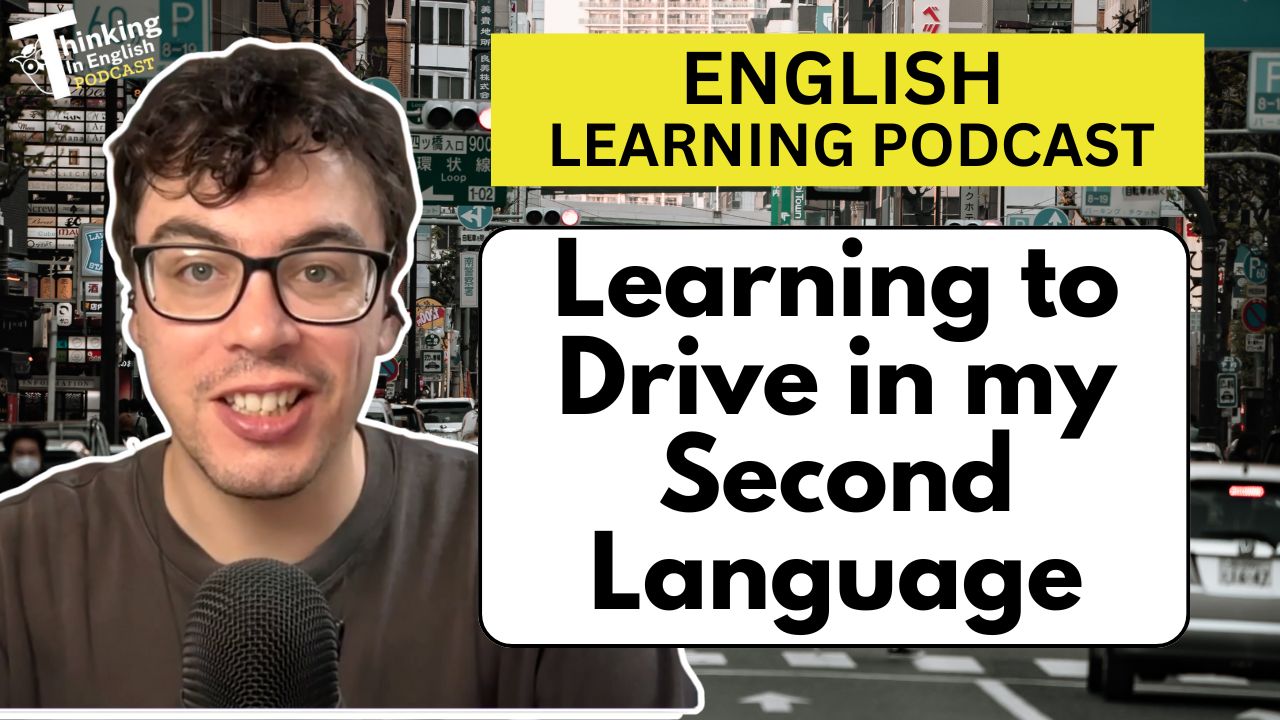
Imagine learning to drive… joining classes, talking to driving instructors, and taking theory exams in a foreign language. That’s exactly what I just did. Two weeks ago, I passed my Japanese driving test!
It wasn’t easy. I went from knowing almost nothing about Japanese road signs, traffic rules, or driving terminology to passing both my provisional and main license written tests on the first try. I also completed over 60 hours of lessons, both online and in a car, all entirely in Japanese.
In this episode, I want to share what this experience taught me about language learning: how you can absorb hundreds of new words, understand complex grammar, and actually use all of it in real life… much faster than I ever thought possible.
Listen Here!
 Apple Podcasts
 Spotify
 YouTube
Interactive Transcript!
You Can Now Read and Listen at the Same Time With an Interactive Transcript!

Vocabulary
- Immersion (N): Being completely surrounded by and involved in something, often language.
- Living in Spain gave her full immersion in Spanish.
- Instruction (N): A command or explanation telling someone what to do.
- The teacher gave clear instructions before the test.
- Terminology (N): The special set of words used in a particular subject or activity.
- Legal terminology can be confusing for beginners.
- Provisional (Adj): Temporary or conditional, not final.
- He received a provisional license to drive.
- Comprehension (N): Understanding of meaning.
- Her reading comprehension is very strong.
- Functional (Adj): Useful and practical, not just theoretical.
- His English is functional for everyday situations.
- Necessity (N): Something that is required or very important.
- Water is a basic necessity for life.
Learning to Drive Overseas
[00:03:00] Moving to a new country comes with a lot of challenges. Everything feels different. The systems, rules and customs are not the same as in your home country.
One of the biggest adjustments can be learning to drive in a new country. Even if you are already an experienced driver, driving in a new place can be difficult. You need to understand the rules and follow the laws, which may be different to your home country. And also adapt to the way people behave on the road.
For me, it was even more difficult, as I never learned to drive in the UK. I never learned while I was at university, and then basically I’ve lived abroad or in London since I was 21.
Learning to drive is often a challenge when you take classes in your native language, but when you do all [00:04:00] of this in a foreign language, for me Japanese, the challenge becomes even greater.
Every instruction, every road sign, every rule is written and spoken in a language you are still learning. Simple things like understanding a sign or following a driving instructor’s command requires focus, intense focus.
Contrast this with learning to drive in your home country, in your native language. You already know the terminology, many of the road rules and how driving tests usually work. You can focus on practical skills.
In a foreign country and in a foreign language, you are learning both the language and the practical skill of driving at the same time.
So for me, learning to drive in Japan meant studying hundreds of new words and phrases. [00:05:00] It was a really difficult, but an incredibly rewarding experience.


My Experience Studying Driving in the UK
At the beginning of August, I turned 30. To celebrate the occasion, I wrote a Thinking in English Bonus Episode on the things I achieved or was proud of doing in my twenties.
One thing that was missing from my list of accomplishments was getting my driving license.
I first took classes over 10 years ago, but ended up moving countries after just four or five classes.
So I decided this year on August 1st to sign up to a local driving school and finally get my license.
When I first started learning, my Japanese driving vocabulary was almost non-existent.
I didn’t really know the vocabulary for terms like lanes or mirrors or traffic laws. In fact, [00:06:00] I didn’t really even know the legal definition of car in Japanese.
Yet, in just a few weeks, I went from that beginner level to passing both the provisional and main license written tests on my first try and doing the entire thing in Japanese.
And this was a slightly strange decision because you can actually take your driving test in English in Japan, but I decided not to do that. I wanted to take the tests, all of my classes in Japanese.
The process was intense. I decided to take all of the classes required in just four weeks. I completed 30 hours of online theory lessons, and then 31 hours of in-car training all in Japanese.
Every lesson was full of new vocabulary, grammar structures I was not familiar with, and lots of [00:07:00] instructions.
My instructors spoke quickly. They used technical language and they expected me to immediately understand. At first, it felt overwhelming, but almost immediately I realized that immersion was the fastest way to learn.
In the car, I had to process instructions in real time. When an instructor said something like, “stop at the intersection”, or “please parallel park”, I was expected to follow instructions immediately, of course.
As these were commands that I had to act on instantly, it helped the language stick in my mind. The vocabulary was attached to a real life action, something that I could see, something that I could do.
The written tests were another challenge. I had to pass a 50 question test for my provisional license, and then a [00:08:00] 90 question test for my final exam. Japanese traffic laws, of course, are full of specialized terms and legal phrasing.
I had to learn hundreds of new words in context. Understand subtle differences in meaning. For example, under Japanese law, “slow down” and “reduce your speed“, have slightly different meanings.
And then apply that knowledge to answer questions correctly.
Also, it felt like the Japanese written test was intentionally trying to use confusing grammar to try and catch people out.
The exam was full of double, sometimes even triple, negative questions. I studied really, really hard to pass the exams, and fortunately I was successful.
I passed everything on my first try, which was my goal, and I actually beat [00:09:00] many native Japanese speakers in my exam scores, which I was amazed by.

Vocabulary & Grammar in Action
As you can probably tell from this episode so far, the most challenging part of learning to drive in Japan for me was not the driving itself, it was the language.
I had to learn specialized vocabulary across several different categories. And then know how to apply all of these new words and new terms in different circumstances.
There was vehicular vocabulary. These are words relating to things to do with vehicles and cars. Parts of cars like the “clutch”, “accelerators”, ” indicators” and “mirrors” . Terms for the “road”, terms for “lanes”, terms for the “shoulder” at the edge of a road.
These are terms that you use constantly while driving, so they became part of my driving routine.
Then there is the legal vocabulary. Traffic [00:10:00] rules, penalties, the right of way, and other road laws. These were important for both the written tests and also answering my instructor’s questions while driving in the car.
There was also a lot of instructional vocabulary. This basically included imperative commands. So these are the commands that instructors give in real time. In English, it would be things like turn, stop, look over your shoulder.
These are short, fast commands, and they must be done immediately.
There were also some interesting “false friends” that I encountered while learning to drive. False friends are words that might sound familiar to your native language, but actually have different meanings or uses.
Japanese driving vocabulary sometimes borrows English words, but not always in the way that I am familiar [00:11:00] with. Some words use American English rather than British English, and some are English like words that are not really used in Britain or America. Instead, they were invented or used in a different way in Japanese.
For example, what we call the “rear view mirror” in English, or at least in the UK, is called “back mirror” in Japanese. Or the “steering wheel” is commonly called “handle” in Japanese. These are borrowed English terms, but they’re not the terms actually used in English.
Grammar was also a really big challenge, especially in the written exams. This is what I struggled with most and what I was most nervous about with taking the exam.
I have struggled over the past eight years with being able to understand the passive voice in Japanese. But I needed to understand the passive [00:12:00] voice as it is always used in safety instructions and written exam questions.
For example, the difference between “overtaking a car“ and “being overtaken by a car“.
One is active. “I overtook that car.”
One is passive. “I was overtaken by the car.”
I also needed to understand the polite and formal Japanese used by the instructors. My instructors were not used to teaching non-Japanese people. So they were using the kind of language they would use with their Japanese students.
Typically polite, relatively formal Japanese. They also used a lot of short imperative commands, which I mentioned earlier.
And then the biggest challenge was understanding double negatives in the written exams.
Each of these different things could completely change the meaning [00:13:00] of a sentence, so comprehension was essential.
This was a daunting challenge. When I first went to the driving school to sign up for lessons, they gave me a very short driving vocabulary test, which is given to every student.
I think I answered only two or three questions correctly, and I spelled most of the words wrong, and I was very nervous for the final exams.
But I managed to do everything.
In fact, I think I learned more Japanese words and improved my understanding of Japanese grammar more in the month of August than I had done in the previous 12 months.
I realized that with the right conditions, like intensive study, immediate application and immersion, it’s possible to learn hundreds of new words and grammar patterns in just a few weeks.
This experience [00:14:00] completely changed how I think about learning language.

Rethinking Vocabulary & Grammar Learning
Before this experience, I struggled with studying vocabulary and grammar in Japanese.
My approach has been typical, probably very similar to all of you watching or listening to this episode. I memorized word lists, studied grammar rules from a textbook, and practiced writing example sentences.
But often this approach felt slow and disconnected from real use. I could remember words for a short time, but they didn’t stick. Grammar rules seemed abstract until I actually had to use them.
Learning to drive completely changed my perspective. The experience showed me that focused and contextual learning is more effective than passive memorization.
I wasn’t just reading or repeating words or writing out example sentences. I was constantly using words in context. [00:15:00] In situations that demanded accuracy and immediate understanding.
Every word, phrase, or grammatical structure I learned had a purpose. To drive safely. To follow instructions. Or to pass the written and practical tests.
Misunderstanding a single instruction could have consequences. I could fail an exam or more seriously, I could crash a car.
I think it’s fair to say that in this process, language became functional or real for me, not just theoretical.
I think perhaps the most important insight I gained was how necessity accelerates learning. When your daily life depends on comprehension, when you need to understand a word or phrase, your brain can adapt quickly.
You can notice patterns. You learn vocabulary, and you can recognize the grammar instinctively.[00:16:00]
This experience also highlighted the difference between general vocabulary and specialized vocabulary. Learning hundreds of terms related to cars, traffic, and law in just a few weeks was possible because each word had a practical function.
I was constantly hearing, seeing, and using the words in real situations.
For example, I would read a word in my textbook. I would then hear that same word in an online theory class or while watching a video. I would then use that word while talking to my driving instructors. And then I would answer a question about that word in a practice written test.
So, my biggest takeaways from the experience are:
First, that intensity is important. I averaged over two and a half hours of driving study, practical or theoretical, a day in [00:17:00] August.
Second, relevance is also important. You need to focus on vocabulary and grammar that have immediate or practical use.
Third, using a language in real life situations whenever possible is really useful.
Fourth, language learned in a meaningful situation becomes permanent or at least lasts longer. Learning things in context rather than out of context.
And this experience has made me rethink how I approach learning language. It’s about creating real life context where language is necessary, and then immersing yourself and practicing intensively.
If you really want to learn a language, you don’t just study it, you should live it.

Lessons for English Learners
So learning to drive in Japan has taught me lessons that apply to learning any language, [00:18:00] especially English.
So here is what I would recommend for you guys based on my experience.
Just like passing the driving test gave me a clear and urgent reason to learn. Setting a tangible, a real goal, in English can increase your motivation. A goal like giving a presentation or writing a report or passing an exam.
When language is necessary, learning happens faster.
Focus on relevant vocabulary.
Don’t try to memorize endless lists of random words. Instead, focus on vocabulary that you will or can actually use in context.
For me, this was driving related words. For you it might be to do with your hobby, a book you are reading, your job, something you’re interested in, a film you are watching.
Constant exposure to [00:19:00] language is important. I was surrounded by Japanese instructions, signs, and conversation every day, and I had to respond in Japanese immediately.
For English learners, this could mean listening to podcasts, reading articles, watching videos, or speaking with native speakers.
The more you interact with English in a meaningful way, the faster English will stick in your mind.
Apply language immediately.
Don’t wait until you feel ready to use new words or grammar. Use them in real situations as soon as you learn them.
I had no chance to feel ready with learning vocabulary. I just had to use the words, ask for help from my instructors when I didn’t understand and learn from context.
You guys can do this by joining my conversation clubs and just using new words and learning how to use them in context.
My method for passing [00:20:00] the written exams was to answer as many practice questions as possible. I answered probably over 1000 different questions.
Every time I made a mistake, I would make a note of why I was wrong. Was it a language issue? Did I not understand the grammar? Or was it a knowledge issue? Was it something specific in the law I got wrong? And then I made sure to not repeat that mistake again.
The more I saw different grammar forms, the more I noticed them. I noticed how they are used. I noticed why something might be wrong or why something might be correct.
Vocabulary alone isn’t always enough.
Understanding how grammar works in real contexts. Like the passive voice or the imperative or conditionals, makes language functional. It makes it real. Grammar becomes meaningful when you see it applied in real life [00:21:00] situations.
So, in short learning a language becomes faster and more effective when you set a goal. Immerse yourself. Focus on relevance. Use language actively. Learn from your mistakes. And you see grammar in action.
My experience learning to drive in Japanese proved that this approach works and I think it can work for English learners too.

Final Thought
Learning to drive in Japan for me was probably a bigger language challenge than a practical skill challenge. It showed me that it’s possible to learn hundreds of new words and grammar points in just a few weeks.
The big lesson for any language learner is this, create situations where you have to use the language and you have to immerse yourself fully.
When you do that, progress [00:22:00] can happen faster than you ever imagined. I went from no vocabulary of driving, no ability to pass a Japanese driving test, and then four weeks later I passed first time.
What do you think? Have you ever learned a new skill in English? Have you ever tried to learn something in a foreign language?
Extended Vocabulary List
Become a Patreon Subscriber to Access the Extended Vocabulary List!

Vocabulary Games and Activities!
Learn and practice vocabulary from this Thinking in English episode.
Practice using 5 different study games and activities – including writing, listening, and memorisation techniques!
Flashcards
Matching Game
Learning Game
Test Yourself
Listening and Spelling
Do you want to Think in English?
I’m so excited that you found my blog and podcast!! If you don’t want to miss an article or an episode, you can subscribe to my page!
