

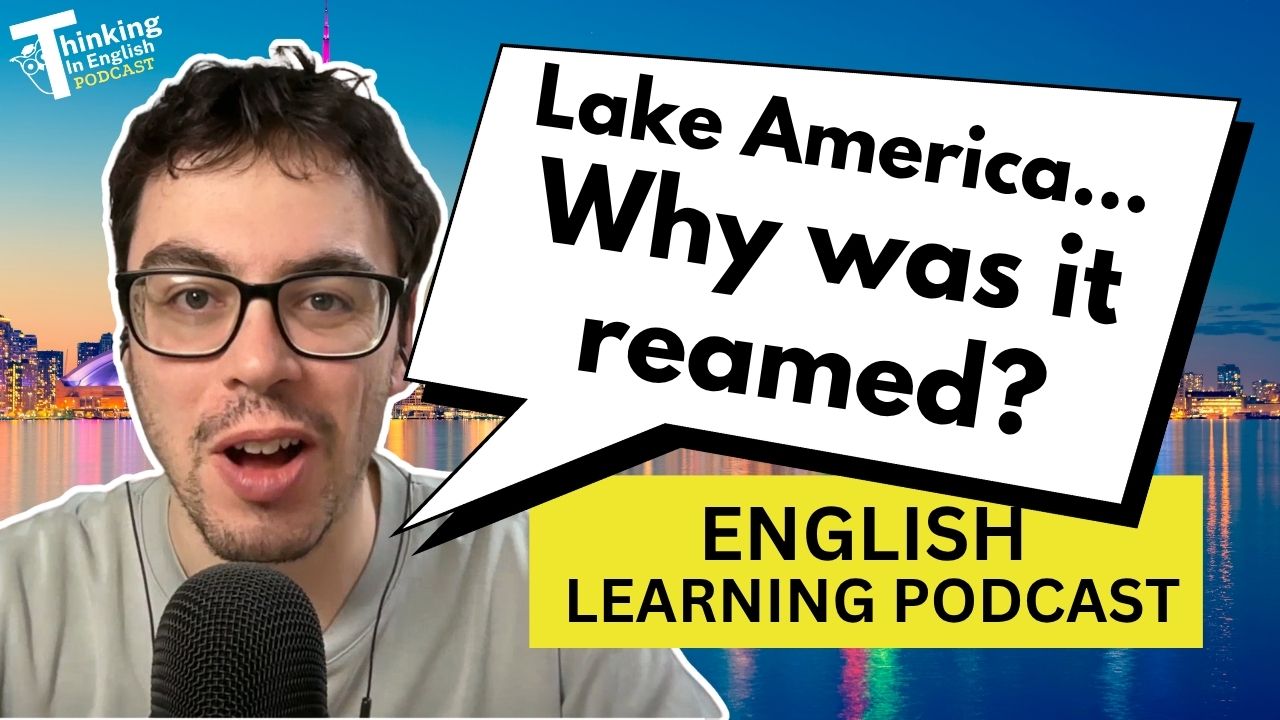
There is a large lake between New York State in the USA and the Canadian Province of Ontario. Do you know what it is called?
Lake Ontario is the name the lake has been known by for centuries. But if you look at an official map produced by the United States government, you may now see a different name: Lake America.
In August 2026, US President Donald Trump signed an executive order directing the US government to use the name “Lake America” instead of “Lake Ontario.” This isn’t the first geographical name Trump has changed. Earlier in his presidency, Trump ordered the US government to use “Gulf of America” instead of the traditional name “Gulf of Mexico” for the large body of water between the United States and Mexico.
Why does a president care so much about what we call a lake or a gulf?
In this episode, I want to explore the power of names. Why do governments rename places? Who has the authority to decide what a place should be called? And what happens when two countries use completely different names for the same place?
Let’s talk about this, while improving your English listening comprehension and learning some new vocabulary!
Listen Here!
 Apple Podcasts
 Spotify
 YouTube
Interactive Transcript!
You Can Now Read and Listen at the Same Time With an Interactive Transcript!

Vocabulary
- rename (v): to give a person, place, or thing a new name
- The government decided to rename the street after a famous writer.
- authority (n): the power or right to make decisions or give orders
- The local government has the authority to change the name of the street.
- national identity (n): the sense of belonging to a particular nation and its culture
- Language, history, and traditions can all play an important role in national identity.
- symbolism (n): the use of something to represent a larger idea or meaning
- The new name has strong political symbolism because it connects the place with the country.
- controversial (adj): causing disagreement or strong differences of opinion
- The decision to change the city’s name was highly controversial.
- preserve (v): to keep something in its original or existing condition
- Museums work to preserve important objects from the past.
- historical memory (n): the way a society remembers and understands its past
- Changing the name of a place can affect how people understand their historical memory.
How Renaming Works
Places have names. Sometimes people decide they want to change that place’s name. How do you go about doing this?
If your aim is to change the name of a local place, [00:04:00] it can be quite simple. The local government changes the name of a street, for example, by maybe holding a vote, putting up some new signs, and updating official documents.
Eventually, people will start to use the new name. Some people won’t, but more and more people will.
But geographical features can be a bit more complicated. Lakes, rivers, mountains, seas, things like this, often cross international borders. They might be in more than one country.
So different countries, different languages, different communities will usually use different names for the same place. When one government officially changes a name, it doesn’t mean that everyone else has to accept their decision.
Lake Ontario is a good example. The United States government has now decided it will use the name Lake America. It is changing the names on government websites and maps [00:05:00] and putting pressure on companies in the US to do the same. I think both Google and Apple now show the lake as being called Lake America in the USA.
But the United States doesn’t control Canada. Canada is going to continue to call it Lake Ontario, just as it has done for centuries, and many other countries around the world will probably just continue using its original name, Lake Ontario.


Endonyms and Exonyms
Countries and geographical regions often have different names in different languages. For example, people from Germany call their country Deutschland, while English speakers call it Germany. People from Greece call their country Ellada, while English speakers call it Greece.
There are a few useful terms for these differences. An endonym is the name used locally or in the local language, while an exonym is the name used by people from somewhere else. So [00:06:00] Deutschland is the German endonym, it’s the name used locally, while Germany is the English exonym. It’s the name used in English.
There is also a difference between an official name and a common name. The Arab Republic of Egypt is commonly known just as Egypt in English, or the Swiss Confederation is commonly known as Switzerland in English. And of course, they also have different official and common names in different languages.
So renaming a place doesn’t necessarily mean that everyone has agreed to use that new name.

Trump’s Naming Agenda
In the case of Donald Trump, he has recently been on a kind of a roll in renaming things. He’s renamed the Gulf of Mexico. He’s renamed Lake Ontario. There’s probably some other things he’s planning on renaming as well.
And I think there are several reasons [00:07:00] why he wants to change name places, and most of the time it’s connected to his political ideology, or I guess the political feelings of his supporters.
One big reason is national identity. A name can communicate which country or which history a place is associated with.
Calling something the Gulf of America rather than the Gulf of Mexico, for example, gives the gulf a much more American identity, a much more US identity. The same is true with Lake America. The new name connects the lake more directly with the United States, even though the lake is shared with Canada. Ontario is a province in Canada, so by calling it Lake America, it kind of takes away that Canadian influence, that Canadian identity.
Another reason to change a [00:08:00] name of a place is political symbolism. Trump isn’t changing names because the new name is more practical. He’s not changing names because the new name is better. The change is intended to communicate a message.
Relations right now between Donald Trump and his neighboring countries, Donald Trump and Mexico or Donald Trump and Canada, are not the best. Trump’s entire political platform is about putting the USA first, right? America first. While it is not the most impactful change, renaming places to have the name “America” in them is a very clear example of putting the US first.
In other situations, governments might want to rename a place to emphasize them becoming independent or rejecting their colonial past, but that’s not really the case in the USA right now. Instead, names are being used as a [00:09:00] form of political power, I guess.
Deciding names on an official map and document gives some control over how that place is represented. Of course, just putting the official name or changing the name of something doesn’t mean that’s what everyone is going to call it.
The Gulf of Mexico is bordered by the United States, Mexico, and Cuba, and it has been internationally known as the Gulf of Mexico for centuries. Trump deciding to use the name Gulf of America was a political statement. It was a political statement about how the United States wants to describe the region, and it was a statement about who controls the region. It’s not Mexico, it’s the United States. It’s America.

Global Name Disputes
This is not unique to Trump or the United States. Around the world, countries change the name of things quite often. They argue about names all the time, and they do this for usually political reasons.
For example, in Japan, the body of [00:10:00] water between Japan and the Korean Peninsula is called the Sea of Japan. This is also the name commonly used internationally. But in South Korea, it is known as the East Sea. The South Korean government has campaigned for the East Sea to become the international name.
The disagreement over the name is due to the history of Japanese imperialism and Japan’s colonial rule over Korea. South Korea argues that the name, Sea of Japan, became the international name during a period when Korea was under Japanese control.
There are similar examples all over the world. One common reason for changing a place name is to remove or replace a name connected with colonialism.
For example, the country now called Ghana was previously known by the British colonial name Gold Coast. Sri Lanka replaced the name Ceylon. Zimbabwe replaced the name Rhodesia after independence. And [00:11:00] Eswatini changed its official name from Swaziland in 2018.
Cities have gone through similar changes. India’s a great example. Bombay became Mumbai. Calcutta became Kolkata. Madras became Chennai. Bangalore became Bengaluru.
Not every name change is straightforward. If we go back to India, the whole country now has two official names: India and Bharat.
And then there is Astana, the capital of Kazakhstan. I’m not sure if I’m pronouncing any of these places right. I apologize if I’m pronouncing them wrong. But Astana is the capital of Kazakhstan. The city has had several different names over the past 100 years.
It was called Akmola, and then Akmolinsk when it became a town in the Russian Empire. Then it was renamed Tselinograd when the Soviet leader Khrushchev was running an agricultural campaign. Tselinograd translates to something about [00:12:00] agriculture.
Then it went back to Akmola when Kazakhstan became independent. Then it was renamed to Astana, which means something like capital city. In 2019, it was renamed Nur-Sultan after the country’s first president, Nur Sultan Nazarbayev. And then three years later, it was changed back to Astana.
This is a clear example of how political change can affect the names of places. Becoming an official town in the Russian Empire changed its name. It was renamed due to Soviet political policies. It was renamed due to independence. It was renamed after a political leader, and then it was renamed again due to feelings about that political leader.
Sometimes names become quite important political arguments. The term British Isles is a famous example. Geographically, the British Isles is a traditional term for the group of islands containing Great [00:13:00] Britain and Ireland, but the word British makes the term uncomfortable for many people in Ireland who don’t consider themselves and aren’t British. So they propose different names, not the British Isles, maybe the North Atlantic Archipelago, something like that.

Who Decides Names
When two places disagree about a name, who gets to decide? Who gets to decide what something is called?
If a city or a town is entirely inside of one country, the national or local government can change its name officially. It might take some time to catch on, and in different languages, the name might not change immediately, but it will change officially. But when a geographical feature crosses a border, countries can’t force each other to accept name changes.
And at an individual level, it is quite difficult to immediately change the vocabulary of millions of people. A good example is the [00:14:00] country Czechia, which is the official short name for the country the Czech Republic. As I mentioned earlier, every place typically has a long official name, the French Republic, and a common name, France.
But for about 20 years, the Czech Republic didn’t have a shorter common name. It was just the Czech Republic in English. In 2016, they officially adopted a new short name in English, Czechia. But there are still a lot of people around the world who don’t know that, who don’t know the name Czechia and still say the Czech Republic.
When I was young, when I used to watch the World Cup or the European Championships football tournament before the year 2016, the country was the Czech Republic. It was never Czechia.
Now people do call it Czechia, but it takes time for people to catch on and change the way they describe a country.
[00:15:00] Changing a name is not an instant process. People will continue using the old name, maybe because they’ve used it for their entire lives. And foreigners might continue using it because they learned the old name at school.
There is another group today as well involved in deciding what places are called: tech companies.
Where do you learn the names of places? Well, some places you might learn looking at your geography textbook at school, but I think a lot of people now look at Google Maps or Apple Maps. And Google and Apple Maps often use different names depending on where the user is located, especially when a name is politically disputed.
If you look at a map in Canada, you will see the name Lake Ontario. If you cross the border to the USA, you will see the name Lake America using the same app.

Why Names Matter
But why do names matter? What’s the point in names?
Well, names tell us [00:16:00] how people understand themselves. They tell us how people understand where they live.
A country like Eswatini chose a few years ago to change its name to a traditional name instead of a colonial name. It used to be Swaziland. It did this because it wants to emphasize its own culture, its own language, its own history. It wants to be Eswatini.
Another reason is historical memory. Names preserve a particular version of history, and changing a name is a way of changing how history is remembered.
I’m going to have to apologize before I say this ’cause my Ukrainian pronunciation is really bad, but the town of Samar in Ukraine was known as Novomoskovsk until 2024. But they renamed it to Samar, removing its Russian influence. Novomoskovsk means New Moscow. Now, the name Moscow has been removed from the town.
Names can also be connected [00:17:00] to political power. This is one reason why geographical names become controversial, but there is a contradiction here. Names are powerful, but they also change nothing about the physical world.
Lake Ontario is still the same lake, whether or not you call it Lake America or Lake Ontario. Mumbai doesn’t become a different city when the name Bombay was replaced. It’s still the same city.

Final Thought
What do you think? The US government is now calling Lake Ontario Lake America and the Gulf of Mexico is now the Gulf of America. Has this actually changed anything?
On my maps, I live in Japan, my maps still say the old names. But in the US I believe names have changed.
Names have history and names have political meaning, which is why I find them really interesting. And I also think it’s fascinating when countries [00:18:00] and why countries change their names.
I’m sure most of you listening come from countries which have changed their official name at some point in recent history.
I’m from the UK, or the official name is the United Kingdom of Great Britain and Northern Ireland. This name has been in use for 99 years. Before 1927, it was the United Kingdom of Great Britain and Ireland. So in 1927, it changed to become Northern Ireland when Ireland became an independent country.
This year, the Pacific Island country Nauru changed its name to the Republic of Naoero. Again, I’ve probably pronounced that really badly. In 2022, Turkey began pushing for the world to use the name Turkiye, and in 2019, Macedonia became North Macedonia.
How about your country? When was the most recent name change in your country’s [00:19:00] history? And why did your country change their name?
Extended Vocabulary List
Become a Patreon Subscriber to Access the Extended Vocabulary List!


Vocabulary Games and Activities!
Learn and practice vocabulary from this Thinking in English episode.
Practice using 5 different study games and activities – including writing, listening, and memorisation techniques!
Flashcards
Matching Game
Learning Game
Test Yourself
Listening and Spelling
Do you want to Think in English?
I’m so excited that you found my blog and podcast!! If you don’t want to miss an article or an episode, you can subscribe to my page!
