

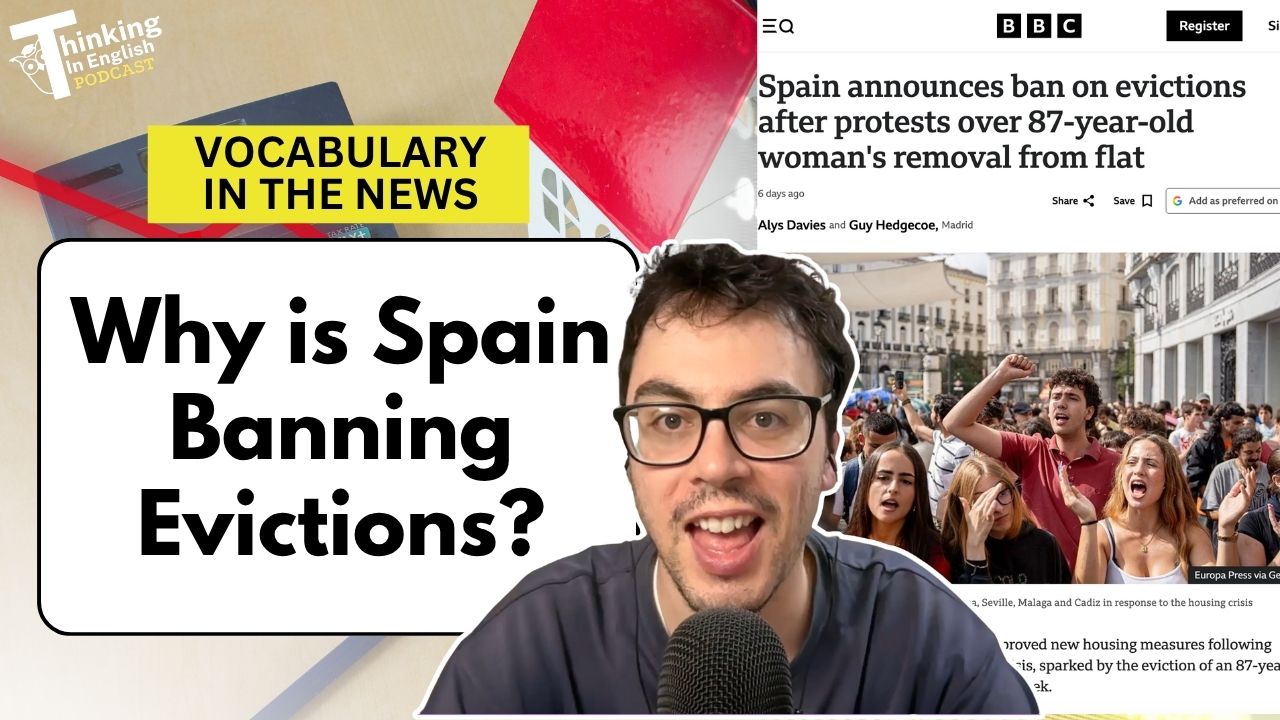
Today, we’re trying something a little different. This is a vocabulary-focused episode based on a recent news story, where we’ll take one interesting event and use it to learn useful English words and expressions in context.
Our story today comes from Spain, where an eviction involving an 87-year-old woman has led to large protests and a national debate about the country’s housing crisis.
We’ll look at what happened, why housing has become such a serious issue in Spain, and along the way, we’ll learn vocabulary related to housing, economics, politics, and protest. I’ll first explain the story and the wider context, and then we’ll break down some of the most useful vocabulary from the story, looking at what these words mean, how they’re used, and how you can use them yourself.
So, let’s begin with the story of an 87-year-old woman, an apartment in Madrid, and a housing crisis affecting millions of people.
Listen Here!
 Apple Podcasts
 Spotify
 YouTube
Interactive Transcript!
You Can Now Read and Listen at the Same Time With an Interactive Transcript!

Vocabulary
- evict (v) — to legally force someone to leave a property
- eviction (n) — the process of legally forcing someone to leave a property
- landlord (n) — a person or organisation that owns property and rents it to others
- tenant (n) — a person who rents and lives in a property
- rent (n/v) — the money paid to use a property; to pay to use a property
- housing shortage (n) — a situation where there are not enough homes for the people who need them
- afford (v) — to have enough money to pay for something
- affordable (adj) — reasonably priced and possible to pay for
- unaffordable (adj) — too expensive for someone to pay for
- intervene (v) — to become involved in a situation in order to influence or change it
- speculative (adj) — involving an attempt to make money from something increasing in value
- vulture fund (n) — an investment fund that buys financially troubled or undervalued assets to make a profit
- roll over (phr v) — to extend or continue a contract or financial arrangement
- approve (v) — to officially accept or agree to something
- lack a majority (phr) — to have less than half the seats or votes in a parliament
- protest (n/v) — an organised public expression of disagreement; to publicly express disagreement
- strike a balance (idiom) — to find a reasonable compromise between different needs or interests
Spain Eviction Story
87-year-old Maricarmen Abascal had been living in the same apartment in Madrid for almost her entire life. Abascal’s family first rented the apartment in 1956. She continued living there after her parents died, paying a relatively low [00:02:00] rent. The apartment had been her home for decades.
But in 2018, an investment company bought the property. The company decided to increase her rent, which left Abascal facing a serious problem. Her new rent was higher than her monthly pension. She could no longer afford to stay in her home.
In September this year, Abascal was evicted from the apartment. She was reportedly taken away on a stretcher after being removed from the property. Images of the eviction spread online and have become a symbol for Spain’s wider housing crisis.
The eviction was followed by protests in Spanish cities like Madrid, Barcelona, Seville, and Malaga. Thousands of people have demanded stronger protections for tenants and action to make housing more affordable.
In response, [00:03:00] Spain’s government has announced new housing measures. These include a temporary ban on evictions until 2030. They are proposing extending some rental contracts until 2028, and introducing stricter regulation on short-term rentals. And also restrictions on investment firms buying properties where normal people live.
However, these proposals still need to pass through parliament. Spain’s government does not have a majority, so it needs support from other political parties, which maybe is unlikely.
Spain is experiencing a serious shortage of housing. The Bank of Spain estimates that the country is short of around 700,000 homes.
House prices and rents have been rising rapidly. The result is that many people are finding it difficult to find somewhere affordable to live.
Tenants want affordable and secure housing. [00:04:00] Landlords want to protect their property and their rental income. Investment companies see housing as an opportunity to make money. The government has the task of protecting people from unaffordable housing, while encouraging the construction of more homes.
So today, we’re going to use this story about Spain’s housing crisis to learn some English vocabulary related to housing, economics, and protest. All of the terms I’m going to introduce to you have been taken from a recent news article that I will attach in the description of this episode. After you’ve listened, you can go and read the article yourself.


Vocabulary
Vocabulary: Eviction
Let’s start with probably the most important word in today’s episode: Eviction.
An eviction is the process of legally forcing someone to leave a property, usually because they have failed to pay rent or because the owner has a different legal reason [00:05:00] for ending their tenancy, ending their contract.
The word eviction comes from the verb to evict, which means to legally force someone to leave a property. So we have the word family: evict, eviction, and evicted.
Maricarmen Abascal was evicted from her apartment after she could no longer afford the rent. Her eviction has become the focus of protests across Spain, and the government has now proposed a temporary ban on some evictions.
If you see the word eviction in an English language news story, it means someone is being forced to leave their residence, usually legally.
Vocabulary: Landlords & Tenants
The next two words I’m going to introduce together because they are connected.
The first is landlord. A landlord is a person or organization that owns a property and rents it to someone else.
The opposite of this word is a tenant. [00:06:00] A tenant is a person who rents a house or an apartment or a property from a landlord. A landlord owns the property. A tenant rents and lives in the property.
In the Spain housing debate, and in most housing debates around the world actually, these two groups, landlords and tenants, have different interests. Tenants typically want affordable and secure housing. Landlords want to receive enough rental income and also to keep control over their property.
You will often hear phrases such as landlord rights and tenant protections.

Vocabulary: Rent
Rent can be a noun or a verb. As a noun, rent is the money you regularly pay to use a property. For example, “My rent is one thousand pounds a month.”
As a verb, to rent means to pay money to use a property. For example, “They [00:07:00] rent an apartment in Madrid.”
There are several useful expressions using this word. You can pay rent, increase the rent, raise the rent, or afford the rent. Increase the rent and raise the rent have essentially the same meaning. You can say, “The landlord increased the rent,” or, “The landlord raised the rent.”
Going back to Spain, Maricarmen Abascal’s rent was increased until it became higher than her monthly pension. She could no longer afford the rent.
Vocabulary: Housing Shortage
And that brings us naturally to our next word: Housing Shortage.
A housing shortage is a situation where there just aren’t enough homes available for the number of people who need them. Many cities around the world are experiencing serious housing shortages.
Housing shortages is a really important concept for understanding the wider story in Spain. The Bank of [00:08:00] Spain estimates that the country is short of around 700,000 homes.
When demand for housing is high, but there just aren’t enough homes available, people need to compete for the homes that do exist. This usually leads to rising rents and rising house prices.
When politicians or economists talk about housing shortages, they’re talking about a gap between the number of homes available and the number of homes people need.

Vocabulary: Afford
To afford means to have enough money to pay for something.
I can afford to fly back to the UK this year for a trip. I’m probably in the UK as you’re listening to this episode, or I’ve just come back from the UK. But I can’t afford to fly back to the UK in business class, need my economy class ticket. If anyone works for British Airways or All Nippon Airways or Japan Airlines and wants to give me a business class ticket, please reach out to me. I’m very appreciative. But no, I can’t [00:09:00] afford to fly in business class.
We very commonly use the word afford with housing. You can afford a house, afford the rent, or afford to buy a home.
You can also say that you barely afford something when you just have enough money to pay for it. “I can barely afford my rent.” That means your rent is right at the top of your budget and you only just have enough money for it.
In Spain, Abascal couldn’t afford the new rent after the property was bought by an investment company. Her rent had become higher than her monthly pension.
Afford is related to the word affordable, which is a noun meaning something is reasonably priced. You can purchase it. The opposite of affordable is unaffordable.
There is a difference though, between something being expensive and something being unaffordable. These are relative concepts. What is [00:10:00] expensive for me might not be expensive to you if you have a really good job and more money than I do. And what is affordable for me might not be affordable for you.
A house might be expensive, but if you have a very high income, you might still be able to afford it.
I think my Patreon subscription, which you should all join to make sure I can keep making episodes, I think that’s very affordable. There are options for £5 a month and £11.50 a month. But if some of you come from countries with much lower average wages than Japan or the UK where I’m based, or weaker currencies, then those prices might be expensive, and they might be unaffordable prices.
It’s a relative concept.
Vocabulary: Intervene
To intervene means to become involved in a situation in order to influence it or change what is happening. Governments can intervene in the economy. Countries can intervene in a conflict. And we can talk about military [00:11:00] intervention or government intervention.
The Spanish government is currently arguing that it needs to intervene in the housing market because market forces have not produced enough affordable housing.
Of course, whether and how governments should intervene in housing markets is a really big political question. But from a language perspective, intervene is a very useful word. We can use it whenever a powerful person or organization becomes involved in a situation to try and change it.

Vocabulary: Speculative
If something is speculative, it is connected to speculation. Speculation is the practice of buying something because you expect its value to increase rather than because you actually need or want to use it right now.
For example, a real estate investment is often speculative. Someone buys an apartment but doesn’t intend to live there. Instead, they expect the property to become more [00:12:00] valuable in the future and then they plan to sell it later for a profit. This is a speculative investment.
They don’t plan to really use the assets right now, the house right now, but they are speculating that in the future it will become more valuable.
Other examples of speculative assets include Bitcoin and some other cryptocurrencies. People purchase these cryptocurrencies because they are speculating that the price will increase in the future.
The Spanish government has described the country’s housing market as speculative, particularly when it comes to discussing investment companies buying properties.
Vocabulary: Vulture Fund
A particularly interesting expression used by the Spanish government is vulture fund.
A vulture fund is an investment fund that buys assets or investments that are financially troubled or undervalued. They do this because they are hoping to make a large profit from [00:13:00] them.
The expression is based on the image of a vulture. A vulture is a bird that feeds on dead animals.
Because of this, vulture fund is not a neutral expression. It has a strongly negative implication. It suggests that an investment company is taking advantage of a difficult situation in order to make money.
This is important when you’re learning English from the news, because people sometimes use emotionally loaded language when writing news articles. In this case, the Spanish government has used the term vulture fund when talking about investment companies involved in the Spanish property market. It’s not a neutral term.

Vocabulary: Roll Over
To roll over something means to extend it or continue it, especially a contract or a financial arrangement. You roll it over instead of allowing it to end. For example, maybe you have a one-year work [00:14:00] contract with a company with the option for the contract to be rolled over for another year.
The Spanish government now wants some rental contracts to be rolled over until 2028. Instead of allowing those contracts to end under existing arrangements, they would continue for a longer period.
Vocabulary: Approve
To approve something means to officially accept or agree to it. This is a really common word, especially common in the news, because people are constantly approving things or rejecting things.
Spain’s cabinet, the prime minister, has approved new housing measures, but that does not mean that the measures have become a law. The parliament still needs to approve them.
Vocabulary: Lack a Majority
If a political party or government lacks a majority, it means that it does not control more than half of the seats in a parliament. This means that the government may need support from other political [00:15:00] parties to pass legislation.
Here’s a simple example. Imagine there is a parliament with 100 possible seats. The biggest political party won 45 seats in an election. The second-biggest party won 30 seats, and the third party won 15 seats.
To pass a law in parliament, you need 51 votes, but the biggest party, the party that has become government, only has 45 seats. This means that the biggest party lacks a majority. They need to find at least six allies from other political parties.
That’s exactly the situation in Spain. Spain’s coalition government does not have enough seats in the Spanish parliament to guarantee that its proposals will become a law. It needs to find support from other parties.

Vocabulary: Protest
As a noun, a protest is an organized public expression of disagreement. For example, “Thousands of people [00:16:00] joined the protest.”
As a verb, to protest means to publicly express disagreement. For example, “Thousands of people protested against rising rents.”
Notice that the pronunciation is different depending on whether we’re using the noun or the verb.
PROtest is the noun. proTEST is the verb. And this is a common rule in English. When you have words that can be a noun or a verb, the noun usually stresses the first syllable and the verb usually stresses the second syllable. IMport versus imPORT. EXport versus exPORT.
In Spain, protests took place in several cities following Abascal’s eviction. Demonstrators were protesting about the housing crisis, especially the rising cost of housing And the difficulty people are facing in finding affordable homes.
Vocabulary: Strike a Balance
To strike a balance means to find a reasonable way of dealing with two different needs or [00:17:00] situations. It’s difficult, for example, to strike a balance between work and family for some people. We can also talk about trying to strike a balance between landlords and tenants.
This expression is really useful because it appears in many different contexts. You might strike a balance between work and family, freedom and security, economic growth and environmental protection.
The spanish government says it wants to address problems facing people who cannot afford housing. At the same time, the country’s housing market also involves landlords and property owners and investors who have their own interests. So one of the challenges is how to strike a balance between different interests.

Big Picture Discussion
We’ve looked at quite a lot of vocabulary today, so let’s take a few minutes to think about the bigger issues behind the story.
Why do you think housing has become so expensive in many countries?
We’ve [00:18:00] seen that Spain is experiencing a housing shortage, but rising housing costs are a problem in many different parts of the world. Why?
Should governments protect tenants from eviction? If someone cannot afford their rent, should a landlord always have the right to evict them?
There are arguments on both sides. Tenants need somewhere safe and affordable to live, but landlords also own the property and they might need the rental income. This is one reason why governments try to strike a balance between landlords and tenants.
And how much should governments intervene in the housing market? The Spanish government has decided to intervene with measures to protect tenants and control some parts of the market.
But government intervention can take different forms. Governments could build public housing, regulate rents, change taxes, or introduce rules affecting landlords and investors.

Final Thought
I think the story coming out of Spain in recent weeks has resonated around the world. The reason is it is a story that I think many people can relate to.
Madrid is not the only place with a housing crisis. There are housing crises across Europe, across the world. Cities are becoming unaffordable for many people. Rents are increasing, but wages are not increasing at the same speed.
And this story out of Spain is a great symbol of the housing crisis. It’s a symbol of housing shortages.
Hopefully, after listening to this episode, you have come away with some interesting vocabulary that you can use, and maybe now you can go read some articles about this topic in English, and you’ll be in a perfect position to understand those articles.
Extended Vocabulary List
Become a Patreon Subscriber to Access the Extended Vocabulary List!


Vocabulary Games and Activities!
Learn and practice vocabulary from this Thinking in English episode.
Practice using 5 different study games and activities – including writing, listening, and memorisation techniques!
Flashcards
Matching Game
Learning Game
Test Yourself
Listening and Spelling
Do you want to Think in English?
I’m so excited that you found my blog and podcast!! If you don’t want to miss an article or an episode, you can subscribe to my page!
