

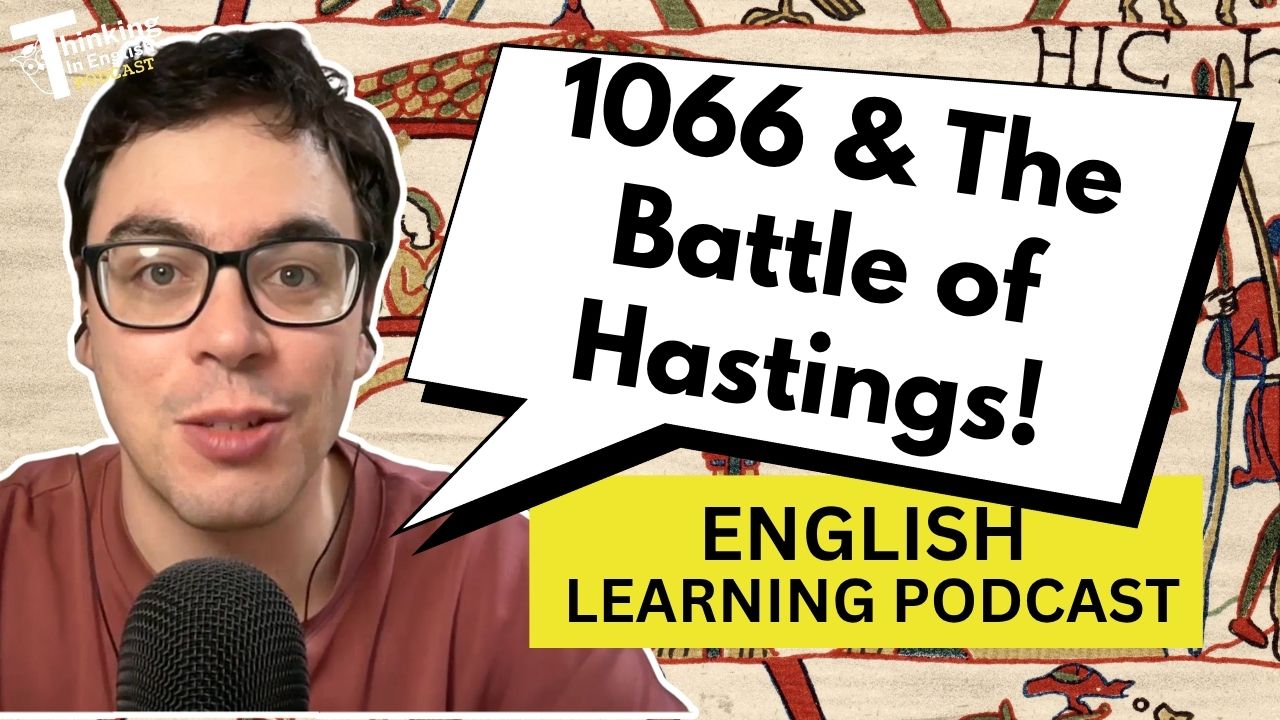
Today, we’re going to talk about one of the most famous historical objects in the world: the Bayeux Tapestry.
The Bayeux Tapestry is a huge piece of embroidered cloth, about 70 metres long, covered with pictures showing kings, soldiers, ships, horses and battles. It was created almost 1,000 years ago and tells the story of the Norman Conquest of England in the year 1066.
The Bayeux Tapestry is in the news right now because it has travelled to Britain. The tapestry normally lives in the French town of Bayeux, but it is currently being displayed at the British Museum in London. This is the first time in nearly 1000 years that the tapestry returned to Britain.
What exactly happened in 1066? Who were the people fighting for the English throne? Why did the Normans invade England? And how reliable is the Bayeux Tapestry as a source of historical information?
Let’s talk about some British history while improving our English listening comprehension and learning some new vocabulary!
Listen Here!
 Apple Podcasts
 Spotify
 YouTube
Interactive Transcript!
You Can Now Read and Listen at the Same Time With an Interactive Transcript!

Vocabulary
- conquest (n) — the act of taking control of a country or territory by force
- The Norman Conquest changed the history of England.
- throne (n) — the position or title of a king or queen
- Several men believed they had a right to the English throne.
- invasion (n) — an attempt to enter and take control of another country
- England faced two major invasions in 1066.
- heir (n) — a person with the right to receive a title, position, or property
- Edward the Confessor had no obvious heir to the English throne.
- claimant (n) — someone who says they have a right to something
- William was one of several claimants to the English throne.
- exhausted (adj) — extremely tired
- Harold’s soldiers were exhausted after marching north and fighting the Vikings.
- narrative (n) — a story or description of connected events
- The Bayeux Tapestry presents a clear narrative of the events of 1066.
England Before 1066
The Bayeux Tapestry shows events from the year 1066, but England in 1066 was a very different country from the country you know and the country I grew up in.
The Roman Empire conquered Britain beginning in the year 43. They gradually spread across the island, building towns and cities, including London.
After the Romans left Britain in the year 411, different groups from Northern Europe, famously the Angles, Saxons, and Jutes, settled in parts of [00:04:00] Britain. They established several different kingdoms, including the kingdoms of Wessex, Mercia, Northumbria, and East Anglia. These kingdoms were often rivals. They fought against each other for territory and power.
Gradually, the rulers of Wessex became increasingly powerful, and by the 10th century, there was an idea beginning of a single kingdom of England. Although the borders of the Kingdom of England were different from the modern country today. And the rulers of these kingdoms became known as Anglo-Saxons. The Angles, the Saxons, and the Jutes were Anglo-Saxons.
England was not isolated from the rest of Europe, though. From the late 8th century onwards, Vikings from Scandinavia began attacking monasteries and towns around Britain. These started as small attacks and raids, [00:05:00] but eventually became much larger invasions.
Viking armies conquered large parts of Britain, and an area of northern and eastern England became known as the Danelaw. England was actually ruled by Scandinavian kings for a while as well. One of the most important was King Cnut, a Danish king who became the King of England in the year 1016. Cnut ruled a North Sea empire. His empire included England, Denmark, and Norway.


Succession Crisis
The political situation in England became particularly complicated when Edward the Confessor became King of England in 1042.
Edward was an Anglo-Saxon king, but he had spent much of his early life in Normandy. Normandy was a powerful duchy, which is a place ruled by a duke, in the Kingdom of France. So [00:06:00] Normandy was in France. We will talk more about Normandy and the people from Normandy soon.
Edward the Confessor was also married to Edith. Edith was the daughter of one of the most powerful English families, the Godwins.
Edward did not have any children, though, so this meant that when he died, there was no obvious heir to the English throne. There was no obvious person to take over as king. Several powerful men believed that they had a legitimate claim to become the next King of England.
The most important person in England to claim the throne was Harold Godwinson. Harold was a powerful nobleman. He was the son of an influential earl, and he was Edward the Confessor’s brother-in-law.
Edward died in January 1066, and Harold was [00:07:00] chosen to become king and was crowned King Harold II.
But another man believed that the English crown should belong to him. William, Duke of Normandy.
William claimed that Edward the Confessor had promised him the English throne. William also claimed that Harold Godwinson, the new King of England, had once traveled to Normandy and sworn an oath supporting William.
In England, William is often known as William the Bastard, because his parents were not married when he was born, and also William the Conqueror. You will soon see why he is called William the Conqueror.
And there was also a third claimant… Harald Hardrada.
Harald Hardrada was the King of Norway. Hardrada believed that he also had a legitimate claim to England based on some earlier [00:08:00] agreements involving the English and Scandinavian royal families.
So, there was an English king, Harold Godwinson, who had been chosen and crowned as King of England. There was a Norman duke who believed that the throne had been promised to him. And there was a Norwegian king who also believed that he should be King of England.

Norwegian Invasion
The year 1066 is one of the most famous years in English history. Perhaps it is the start of modern English history, I guess. England faced two major invasions from two different parts of Europe, and the English king had to fight both of these invasions.
The first invasion came from Norway. In September 1066, Harald Hardrada, the King of Norway, sailed to England with a large army. He was supported by Tostig Godwinson, the brother of the [00:09:00] English king, Harold Godwinson. Hardrada attacked Northern England and captured the city of York.
King Harold Godwinson was in the South of England, preparing for a possible invasion from Normandy, but now he had to react. Harold Godwinson gathered his army and marched north. His soldiers traveled hundreds of kilometers in just four days, which really surprised the Scandinavian invaders.
The English army confronted the Norwegian army at the Battle of Stamford Bridge on the 25th of September 1066. And the English won a decisive victory.
Harald Hardrada, the Norwegian king, was killed. The Norwegian army was almost completely destroyed.
But while they had won the battle, the English were exhausted, and they had suffered a lot of injuries and deaths in the fighting.

Battle of Hastings
Just [00:10:00] 3 days after the Battle of Stamford Bridge in Northern England, the country was invaded again, this time in the south.
While Harold Godwinson and his army had been fighting in the north, William, the Duke of Normandy, had been preparing his own invasion. He gathered a large army and a fleet of boats in Normandy. They crossed the English Channel, the sea between England and France, and landed in Southern England in September 1066.
Harold marched again, this time south. By the time the English army reached the area around the town of Hastings in the South of England, the English soldiers were exhausted. They were exhausted from traveling, and they had just fought a major battle.
The Norman army, meanwhile, had established a strong position and was prepared to fight. The [00:11:00] two armies met for battle in October 1066.
The English forces took up a defensive position on a hill. The soldiers stood closely together, using their shields to create a defensive barrier. The Normans attacked repeatedly.
The Normans had brought a combination of different military forces. They had infantry soldiers. These were soldiers on foot. They had archers, people using bows to fire arrows. And they also brought their cavalry, soldiers on horseback.
Eventually, the English army failed. King Harold Godwinson was killed. The exact circumstances of his death are unknown, but the Bayeux Tapestry famously shows a figure being struck near the eye by an arrow, followed by another scene showing a soldier being killed by a Norman cavalryman. [00:12:00] These scenes are usually interpreted as representing Harold’s death.
William, Duke of Normandy, won the Battle of Hastings. His army continued to campaign through England. Eventually, William took control of the entire kingdom and was crowned King of England at Westminster Abbey on Christmas Day 1066. William became William the Conqueror, and he became the first Norman king of England.

Who Were the Normans
But who exactly were the Normans? Normandy was part of the Kingdom of France, so you might assume the answer is that they were French. And that is true, but it’s a little bit more complicated than that.
The word Norman is usually connected to the Old Norse, the Scandinavian, the Viking idea of “North Men”.
The ancestors of Normans were [00:13:00] actually Vikings who had settled in France in the late 9th and early 10th centuries. In the year 911, the French King, Charles the Simple… I love these king’s old names, right? The French King, Charles the Simple, made an agreement with a Viking leader called Rollo.
Rollo was given territory in northern France in return for defending the area from other Vikings. This territory became known as Normandy.
The Scandinavian settlers became integrated into society. They converted to Christianity. They started to use the French language, but they still had their own identity as Normans.
By the time William became Duke of Normandy, the Normans were perhaps Europe’s most powerful military. Norman knights and rulers would eventually conquer territories in southern Italy and Sicily as [00:14:00] well. So the Normans controlled land from Britain across Europe all the way to Italy.

How 1066 Changed England
The Norman Conquest completely changed England.
After becoming king, William rewarded his supporters with land. Land that had been previously controlled by Anglo-Saxons was given to Normans.
William built castles across England. You can still visit some of the places built by the Normans, built by William the Conqueror, the Tower of London and Windsor Castle, which is where the king still lives right now. These are castles, defenses that the Normans built to defend themselves against rebellion.
The Norman Conquest also affected the English church. William replaced Anglo-Saxon church officials with men from Normandy
The Normans spoke a variety of French, usually called Norman [00:15:00] French or Anglo-Norman. Latin was also used, especially in the church and in the government. But the majority of the population of England spoke forms of Old English, a Germanic language. Eventually, Norman French and Old English began to mix and influence each other. This is one of the reasons modern English contains so much vocabulary with French and Latin origins, as well as Germanic vocabulary.
You can see this in pairs of words such as “cows” and “beef”, “cows” being a Anglo-Saxon, Old English word for an animal, and “beef” coming from Norman French. There are lots of other examples. I’ll list them. The first word will be Germanic, and the second word will be Norman French-influenced: “swine” and “pork“,” house” and “mansion“, [00:16:00] “start” and “commence“, “freedom” and “liberty“.
The first word was Germanic, the second French in origin. The words don’t always exactly mean the same thing, but they reflect the different linguistic traditions in English. And you might notice that the slightly more simple, slightly more everyday word, is often Germanic, and the fancy or academic or slightly higher level word tends to be French in origin.
So the year 1066 changed the King of England. It changed who owned the land, who held political power. It changed how England was governed. It changed the organization of the church in England. And it changed the language that people speak eventually.

The Tapestry
The Normans recorded the events of this year, 1066, in the Bayeux Tapestry.
The first thing to understand is that, despite its name, the Bayeux [00:17:00] Tapestry is not technically a tapestry. A tapestry is made by weaving a picture into fabric, but the Bayeux Tapestry didn’t do this.
The Bayeux Tapestry is technically a piece of embroidery. Images and text were made and then stitched onto pieces of cloth using wool. So it’s embroidery, not tapestry, but I’m gonna keep using the word tapestry because that’s its name.
The Bayeux Tapestry is enormous. It’s almost 70 meters long, and it was probably produced during the second half of the 11th century, a few years after the events of 1066. But we don’t actually know.
We also don’t know who exactly designed it or embroidered it, although traditionally it has been connected with Odo, who was the Bishop of Bayeux, and William the Conqueror’s half brother.
The tapestry is divided [00:18:00] into a series of scenes. It contains lots of images and short pieces of Latin text to help explain what is happening.
The story in the tapestry begins before the Norman invasion. It shows Harold Godwinson, before he was King of England, traveling to Normandy and meeting William. It then shows the death of Edward the Confessor, Harold’s coronation as King of England, and then William’s preparations for invasion.
The most famous part of its depiction is the Battle of Hastings. The tapestry shows Norman soldiers fighting English soldiers. It shows the death of King Harold and the English army fleeing.
The tapestry has a clear narrative. It shows events in a particular order and gives importance to certain events. For example, Harold Godwinson’s oath to William is given an important place in the story.
This matters because [00:19:00] the oath, the promise, supports the Norman interpretation of events. If Harold Godwinson had promised to support William’s claim to the English throne, and then went back to England and became king himself, William could justify his invasion. He could present his invasion as a justified response to King Harold’s betrayal.

Reliability and Legacy
So we’ve been talking about the events of 1066 and the Bayeux Tapestry. Does it matter today?
On the one hand, it is an old piece of cloth showing a battle that happened almost 1,000 years ago. Maybe it’s not that important. On the other hand, it is currently on display in a special exhibition at the British Museum, and all tickets to the exhibition this year have already sold out. If you want to see it next year in 2027, tickets will be released in a few weeks, I think, and it will also [00:20:00] probably sell out quickly. So it must be important to some people today
For historians, the tapestry is valuable because it provides evidence about the world in the 11th century. It shows how people traveled, how ships were built. It shows what soldiers were carrying into battle and what their horses and their weapons looked like. It showed what buildings and clothing might have looked like as well.
But the tapestry also has limitations. We don’t know who commissioned it. We don’t know who made it. We don’t know precisely where or how it was produced.
It presents the events of 1066 in a particular perspective. The story ends with the English army fleeing from the Battle of Hastings. We don’t see anything after that. We don’t see William’s coronation or the years of resistance to Norman rule that followed.
The tapestry is normally kept in Bayeux in Normandy, so it being displayed in England is a [00:21:00] really big deal. It details perhaps the most important moment in the history of England, and I think that is why so many people are interested in seeing it. Almost 1,000 years after it was created, people are still looking at it.

Final Thought
The Bayeux Tapestry is a surviving record of the events surrounding the Norman conquest of England. It is an example of people using stories and images to understand the past. Almost 1,000 years after it was created, we can still look at these images. We can still learn about the politics and the warfare of 11th century England and Normandy.
But what do you think? If you could create a tapestry showing one event from your country’s history, what event would you choose, and what would you include? Would you like to [00:22:00] see the Bayeux Tapestry while it is in London?
Extended Vocabulary List
Become a Patreon Subscriber to Access the Extended Vocabulary List!


Vocabulary Games and Activities!
Learn and practice vocabulary from this Thinking in English episode.
Practice using 5 different study games and activities – including writing, listening, and memorisation techniques!
Flashcards
Matching Game
Learning Game
Test Yourself
Listening and Spelling
Do you want to Think in English?
I’m so excited that you found my blog and podcast!! If you don’t want to miss an article or an episode, you can subscribe to my page!
