

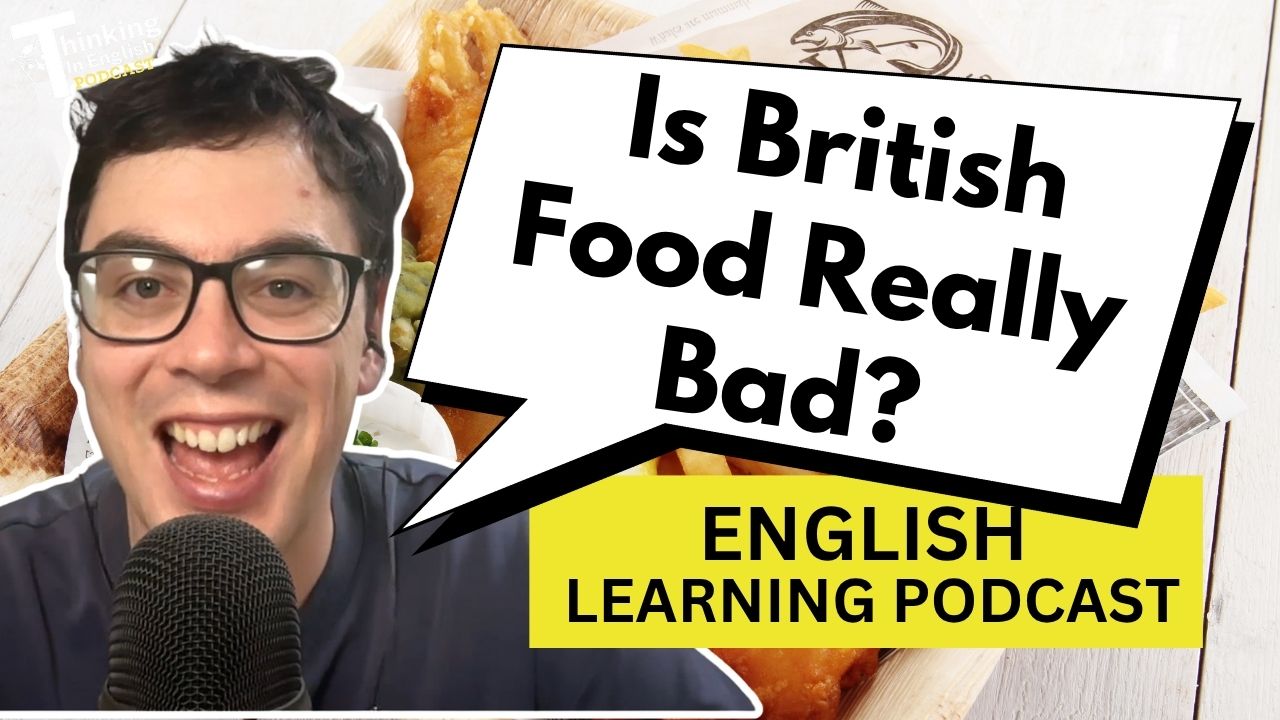
British food has a bit of a reputation.
I’m sure that for a lot of you, the words “British food” brings to mind boiled vegetables, overcooked meat, greasy breakfasts, and meals that are, above all, rather bland. British cuisine is often compared unfavourably with the food of countries such as France, Italy, Spain, or Japan. There is a common idea that while other countries have sophisticated culinary traditions, Britain somehow missed out.
This stereotype is not completely new. British people themselves have made jokes about their country’s food for years. British comedy is full of references to terrible meals.
But why exactly did this reputation develop? And is it actually true?
So, let’s talk about British food while improving our English listening comprehension and learning some new vocabulary!
Listen Here!
 Apple Podcasts
 Spotify
 YouTube
Interactive Transcript!
You Can Now Read and Listen at the Same Time With an Interactive Transcript!

Vocabulary
- reputation (n.): the general opinion people have about someone or something
- British food has a reputation for being bland and overcooked.
- bland (adj.): having very little strong or interesting flavour
- Many people stereotype British food as bland because of the simple dishes associated with the post-war period.
- cuisine (n.): a particular style or tradition of cooking
- British cuisine includes traditional dishes such as pies, roast dinners, and fish and chips.
- stereotype (n.): a common but oversimplified idea about a particular group or thing
- The stereotype that British people only eat boiled vegetables ignores the diversity of modern British food.
- rationing (n.): a system that limits how much of certain goods people can buy
- During the Second World War, rationing limited the amount of meat, butter, sugar, and other foods people could buy.
- scarcity (n.): a situation in which something is difficult to obtain because there is not enough of it
- The scarcity of food during and after the war encouraged people to cook simple meals with whatever ingredients were available.
- revival (n.): a return to popularity or importance after a period of decline
- Britain has experienced a revival of interest in regional ingredients, traditional recipes, and high-quality local food.
Food in Tudor England
The first thing to understand is that British food wasn’t always considered bad. In fact, in the 16th century, English food was comparable, similar, to the food being eaten by ordinary people in Europe.
Britain at that time was a rural society. Most people lived in villages and depended on the land around them. For ordinary people, food was simple and seasonal.
A common [00:04:00] meal might be a type of vegetable stew called pottage. This could contain vegetables and grains and, if times were good, maybe a little bit of meat or fish. Bread was also an important staple. A staple means a basic food that people eat almost every day, and bread was a staple. People would also potentially have dairy products from cows and sheep, and perhaps keep chickens or other animals.
This was not luxurious food. Hunger and starvation were actually serious risks for people across Britain, across Europe at the time. People had to make use of almost everything available to them, including eating parts of animals that we might be less comfortable eating today.
This kind of food wasn’t uniquely British. Peasants across Europe ate simple food based on what they could grow, raise, preserve, catch. There was nothing [00:05:00] unusual or inferior about the British diet.
And if we look at the other end of society, British food was actually extremely elaborate. The food served to wealthy people and royalty was nothing like simple pottage eaten by ordinary people. Aristocratic meals contained enormous quantities of meat, elaborate dishes, sugar, and imported spices. Spices such as pepper, ginger, cinnamon, cloves, nutmeg, and mace were used extensively in cooking.
They were really expensive, so they were associated with wealth and status, but they were used generously. Sugar was considered such a luxury that they added it to savory dishes such as meat as well.


French Influence Arrives
Something more complicated, though, started to happen from the 17th century onwards. France started to become powerful, or more powerful than it was. France [00:06:00] was becoming one of the most influential countries in Europe.
And French elites, French aristocrats, used food as a way of demonstrating their sophistication, their superiority. Cooking became more refined in France. Chefs began developing new techniques. Chefs in France were creating new ways to prepare vegetables, and they started to establish rules for what was considered good food.
And of course, British aristocrats copied them. King Charles II, for example, before he was the king, spent time in exile in France during the English Civil War. He returned from France with an appreciation for French food and French culture. French cuisine became really fashionable in Britain, among the wealthy classes anyway. But the food of ordinary people continued to be based on local ingredients and traditional recipes
[00:07:00] By the 18th century, some British writers were already complaining about this trend, criticizing wealthy British people who preferred French cooks to English ones.
And there was an even bigger change happening for normal people, a change that would have a much larger effect on British cuisine.

Enclosure and Lost Land
For centuries, many rural communities had access to common land, right? This is land that was shared among all people. People could use this land for animals or to grow food or to collect resources such as firewood.
But during the 18th and 19th centuries, something called “enclosure” happened. Landowners enclosed common land. Fences and boundaries were built around the land. The land that had been previously available for people to grow their food now became privately controlled.
If you lose access to the land where you keep your cows and grow [00:08:00] your vegetables, you lose the system that allows you to feed yourself. It’s something that didn’t happen to France or Italy or Spain, at least not to the same extent.

Industrial Revolution Diet
And then came an even bigger change: the Industrial Revolution.
The Industrial Revolution changed Britain from an agricultural society into an urban, industrial society. Between 1750 and 1850, millions of people moved into towns and cities to work in factories. People moved from their villages and farms into places like Manchester, Birmingham, Liverpool, and London.
Instead of living close to farmland and producing their own food or buying local food from their neighbors, people needed to depend on shops and markets for their meals.
Factory work involved long hours of physically demanding labor. If you’re [00:09:00] in a factory, you are inside all day from 7:00 AM to 7:00 PM at night. Working-class families now had less time to prepare food. They also had less money or no money of which to buy food with.
Meals that families ate then needed to be affordable, they needed to be really filling, and they needed to be easy to prepare. Bread, potatoes, oats, meat, cheese, these kinds of things became important. Pies and stews, puddings, and dishes that could feed an entire family. This is what people started to eat.
The Industrial Revolution also changed the way food was produced. Britain became the pioneer of mass production, and this was applied to food as well.
Factories could produce food in large quantities. Railways made it possible to move ingredients around the country. This was a big improvement in some respects. It [00:10:00] made certain foods cheaper. Certain foods were now available more widely. People in cities could get food from other parts of the country.
But there were big downsides. People no longer knew necessarily where their ingredients came from. A person living in an industrial city would be eating food that had traveled hundreds of kilometers and had been processed by people they never met.
And because working-class people had limited incomes, the quality of the food was not the priority. They needed food that would provide them with enough energy to get through a difficult working day.
Britain was the first country to have this massive urbanization.
A country is considered to be an agricultural society until about less than 50% of the workforce is no longer in agricultural work. Britain stopped being an agricultural society in [00:11:00] the early 1800s, and the transition away from being an agricultural society started about 50 years before that, in the 1750s.
So people in Britain have lived far away from their food and ingredients for quite a long time.
But compare that to places with great food cultures. France only reached the level of not being an agricultural society in the 1930s, Italy in the 1950s, Spain in the 1950s as well, Japan in the 1920s, China in the 2000s.
Countries like this with great food cultures partly have a great food culture because people were around their food for much longer and much more recently.

World Wars and Rationing
If the Industrial Revolution changed the way British people produced and ate food, the World Wars changed what people could eat.
During the First World War, Britain experienced real food shortages. Britain depended on imported food at the time, [00:12:00] but German submarines threatened all the ships crossing the Atlantic. So the British government encouraged people to grow their own vegetables.
During the Second World War, in January 1940, Britain introduced food rationing. Food rationing means limiting the foods available. People were told what they could eat. They were given a ration book, which gave them coupons to exchange for certain ingredients. And they could only purchase certain quantities of particular foods.
Items like meat, butter, bacon, sugar, eggs, and cheese were restricted. Some foods were completely unavailable. This produced a very unusual food culture. People were encouraged to use cheap ingredients and substitute ingredients when it was too difficult to find the correct thing.
When you don’t have much meat, butter, eggs, sugar, you don’t really have opportunities to create tasty dishes. And when [00:13:00] the country is at war, making nice food is not really the priority of most people.
Rationing, though, did not mean that British food became universally terrible. People still had vegetables, fish and bread and potatoes and other ingredients. People learned how to make nutritious meals from their supplies. Some wartime dishes are still around today and they’re examples of British food culture.
The bigger problem, though, is that food rationing in Britain didn’t end until 1954, almost nine years after the Second World War had finished. This was later than France ended their rationing, and actually even later than Germany.
What this means is that an entire generation of British people grew up in a society that had experienced food scarcity and limited food choices.
A lot of food culture is about habits and [00:14:00] expectations. If you go to a country like Italy, people tend to learn how to cook delicious food from their grandparents. But if your grandparents learned to cook during food rationing, your parents would have grown up eating simple meals, and those habits continue and get transferred down society.
When people imagine traditional British food, they picture boiled vegetables with potatoes and gravy and mild flavors. This was the result of World War II. There were no spices. Ingredients were really scarce. People did make delicious food, but perhaps it’s not the food that you’d consider tasty in the 21st century.
And this is actually partly where the stereotype of British food becoming bad comes from. It’s often traced to soldiers from the USA arriving in Britain after World War II and discovering the food was not tasty, the food was poor quality.

Postwar Convenience Foods
By 1954, [00:15:00] Britain ended food rationing, but that did not mean that British food returned to great traditional cooking.
People in Britain were becoming wealthier and even more urban than they had been before. Women started to enter employment in greater numbers. Technology that was used in houses was changing. Supermarkets started to spread to every town. For the first time, many British families had access to a wide range of food.
But that did not produce better cooking. More choice does not really lead to better cooking.
The post-war decades saw the growth of processed food and convenience food: frozen vegetables, canned food, instant meals, microwave meals. This wasn’t uniquely British, of course. Similar things have happened in every country.
Some traditional cooking practices and skills began to be forgotten. For example, vegetables were boiled much longer than [00:16:00] necessary because people just didn’t know how to cook. Meat was cooked until it was extremely well done, partly due to misunderstandings about food safety. Ready-made sauces and frozen foods became common. They were easier than making your own sauce. And people’s school food had a particularly poor reputation.
Countries such as France and Italy have really developed reputations as great sophisticated cuisines. British cuisine, though, is associated with pubs and fish and chips and fried breakfasts.
At exactly the same time, though, Britain was also becoming an incredibly multicultural society.
Large numbers of people arrived from South Asia and the Caribbean and Africa after the Second World War. They brought their own food traditions with them, and these foods have gradually become part of British life.
There are Indian restaurants across British cities. Chinese takeaways in every town. Caribbean food is quite visible, especially in places like London. [00:17:00] You can also find cuisines from the Middle East, East Asia, and many other parts of the world.

Spices and Bland Myth
One of the most common criticisms of British food is that it is bland. When people say this, they basically mean that British food doesn’t really use spices.
There is a common joke on the internet that Britain colonized the world for spices, but never really used them. This isn’t really true.
British cooking historically used loads of spices: black pepper, ginger, nutmeg, cinnamon, cloves, mustard, and mace. Spices appear in traditional British recipes for meat, desserts, sauces, baked goods, and drinks.
Black pudding is a traditional spiced blood sausage and part of a traditional breakfast. British Christmas food, like mince pies, are full of spices like nutmeg, cinnamon, mace. You’ll find spices especially in British desserts.
But for much of history, spices were really expensive. They traveled a long way to get to the UK. The UK [00:18:00] grows lots of delicious herbs, mint and rosemary and thyme, we use a lot of that in our cooking. But spices were expensive. They were grown on the other side of the world.
British cuisine didn’t develop around the idea of intense spicing. This is something you find in South Asia, in the Middle East, and Southeast Asia. Food culture there relies on using lots of intense flavors and spices. Traditional British cooking relied on the flavor of the main ingredients.
A roast joint of beef would usually just be seasoned with salt and pepper, some herbs as well, and then served with vegetables and gravy and perhaps horseradish or mustard.

Curry as British Food
Perhaps the best challenge to the idea that British food is bland is found in “curry”.
Walk through any British town or city and you will find Indian restaurants. I grew up in a town of less than 5,000 people, and that town [00:19:00] had four Indian restaurants. Curry has become such a normal part of British life.
There is an obvious difference between food from India and food that was created in Britain by people of South Asian heritage. Britain has a large South Asian population, and British Indian cuisine developed through the mix of South Asian cooking traditions and British ingredients and tastes.
Chicken tikka masala is perhaps the most famous example. This is, for a long time, considered the national dish of the UK. Its exact origins are disputed, but it’s generally understood to be a product of the British Indian restaurant tradition. It uses the language and the techniques of Indian cuisine, but was adapted for British flavors.
And chicken tikka masala isn’t alone. The chicken balti, for example, was invented in Birmingham in the 1970s by Pakistani [00:20:00] immigrants and is now a major part of Birmingham’s food culture. If you go to Birmingham, you’ll see hundreds, maybe even thousands of restaurants selling baltis.
British curry houses develop their own styles of curries and their own sauces and breads that aren’t really found in South Asia. The foods might have South Asian roots and inspiration, but they are uniquely found in Britain.
This isn’t unusual. Most countries around the world have incorporated foods introduced by immigrants.
Take the United States. Pizza is very strongly associated with New York food culture, even though pizza is an Italian food, originated in Italy. Italian immigrants moved to the US, transformed the dish pizza to a new style, created New York and Chicago pizzas that are now distinctly American.
Consider Germany, where the doner kebab is an enormously [00:21:00] popular fast food. Doner was developed in Germany by Turkish immigrants.
There are so many more examples.
Chinese immigrants, in particular, transformed the food of Southeast Asia. If you go to Singapore or Malaysia, Indonesia, Thailand, the Philippines, you will find dishes that are inspired by Chinese cuisine, but they are now considered dishes of those countries.
Perhaps the best example I can think of, one that’s relevant to where I live now, is the famous Japanese noodle dish “ramen“.
Ramen was introduced by Chinese immigrants and can trace its history to Yokohama’s Chinatown in the late 1800s. The first ramen-only restaurants only opened in Japan in the 1920s, I think.
The first curry house in the UK, opened in 1810… 100 years earlier.
If ramen is considered a Japanese food, surely curry can be considered a British [00:22:00] food, or at least a British Indian food.
Britain’s most famous dish is fish and chips. Fried fish has connections to Jewish communities who came to Britain from Spain and Portugal. Potatoes originated in South America. But nobody seriously argues that fish and chips isn’t British. We accept that they are British because of their history.
Indian food is Indian, of course. But British Indian food can also be British. It was created through migration and has become part of British food culture. If you only look at the dishes that existed in Britain in the 1940s, you’re gonna miss a huge part of what British people actually eat.

Modern Revival and Ingredients
The stereotype of British food being bad hasn’t disappeared, but Britain has a much more sophisticated and diverse food culture now.
British chefs have taken traditional foods and prepare them in new ways. Some people describe it as a revival of British [00:23:00] cuisine. There are some genuinely excellent ingredients available in Britain.
British cheeses are a good example. Cheddar is probably the most internationally famous British cheese, but Britain has hundreds of cheeses: Stilton, Red Leicester, Wensleydale, Lancashire, and lots more.
Britain also has excellent seafood. There’s also great meat in the UK, a lot of free-range animals. There is a strong tradition of British baking. Cakes, biscuits, pies, tarts, puddings. These are things that I like.
A well-made sticky toffee pudding is perhaps the best dessert in the world, in my opinion.
Another important development in British food recently has been the transformation of the pub. The traditional British pub was a place to drink, but now modern pubs have become restaurants as well.
British chefs have also become really internationally respected. Chefs such as Gordon Ramsay, Heston Blumenthal have changed [00:24:00] the perception of British cooking.
The UK has a lot of Michelin-starred restaurants. And most of the Michelin-starred restaurants in the UK cook British food or modern British food. And there are so many other restaurants that are not Michelin-starred selling great British dishes and great British food.
I’ve had people tell me before that they’ve been to London and they’ve not found anything nice to eat in London, which is incredible ’cause London is perhaps one of the best food cities in the entire world. There is so much delicious food, great restaurants in London.
Part of it might be a financial problem. Restaurants in the UK are quite expensive. People in the UK do not eat out for every meal. Usually, eating out at a restaurant might be something a family does once or twice a month maybe less, maybe more, but it’s not something completely regular.
The issue is that people often go to chain restaurants or places that are known for selling cheap, mass-produced [00:25:00] food. If you go to the USA and just eat McDonald’s, are you going to think the food in the US is great? Probably not.
So if you are visiting Britain, what should you actually eat?

What to Eat in Britain
The most obvious choice is fish and chips: fried fish, usually cod or haddock, with thick-cut chips served with salt and vinegar. Probably Britain’s most internationally famous dish.
Another classic meal is the Sunday roast. Traditionally, this is eaten on Sundays, hence the name, and it involves roasted meat, chicken, pork, lamb, beef, sometimes other things like turkey as well potatoes, vegetables, gravy, Yorkshire pudding.
It’s incredibly delicious, and I’d recommend going to a nice pub and ordering a nice Sunday roast if you can.
For breakfast, you can try full English breakfasts: eggs, bacon, sausages, beans, mushrooms, tomatoes, and toast, sometimes black pudding as well.
British cuisine is also particularly good at pies and pastries. A steak and ale pie or a shepherd’s pie or a [00:26:00] Cornish pasty are great.
British food also has lots of desserts and cakes: sticky toffee pudding, Eton mess, bread and butter pudding. They’re all worth trying.
There’s also regional food in the UK as well. Cornwall has Cornish pasties. Lancashire has Lancashire hotpot. Wales has Welsh rarebit. Scotland has so many dishes: haggis and Cullen skink.
And there is the food that represents modern Britain. You should absolutely try a British Indian curry. And if you want to see the modern British food revival, go to a great gastropub or a contemporary British restaurant.
Don’t just go to the supermarket and buy a sandwich and complain that British food is bad. Go and buy nice food, and then see if it’s actually tasty.
When I studied in London, I had two friends from France and Spain who used to complain about British food all the time. It turns out they never really tried British food. They just complained about it.
I took them to a farmers market that popped up [00:27:00] near the university every Wednesday, and I bought them some pies. They would go back to that market every week or almost every week to buy the same pies because they thought they were so tasty.
The reality is that perhaps British food is not the best cuisine in the world. There are lots of countries around the world that make delicious food. But Britain doesn’t necessarily deserve its negative reputation.

Final Thought
Perhaps British food isn’t quite as bad as you think. Its reputation has a complicated history. It’s related to industrialization, war, rationing, social changes, and Britain’s relationship with the rest of the world.
Food changes and evolves. Every country’s food changes. Even where you live, your country, your food culture, is going to have terrible dishes. Every country does. It’s also gonna have great dishes.
If you go to Britain, you can eat great food, you can [00:28:00] eat terrible food.
But what do you think? Does British food deserve its bad reputation? If you’ve ever tried British food, did something surprise you? Did you like it? Did you not like it?
Extended Vocabulary List
Become a Patreon Subscriber to Access the Extended Vocabulary List!


Vocabulary Games and Activities!
Learn and practice vocabulary from this Thinking in English episode.
Practice using 5 different study games and activities – including writing, listening, and memorisation techniques!
Flashcards
Matching Game
Learning Game
Test Yourself
Listening and Spelling
Do you want to Think in English?
I’m so excited that you found my blog and podcast!! If you don’t want to miss an article or an episode, you can subscribe to my page!
