

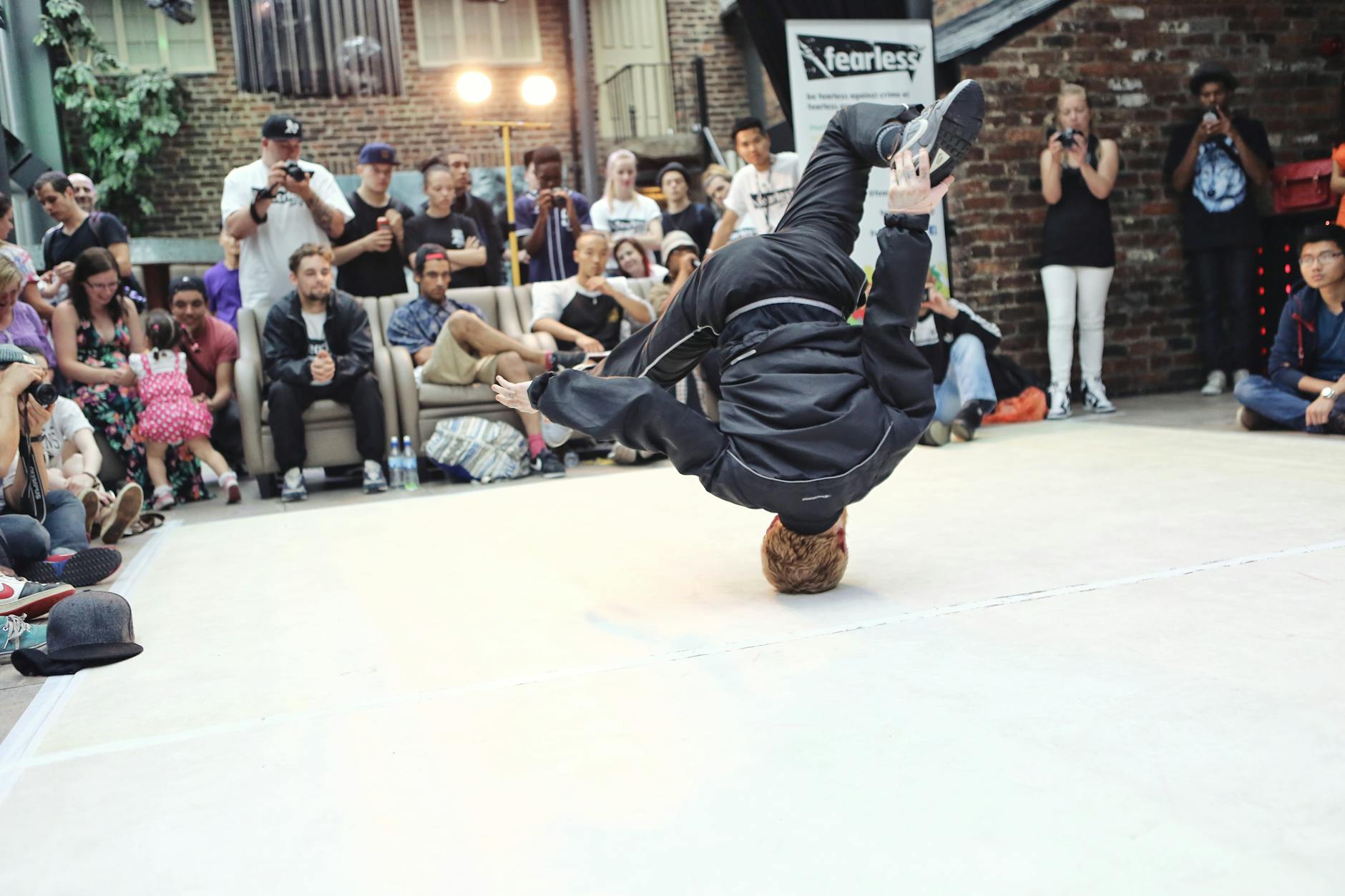
The 2024 Paris Olympic games will start on July 26th, and for the first time breaking will be included as an official sport.
Breaking, a form of competitive street dance, may not be exactly what you imagine when you think of the Olympics. So, today, I want to take a look at how breaking evolved alongside Hip-hop music on the streets of New York city, and then discuss how it ended up being selected as an Olympic discipline.
At the same time, we’ll learn some useful breaking related vocabulary!
Listen Here!
 Apple Podcasts
 Spotify
 YouTube
Interactive Transcript!
You Can Now Read and Listen at the Same Time With an Interactive Transcript!

Vocabulary
- Acrobatic (Adjective): Relating to or involving spectacular gymnastic feats.
- The dancer’s acrobatic performance included a series of impressive flips and spins.
- Break (Noun): In music, a brief, instrumental section within a song where the vocals are absent, often used for dancing.
- During the break in the song, the DJ extended the instrumental section to keep the dancers moving.
- Hip-hop (Noun): a genre of popular music, also known as rap.
- Hip-hop emerged in the 1970s in the Bronx and has since become a global cultural phenomenon.
- Discipline (Noun): In sports, a specific category or field of competition.
- Breaking, also known as breakdancing, is now recognized as an official discipline in the Olympic Games.
- Mainstream (Adjective): The ideas, attitudes, or activities that are regarded as normal or conventional; belonging to the dominant trend in opinion, fashion, or the arts.
- What started as a subculture in the Bronx eventually became mainstream, influencing music, fashion, and dance worldwide.
- Musicality (Noun): Sensitivity to, knowledge of, or talent for music; the quality of being musical.
- The breaker’s musicality was evident in how perfectly his movements matched the rhythm of the music.
- Agility (Noun): The ability to move quickly and easily.
- The gymnast’s routine showcased her incredible agility as she transitioned from one complex movement to another.
Paris 2024 Olympics
The Olympic Games, the world’s largest and most famous international sports competition, is being held this summer in Paris.
It is 100 years since Paris last held the Summer Olympic games, and in that time a lot has changed in society, in culture, and in the world of sports.
Many of the sports included in the 1924 Olympics are still mainstays of the modern Olympic schedule. Athletics, swimming, cycling, boxing, sailing, wrestling, and more are all still featured in the Olympics.
In fact, I believe the only sport no longer in the Olympics that was included in 1924, is polo (not water polo). Polo is a ball games played on horses, and one of the oldest team sports still played today, but has not been an Olympic sport since 1936.
If we look at the sports included in the 2024 Olympics, we will see a lot of things that were not featured in 1924 (including sports that had not even been invented 100 years ago). Surfing, skateboarding, speed climbing, BMX racing, and various martial arts have all been added to the games relatively recently.
These sports have been added to appeal to a wider range of people across age groups, nationalities, and cultures.
Paris 2024 is introducing two completely new sports. One is kayak cross, a kind of team race using kayaks (kayaking has been part of the Olympic world for a while).
The other is breaking, better known to most people as “breakdancing.”
When I first heard that breaking or breakdancing had been selected as a new Olympic sport, I had a few different questions running through my head.
Is that a sport? They have breakdancing competitions? How do they judge the winner? Is it popular enough to be part of the Olympics? I thought it was an art form (like most dance) rather than a sport performed by athletes?
Today, I want to look at how breakdancing became an Olympic sport! How did a form of dance invented on the streets of New York city in the 1970s find its way into the most prestigious sporting competition on the planet?


What is Breaking (Breakdancing)?
The first thing I should do is define and explain breaking. The sports official name is breaking, not breakdancing. Apparently “breakdancing” is a name used by outsiders, while to the practitioners, performers, and competitors it has always been known as “breaking,”
“Breaking,” is a dynamic and acrobatic style of street dance that emerged in the early 1970s. This dance form is an integral part of hip-hop culture and is known for its unique combination of athleticism, rhythm, and artistic expression.
There are a few key characteristics of breaking.
The first characteristic is acrobatic movements. Breaking involves a variety of physically demanding moves that require strength, agility, and precision. These moves often include spins, flips, and other things you would also see in a gymnastic performance. Some of the most iconic acrobatic moves in breaking include head spins, windmills, and flares.
The second characteristic of the discipline would be intricate and stylized footwork, often performed in both standing and grounded positions. This footwork is referred to as “top rock” when performed while standing and “down rock” when performed on the floor. The transition between these positions showcases a breaker’s versatility and skill.
Third, a fundamental aspect of breaking is its connection to music, specifically the beats and rhythms created by a DJ. During breaking battles, the DJ plays a crucial role by spinning tracks that set the tempo and mood for the dancers.
The MC (master of ceremonies) enhances the atmosphere by hyping up the crowd and interacting with the dancers, adding to the competitive spirit of the event.

Terminology
To understand the Olympic discipline of breaking, you need to understand some new terminology.
B-Boys and B-Girls: These terms refer to male and female breakers, respectively. The “B” stands for “break.”
Battles: Competitive encounters where breakers face off against each other, showcasing their skills in an improvisational and often confrontational manner. Judges or the audience determine the winner based on various criteria, including creativity, execution, and overall impact.
Top Rock: The upright, standing movements and steps that breakers perform before transitioning to floor work. Top rock sets the stage for the more acrobatic elements of a breaker’s routine.
Down Rock: The movements performed on the ground, which include intricate footwork and body manoeuvres. Down rock is essential for showcasing a breaker’s control and style.
Power Moves: These are the highly athletic and visually impressive moves that involve spins, flips, and other dynamic actions. Power moves often serve as the climactic points in a breaker’s performance.
Freezes: Moments in a breaker’s routine where they hold a specific position, often balancing on their hands or head. Freezes demonstrate strength, control, and the ability to maintain balance in challenging poses.
Breaking is now about to make its Olympic debut. If you had told someone 10 or 15 years ago that it would be in a future Olympics, they would probably not believe you. In fact, the sport didn’t exist as a sport until recently and was only invented in the 1970s.
Let’s take a deeper look at how it evolved from the streets of New York.

History of Breakdancing?
The Bronx, one of the boroughs of New York city, was an interesting place in the 1970s. It was experiencing economic decline and hardship. The industrial jobs that had once been dominant disappeared, leading to widespread unemployment.
There was a housing crisis. House conditions were poor, and many landlords actually set their buildings and houses on fire to collect insurance money, further worsening the housing crisis.
The post-war period saw many middle-class families, particularly white families, moving to the suburbs. This became known as the “white flight” and left behind poorer residents, predominantly African American and Hispanic communities, who faced increased segregation and lack of investment.
Against this background and challenging conditions, the Bronx developed a unique culture and arts scene.
Most famously and importantly, the Bronx was the birthplace of hip-hop in the 1970s.
DJ Kool Herc is widely credited with creating the genre of hip hop music by extending the instrumental breaks of songs to create a continuous beat that dancers could move to.
Kool Herc noticed that at the parties he hosted, the people dancing became most active and excited during the instrumental breaks of songs. He used two turntables allowing him to loop sections of records and extend the instrumental breaks, forming the basis of modern DJing and creating continuous beats that kept people dancing.
Following Kool Herc, other influential DJs such as Grandmaster Flash and Afrika Bambaataa introduced new techniques like scratching and cutting, which became fundamental elements of hip-hop.
The role of the MC (or Master of Ceremonies) also evolved at the time. They added lyrics, or words, to the new beats… and ultimately developed one of the most popular styles of music in world – rap and hip hop.
And alongside hip-hop music, breaking (or breakdancing or b-boying) emerged as a vibrant dance style.
It combined elements of gymnastics and dance and was performed (often improvised) to the beats created by hip-hop DJs.
Early breaking was often performed by dance crews, close groups of friends, who would practice together and develop new moves. These crews would then compete against each other in “battles”.
In these battles, dancers would face off with each other, showcasing their best moves and their skill at improvising. The goal was to show more skill, creativity, agility, and musicality than your opponents, while also engaging the audience and fellow dancers,
By the late 1970s and the early 1980s, breaking began to become better known and more visible. It was featured in documentaries and major films like “Flashdance” that brought breaking into the mainstream.
While the popularity of breaking ebbed and flowed (meaning went up and down), B-boys and B-girls continued to practice and develop their skills.

How Did it Become an Olympic Sport?
Now we know a little more about the history of breaking, but how did this form of competitive street dance become an Olympic sport?
The story begins not with breaking, but with an organisation called International DanceSport. The International Olympic Committee recognised this organisation as the official organisation for all dance disciplines in 1997. It represented ballroom dancing and tried to get this accepted as an Olympic sport.
After failing, they rebranded to the World DanceSport Federation and in 2015 contracted an expert to help get some form of dance into the Olympics.
The expert decided that there was one type of dance that could potentially become an Olympic competition: breaking.
The problem, however, was that the World DanceSport Federation had no connection with the majority of breaking competitions or performers/athletes.
Despite this, they began an effort to get breaking into an official Olympic competition. They moved the headquarters of their organisation to Switzerland and campaigned for breaking to be a featured sport at the 2018 Summer Youth Olympics in Argentina.
The breaking community was divided over this. Sports like skateboarding, surfing, and now breaking, have struggled with the change from alternative lifestyle hobby to mainstream competition.
These sports are now Olympic disciplines, and need official organsiations, but their origins and members are often opposed to organised events, mainstream activities, or organisations.
The WDSF continued anyway. They worked with parts of the breaking communities to establish, for the first time, a universal set of rules and guidelines for how the competition should be judged.
They also focused on the discipline’s strengths. It appealed to a younger audience and a new audience. It was inexpensive to host (it doesn’t require large stadiums or arenas to be built). And it had the chance to go viral online.
This clearly impressed the Olympic Committee, and the organisers of Paris 2024, who quickly selected breaking as a new sport in the 2024 Olympics.
This is amazing considering how quickly the discipline went from being completely outside of mainstream sport to the Olympics.
While many breakers are still concerned at being organised under the WDSF and non-breakers, their discipline will be on the world stage like never before.

Is Breaking Even a Sport?
However, breaking’s inclusion has still puzzled many people, including may breakers themselves. Why? Not everyone is convinced that breaking is a sport.
Critics (and sometimes breakers themselves) argue that breaking, with its emphasis on creativity and expression, aligns more closely with artistic disciplines.
On the other hand, it isn’t actually that different from some long-established Olympic sports. Figure skating, at the winter Olympics, is basically a combination of dance and gymnastics on ice. Gymnastics (especially rhythmic gymnastics) involves dance. Synchronised swimming is artistic swimming with music.
Like breaking, these sports combine dance and athleticism. Like breaking, they include music and costumes. Like breaking, they are judged on creativity, musicality, technique, and skill. They are quite similar.

How Will it Work in the Olympics?
We’ve covered how breaking went from the streets of New York to the Paris Olympics, but what will the Olympic breaking competition actually look like?
The inaugural breaking events will be held on August 9th and 10th.
A total of nine judges will be used to score the performers on a mix of musicality, performance skill, technique, variety of moves, personality, and creativity.
There are some things that will make breaking unique amongst all Olympic sports.
Most obviously, it will be the only sport in which the judges also perform and demonstrate their skills at breaking. Before a breaking competition, the judges perform a showcase!
I’m definitely curious to see breaking in the Olympics and to see how it works in practice. There has been some debate over whether its inclusion in the Olympics is a good or bad thing, but ultimately seeing top athletes perform spectacular routines will always be exciting.
And if you are interested in watching breaking at the Olympics, make sure to do it this summer. It will not be included in 2028, and there is no guarantee that it will ever return. This could be your first and last chance to see Olympic breaking!

Final Thought
Today I wanted to talk about how breaking or breakdancing evolved from the streets of New York to the 2024 Paris Olympics.
We started by looking at what breaking is and a few words that would be useful to understand the new Olympic sport.
We then discussed the 1970s in the Bronx, and how the conditions in New York led to the creation of hip hop, rap, and breaking.
Following this, we traced breaking’s development and discussed how it became an Olympic sport.
There is still debate and a little bit of controversy over breaking.
Is it a sport or an art form? Are breakers athletes or performers? How can you accurately judge a dance battle? Should it be an Olympic sport?
What do you think?
Extended Vocabulary List
Become a Patreon Subscriber to Access the Extended Vocabulary List!

Vocabulary Games and Activities!
Learn and practice vocabulary from this Thinking in English episode.
Practice using 5 different study games and activities – including writing, listening, and memorisation techniques!
Flashcards
Matching Game
Learning Game
Test Yourself
Listening and Spelling
Do you want to Think in English?
I’m so excited that you found my blog and podcast!! If you don’t want to miss an article or an episode, you can subscribe to my page!

Hi Tom. Big thank you for this episode. As a former breakdancer, I’m so surprised and extremely happy that breaking became a competition on the Olimpics. Another opportunity to show breakdancing widely to world and make this discipline more popular. I know how much effort and passion b-boys and b-girls need to put to create choreography and how hard and how dangerous some maneuvers can be. Stay flexible and agile and don’t forget the rhythm.
Excellent Mateusz – I’m excited to watch this summer!