

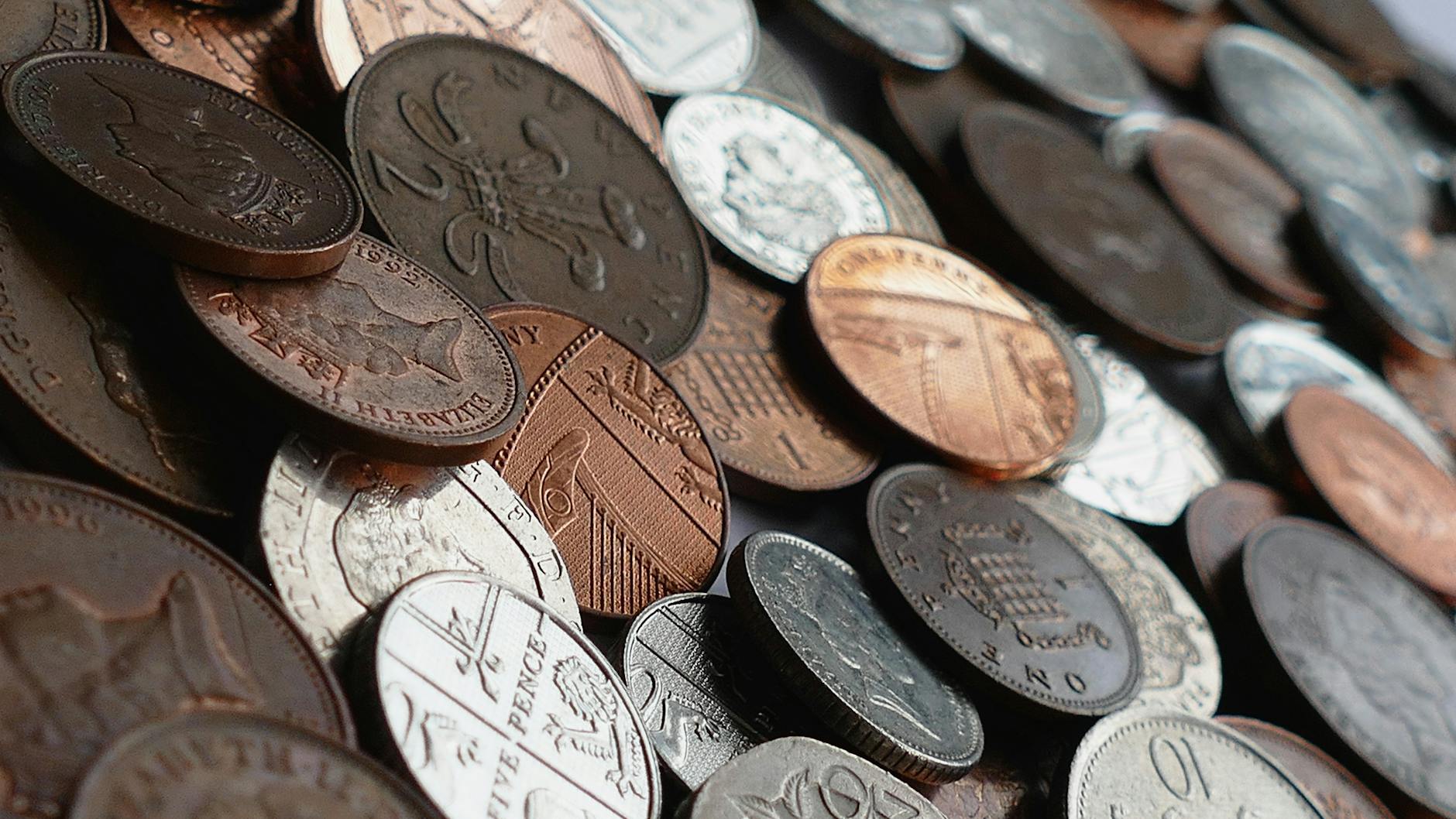
What is the smallest and least valuable coin used in your country? Could you imagine your currency without that coin? Should we remove these small value coins from our money?
Let’s discuss this topic, while learning lots of economic vocabulary, in today’s episode of Thinking in English!
Listen Here!
 Apple Podcasts
 Spotify
 YouTube
Interactive Transcript!
You Can Now Read and Listen at the Same Time With an Interactive Transcript!

Vocabulary
- Penny (Noun): A small denomination coin worth one cent in the US or one pence in the UK.
- In 2013, Canada decided to eliminate the penny from its currency due to high production costs.
- Coin (Noun): A small, flat, round piece of metal used as money.
- Japan continues to use the 1-yen coin frequently in daily transactions.
- Currency (Noun): The system of money in general use in a particular country.
- The euro is the official currency in 20 European countries
- Denomination (Noun): The value assigned to a particular coin or note.
- Each denomination is represented by a specific coin or note with a distinct value, design, and size.
- Circulation (Noun): The availability of money or coins in use within an economy.
- If there were no 1 cent coins in circulation, this wouldn’t be a problem anymore.
- To round (Verb): Adjusting a number to the nearest higher (round up) or lower value (round down).
- Canada introduced a rounding system for cash transactions to the nearest five cents.
- Cumulative (Adjective): Gradually increasing or growing by successive additions.
- Rounding can lead to small, but cumulative, losses for consumers over time.
Introduction
When I’m in the UK, I rarely use cash anymore.
I use my credit or debit cards for everything. The contactless function makes every transaction quick and easy – I just tap my card on the payment terminal and I have paid for whatever I want.
I don’t have to deal with coins, change, or notes. In fact, I’m sure many of you listening don’t even use cards anymore – we can now use our phones to pay in many shops and stores.
In Japan, however, I still use a lot of cash.
Although it has changed a lot in the past 5 or 6 years, cash is still very important in Japan. A few of my favourite cafes and restaurants only accept cash. This means I need to always have some notes and coins in my wallet.
Right now, my wallet is full of pretty useless 1-yen coins. The yen is Japan’s currency, and 1 yen is the lowest denomination and coin value in Japan.
You can’t buy anything with a 1-yen coin. A bottle of coke, for example, is about 140 yen which would require one hundred and forty 1-yen coins… or a 100-yen coin and four 10 yen coins.
There is some use for the yen though. Japan’s sales tax (the tax added to products in a store) often makes items have odd prices. 1-yen coins can be used to round up the change, so that you don’t receive even more 1-yen coins by paying with a larger amount of money.
Although, if there were no 1-yen coins in circulation, this wouldn’t be a problem anymore (shops would have to price things to the nearest 5 yen).
Many countries have these small denomination, low value coins. But why?
Today, I want to take a look at the debate over pennies, cents, and small change. Why do they exist? Why are they so useless? And should we still use them?


Understanding Coins, Currencies, and Denominations
Let’s start with an introduction to coins, currencies, and denominations.
Currencies encompass all forms of money in use within an economy, including both coins and paper notes. The main function of currency is to act as a medium of exchange, a unit of account, and a store of value. In simple terms, the purpose of a currency is for buying and selling things, to show how much things are worth, and to save for future use.
Currencies are issued by a country’s central bank or monetary authority, and their value is typically regulated by the government. In addition to coins and notes, modern currencies also include digital money, which exists in electronic form and is increasingly used in global financial systems.
Coins are metallic forms of money that are typically issued by a government and used as a medium of exchange within an economy. You can exchange a coin for a product or service of the same value.
Coins are a physical representation of value. They are usually made from metals such as copper, nickel, zinc, and sometimes precious metals like silver and gold. They are designed to be durable, portable, and difficult to counterfeit.
Denominations refer to the different values given to the different types of money. Each denomination is represented by a specific coin or note with a distinct value, design, and size.
For example, in the United States, the penny (1 cent), nickel (5 cents), dime (10 cents), and quarter (25 cents) are all different denominations of coins.
Having a variety of denominations is crucial to allow for different types of purchases. If you are trying to buy a car in cash or a cup of coffee in cash, you are going to need different denominations of currency.
Countries regularly adjust and change the denominations used in their currency. The UK, for example, completely changed its low denomination coins between 1960 and 1980 to make the system decimal (there are now 100 pennies in £1).
In the past, the UK had farthings (worth a quarter of a penny) and halfpennies (worth half a penny), but these coins became too small and worthless to be useful in daily life.
This is a common trend across the world: gradually the lowest value coins in a currency become less valuable and less useful.

Why Do Low-Denomination Coins Become Less Valuable?
Low-denomination coins, such as pennies and small-cent coins, tend to lose value over time due to several different reasons.
One major factor is inflation.
Inflation is the gradual increase in prices for goods and services. As goods and services become more expensive, the purchasing power of money (the number of things a specific coin can buy) decreases or diminishes.
For example, a penny that could buy a small candy decades ago may now be practically useless for most transactions.
Let me give you another example. In 1914, it cost 1 penny in the UK to post a letter. Today, it costs £1.35 (or 135 pennies) to post a letter with a first-class stamp or 85 p (85 pennies) to post a letter with a second-class stamp.
In 100 years, the power of that penny, the amount it can buy you, has decreased a lot as everything else has become more expensive.
Second, sometimes low value coins cost more to make than they are worth.
In the United States it apparently costs approximately 2.7 cents to produce a coin worth 1 cent. When the production cost is higher than the coin’s actual value, it creates a financial burden on the government and taxpayers.
And third, the rise of digital payment methods and the decline of cash transactions further contributes to the decreasing value of low-denomination coins. With more people using debit cards, credit cards, mobile wallets, and online transactions, we just don’t need as many coins as we used to.

Examples of Countries That Have Eliminated Low-Value Coins
In fact, several countries have successfully eliminated or got rid of low value coins from their currency systems.
In 2013, Canada decided to eliminate the penny (1 cent) from its currency. The primary reason for this decision was the high cost of production. It cost more to make a penny than it was worth, so the government was losing money for every penny made.
To implement this change, Canada introduced a rounding system for cash transactions. Prices are rounded to the nearest five cents, effectively removing the need for pennies. For instance, a total of $1.02 is rounded down to $1.00, while $1.04 is rounded up to $1.05.
Several Eurozone countries have phased out their 1- and 2-euro cent coins due to their limited use and the high costs of production. Countries like Finland, the Netherlands, and Ireland have adopted rounding rules similar to Canada’s.
From the introduction of the euro, Finland opted not to use 1 and 2 cent coins, instead rounding prices to the nearest five cents.
Since 2004, the Netherlands has encouraged retailers to round cash transactions to the nearest five cents, leading to a natural decline in the circulation of the smallest coins.
In 2015, Ireland followed suit by introducing a rounding scheme that rounds cash transactions to the nearest five cents, effectively removing the need for 1 and 2 cent coins.
In 1991, Australia withdrew its 1 and 2 cent coins from circulation. The country adopted rounding rules for cash transactions, which helped ease the transition. The move has been credited with reducing costs for both the government and businesses.
Sweden has a long history of phasing out low-denomination coins. The country eliminated its 1 and 2 öre coins in the 1970s and later removed the 5 and 10 öre coins. By 2010, Sweden had also phased out the 50 öre coin, leaving the 1 krona as the smallest denomination.

Examples of Countries That Still Use Low-Denomination Coins
On the other hand, there are still quite a few countries who keep minting (making) and using low value coins.
The United States continues to produce and use the penny (1 cent), a coin that holds significant historical and cultural value. The penny features the image of Abraham Lincoln, an iconic figure in American history.
Japan continues to use the 1-yen coin, which holds practical significance in the country’s cash-based economy. The 1-yen coin is made of lightweight aluminium and is used frequently in daily transactions. I use 1 yen coins every day in the self-checkout counters at the supermarket!
The United Kingdom continues to use the penny (1p) and the two-pence (2p) coins. British retailers often price items ending in .99 necessitating the use of 1p coins to provide exact change.
Also, pennies and two-pence coins are commonly used in charitable collections and donation boxes, playing a role in community fundraising efforts. People are willing to give away these low value coins without a second thought, and this can be quite valuable for charities.

Should We Eliminate Low-Denomination Coins?
In the final part of this episode, I want to summarise (in a simple way) the debate over eliminating low-denomination coins and getting rid of pennies, 1 cent coins, or anything similar.
Pros of Eliminating Low-Denomination Coins
Let’s start with the arguments for getting rid of low-denomination coins.
First, getting rid of these coins would save the government money. In the US, a penny (worth 1 cent) cost about 2.7 cents to produce in 2022. That is almost 3 times more than the coin is worth.
The US produces billions (not millions, but billions) of pennies every year. In 2023, they produced around 4.5 billion pennies. In dollar value, this would be worth about $45 millions dollars in value. However, it would cost $135 millions to make them.
Not having to make these coins would save literally millions of dollars a year – the same is true in all countries.
Eliminating small coins could also help businesses. Low value coins can slow down transactions as shop staff take longer to count individual coins, and handling, storing, and transporting small value coins is a cost for businesses.
Reducing the number of coins in circulation would also make it easy to use the currency. For example, if the UK removed 1 penny, 2 penny, and 5 penny coins (all tiny values), every price in a shop would need to be a multiple of 10 – which would make prices easier to calculate in your head.
Removing smaller coins could also encourage people to use more modern digital forms of payment (like cards or mobile payments) and encourage stores to accept these forms of payment.
When I was a student in the UK I used to use a lot of cash. And here in Japan I still use a lot of cash. Both the UK and Japan like to have products with uneven prices – in the UK many things are priced ending in 99p (meaning you almost always get a penny in change).
This means I constantly accumulate low value coins. At the moment, I have 12 1-yen coins in my wallet… getting rid of the 1-yen completely from circulation would remove this inconvenience.
And there have been many successful countries that have transitioned away from their least valuable coins. Canada, Australia, and Finland are examples!
Even more countries (including Japan) have stopped producing new low value coins, perhaps with the ambition to one day remove them completely!

Cons of Eliminating Low-Denomination Coins
On the other hand, there are some people and countries who continue to produce and support low-denomination coins.
One of the primary concerns is the impact of rounding on consumers. When low-denomination coins are eliminated, cash transactions are often rounded to the nearest five or ten cents. This rounding can lead to small, but cumulative, losses for consumers over time, particularly those who rely heavily on cash transactions.
Imagine every day you buy a newspaper priced at 99p (in the UK). If we removed pennies, this would be rounded up to £1. Over the year, you would spend an extra £3.65 on newspapers than you would have without rounding.
This is not much at all, but the rounding would apply to everything. As I mentioned previously, so many products in the UK are prices ending in 99p. A pack of biscuits might cost 99p, a coffee could cost £2.99, your lunch might cost £9.99, and a new textbook could cost £15.99.
Under a rounding system these prices may be 1 penny higher – which adds up.
However, some countries have tried to solve this problem by not rounding the price of individual products but of the overall transaction. In other words, even though Canada doesn’t have pennies anymore, individual products can still be priced with a 1 penny value, and then the total value of the transaction is round up or down.
Even without the rounding calculations, there is the risk retailers and shops would just round their prices up anyway – removing low value coins could lead to general price inflation.
There are other arguments in support of low value coins.
Many charities rely on small coin donations, often collected in donation jars and boxes. Eliminating low-denomination coins could reduce the amount of small change available for donations, potentially impacting charitable organizations that depend on this source of funding.
Low-denomination coins often hold significant historical and cultural value. The public and government may not want to remove a coin that had importance.
It is thought to have been indirectly inspired by or derived from early Roman coins. It existed in the Anglo-Saxon times, through the Norman invasion of Britain and Middle Ages, all the way up to the 18th century when the English and Scottish currencies were combined together.
During that period, the penny was a silver coin, that became increasingly small over the centuries.
Eventually, the penny became a copper coin, and then bronze coin, and now a copper-plated steel coin. In the 1970s the British currency completely changed (decimalisation) and the penny became the smallest denomination.
This coin has been around for over 1000 years – it would be tough to get rid of it!

Final Thought
What do you think?
On the one hand, eliminating small value coins would save money, make business transactions easier, and be generally more efficient.
On the other hand, it could cause price inflation and the public may oppose the removal of historic units of currency.
Should we get rid of small denomination coins? Are pennies, cents, and small change a waste of money?
Extended Vocabulary List
Become a Patreon Subscriber to Access the Extended Vocabulary List!


Vocabulary Games and Activities!
Learn and practice vocabulary from this Thinking in English episode.
Practice using 5 different study games and activities – including writing, listening, and memorisation techniques!
Flashcards
Matching Game
Learning Game
Test Yourself
Listening and Spelling
Do you want to Think in English?
I’m so excited that you found my blog and podcast!! If you don’t want to miss an article or an episode, you can subscribe to my page!

Hi! I am brazilian ans I move to Sydney recently and I started to listening this podcast every single day. This is really useful for me. Thank you so much.
Brilliant! Thank you for listening 🙂