

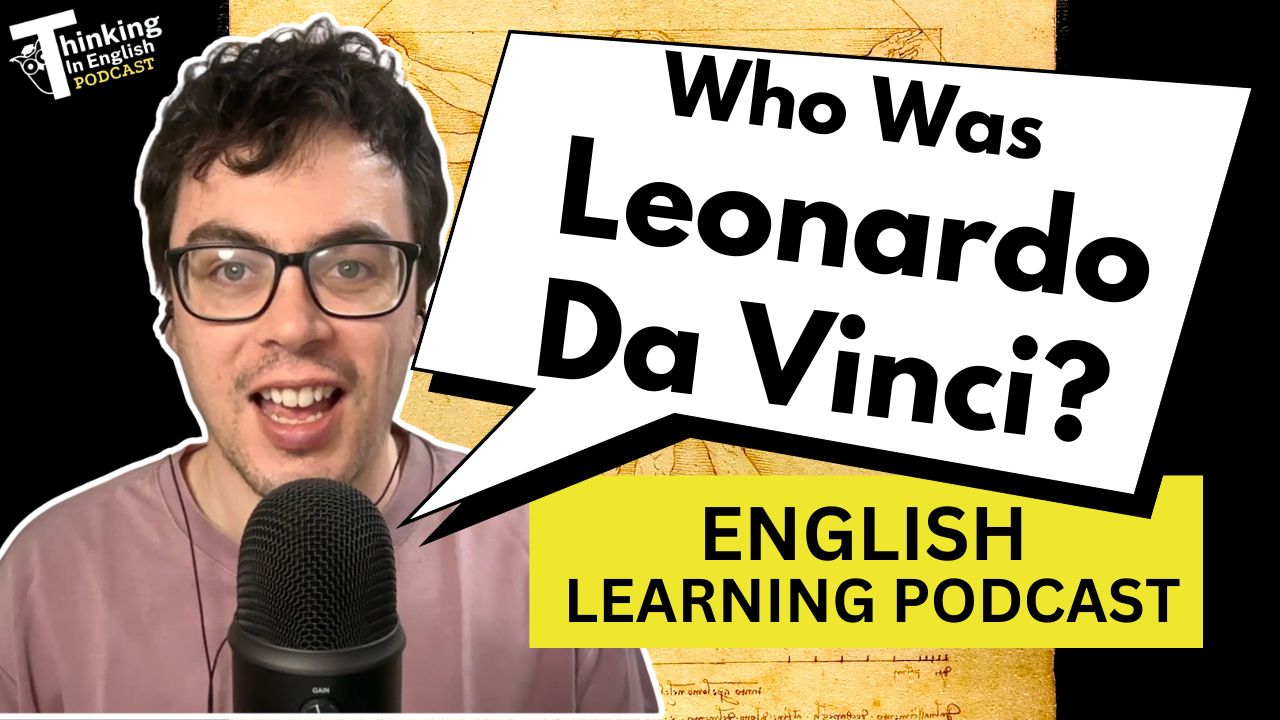
Leonardo Da Vinci was one of the greatest minds in history.
He painted some of the most famous works of art ever: the Mona Lisa, Last Supper, and more. He was also a scientist, an engineer, an anatomist, and an inventor.
He is often described as the perfect example of a “Renaissance man.” A Renaissance man is someone who is skilled in many different areas, especially during the time of the Renaissance. The Renaissance was a period of history when art, science, and learning were rapidly developing across Europe.
In today’s episode, we’re going to explore the life of Leonardo da Vinci. Who exactly was he? What were his greatest achievements? Can we really call him a scientist? And does his legacy still matter today, more than 500 years after his death?
And we’ll do this while practicing our English listening comprehension and learning some new vocabulary!
Listen Here!
 Apple Podcasts
 Spotify
 YouTube
Interactive Transcript!
You Can Now Read and Listen at the Same Time With an Interactive Transcript!

Vocabulary
- Renaissance (n): a historical period of cultural, artistic, and scientific revival in Europe
- The Renaissance led to major advances in art, science, and philosophy across Europe.
- illegitimate (adj): born to parents who are not married
- In the past, being illegitimate could limit a person’s social opportunities.
- apprenticeship (n): a system of learning a skill by working with an expert
- He began an apprenticeship with a local carpenter to learn practical skills.
- patronage (n): financial support given to artists or thinkers
- Many artists depended on royal patronage to continue their work.
- masterpiece (n): an artist’s greatest or most important work
- The painting is widely considered a masterpiece of modern art.
- composition (n): the arrangement of elements in a piece of art
- The composition of the painting directs the viewer’s attention to the centre.
- anatomy (n): the study of the structure of the human body
- Medical students must study anatomy to understand how the body functions.
Leonardo’s Early Life
Leonardo da Vinci was born in 1452 in the small Italian town of Vinci. His name “da Vinci” is not a modern surname. It means “Leonardo from the town of Vinci“.
Leonardo was an illegitimate child. Illegitimate, in this context, means that he was born to parents who were not married.
In 15th century Italy, this could limit your opportunities. It could be challenging, for example, for illegitimate children to go to school.
Fortunately for Leonardo, his father treated him well and made sure that he received some education. But because he was illegitimate, he was not really able to attend Latin schools. [00:04:00] Latin, at the time, was a very important language in law and religion and academics. And he was also not able to join his father’s profession.
So as a teenager, he was sent to the city of Florence, which was one of the most important places during the Renaissance.
In Florence, he began an apprenticeship under the artist Andrea del Verrochio Now there’s gonna be a lot of Italian words in this episode. I don’t speak Italian, so if I make pronunciation mistakes, I am very sorry.
But Verrocchio was a master painter, a sculptor, and a goldsmith. He was basically a great artist. He worked with all different types of materials.
An apprenticeship is a system where a young person learns a skill by working closely with an expert. We still have the idea of apprentices in the UK today. Maybe in other countries [00:05:00] too. People learn vocational or practical skills like construction or plumbing or hairdressing through apprenticeships in the UK.
In Verrocchio’s workshop (a workshop being the place where art and crafts are created), Leonardo studied various different things. He learned painting, drawing, sculpture, mechanics, and basic engineering.
Renaissance artist workshops were very busy environments. The assistants helped to complete the main artist’s projects, especially their larger projects. So working as an apprentice to a master artist gave Leonardo the practical skills that he needed to become a great artist,and also the exposure to a wide range of types of art and disciplines and ways of expressing emotion [00:06:00] and being an artist basically.


What Was the Renaissance
As I mentioned in the introduction, Leonardo da Vinci has been described as the perfect example of a Renaissance man, so we should probably talk about the Renaissance.
The Renaissance was a time of cultural and intellectual change in Europe. The word comes from French and means rebirth. The Renaissance was a period of renewed interest in art, literature and knowledge of ancient civilizations like ancient Greece and Ancient Rome.
It began in Italy, around the 14th century, and gradually spread across Europe over the next few hundred years. Cities like Florence became places for creativity and innovation.
One reason for this was wealth. Powerful and rich families like the Medici family used their money [00:07:00] to support artists, scientists and thinkers.
This kind of support is known as patronage. Patronage refers to financial support given to artists or scholars.
On a slight tangent, this system of patronage is still around today. It is one of the main ways that content creators, like me, make a living.
I have a community on a website called “Patreon” where you can become a “patron”. Both of these come from the word “patronage”. So, you can give a small amount of money to support Thinking in English and in return I can make more content and episodes and organize more events.
So, what made the Renaissance different from before?
There was a focus on humanism. This was a way of thinking that emphasized humans, right? Emphasized human potential [00:08:00] and creativity. And looked at individual people and the importance of individual achievements.
Earlier art in Europe tended to be primarily religious, looking at scenes from the Bible or painting religious figures.
Second, during the Renaissance, there were huge advances in art and science. Artists began to create more realistic images. Thinkers, and philosophers, and scientists started to question some of the old ideas about the world and study the natural world through observation.
And third, the Renaissance is famous due to the individuals who were working during this period. People like Michelangelo, Raphael, Galileo, and of course Leonardo da Vinci. These people helped to transform art and science.

Masterpieces
I think Leonardo Da Vinci, out of everything [00:09:00] he did in his life, is obviously best known for his art.
Two of his most well-known works are the Mona Lisa and the Last Supper. These paintings are described as masterpieces. Masterpieces are the greatest works of an artist’s career.
The Mona Lisa has fascinated people for centuries. It is believed to be a painting of a merchant’s wife, and eventually ended up in the French Royal Family’s collection.
The Mona Lisa might be the most famous artwork in history. It is seen by hundreds of thousands of people a year in the Louvre, which is where it is now.
The Last Supper captures a moment from the Bible. It shows the reaction of Jesus’s disciples when he tells them that one of them will betray him. And it is again, one of the most famous paintings in history.
Leonardo made art slowly. Sometimes he worked [00:10:00] extremely slowly. He would spend years on a single painting. For example, the Mona Lisa was likely worked on for several years, and some historians believe he never considered it finished.
He actually carried it with him for much of his life and he took it between various different cities. And eventually when he moved to France from Italy, he took the Mona Lisa with him as well.

Techniques and Composition
Before he began painting, Leonardo would create detailed sketches and studies. He carefully observed human faces and muscles and different expressions.
One key technique he used was Sfumato, which is a method of softly blending colors and tones so that there are no sharp lines. You can clearly see this in the Mona Lisa, where the transitions between the light and the shadow are so smooth that they are almost invisible.
Leonardo also paid attention to [00:11:00] composition. Composition is the arrangement of elements in a painting. In the Last Supper, for instance, all of the lines in the room, in the painting, lead your eye towards the central figure of Jesus.

Anatomy and Inventions
But, while Leonardo is best known as an artist, he was also fascinated by how the world worked.
One of his main interests was anatomy, which is the study of the human body. To understand anatomy better, he carefully cut open human and animal bodies to study their bones and their muscles and their organs. This was unusual at the time, but it allowed him to produce incredibly detailed and accurate drawings of the human body.
Leonardo also designed a wide range of machines, including early ideas for flying machines and tanks and weapons. These were [00:12:00] early models or concepts of inventions that had never been built before.
For example, he sketched things that resembled helicopters and parachutes. He also designed practical structures, such as bridges. Some of these were intended to be portable for military use.
Much of this work was recorded in his notebooks. These were filled with sketches and diagrams and observations. He wrote about everything.
He wrote about, of course, art, but also human movement and how water flowed. He filled his notebooks with observations about everything.
His notebooks also had something strange about them. A lot of the writing is backwards. He had a habit of writing in mirror script, which means writing backwards.

Was He a Scientist?
Can we call Leonardo da Vinci a scientist?
On the one hand, no. He did not follow the [00:13:00] scientific method. The scientific method is the structured process involving creating a hypothesis, doing an experiment, and then having results that can be repeated.
This system wasn’t really around when Leonardo Da Vinci was doing his experiments or his observations. But he did do a lot of experiments. He did lots of experimentation, lots of observation. He questioned traditional ideas and he tried to understand cause and effect, which are some of the most important principles in modern science.
So he was ahead of his time, but he didn’t really use the tools or framework of modern science.

Later Life and Challenges
Actually, Leonardo’s curiosity was probably one of his weaknesses, as well as one of his strengths.
Leonardo had a reputation for starting projects and then never finishing them. He would become fascinated by a new [00:14:00] idea, move on, and not complete his previous work.
Throughout his life, he moved between different important cities, including Florence, Milan, and eventually France. These moves were often connected to work, as he relied on wealthy patrons to support him.
One of Leonardo’s most important patrons was the ruler of Milan. Leonardo worked for him as an artist and an advisor.
Much of Leonardo’s work came through commissions. People paid him to paint paintings or make things. He was paid for specific projects such as paintings or designs.
But his tendency to experiment and take a lot of time frustrated his patrons, who expected quicker results.
It’s like if you became one of my patrons, I make an episode every Friday. If I stopped making episodes, you probably wouldn’t want to pay me anymore. If I [00:15:00] stopped hosting my conversation clubs, you probably wouldn’t want to pay me anymore.
And Leonardo Da Vinci, it might take him a few years before he made the painting that you had paid him for.
In his later years, Leonardo accepted an invitation from Francis I of France and moved to France. He was given a position and a residence near the Royal Court and he no longer needed to worry as much about securing commissions or financial support because he had a permanent place working for the French Royal family.
His health began to decline and he likely suffered from partial paralysis, which made it more difficult for him to continue painting. Instead, he focused more on organizing his notes and on his past work.
Leonardo da Vinci died in 1519 in France. He left behind unfinished projects and countless notebooks.

Leonardo’s Legacy
More than 500 years after his death, [00:16:00] Leonardo da Vinci continues to be influential today. In art, his impact is undeniable. Techniques like Sfumato, his focus on realism, his attention to human emotions, changed how artists worked for centuries.
While he wasn’t a scientist in the modern sense, his methods reflected a new scientific mindset that would later become part of science and art and other parts of life. He designed devices that were so ahead of their time.
Most of his ideas were never built or impossible, but they were incredible and they encouraged other people to imagine new devices.
Leonardo is often described as a polymath. A polymath is someone with expertise across many fields. He is also the perfect example of the “Renaissance Man”: a person who doesn’t limit themselves [00:17:00] to just one area of knowledge.
His work is a great example of interdisciplinary thinking. Interdisciplinary thinking comes from combining ideas from different subjects to create something new.
Perhaps the main evidence of Leonardo da Vinci’s legacy is that around the world almost everyone has heard of the great painter Leonardo da Vinci. Or if they haven’t heard of his name, they probably know his work the Mona Lisa.

Final Thought
Who was Leonardo da Vinci?
He was an artist, an inventor, and a thinker. He painted masterpieces, studied the human body, designed new machines. You can see his works of art in the most famous museums and galleries in cities across the world. He was undoubtedly a genius.
But what do you think? Was Leonardo da Vinci the greatest artist in history? Should we count him as a scientist?what do you think?
Extended Vocabulary List
Become a Patreon Subscriber to Access the Extended Vocabulary List!

Vocabulary Games and Activities!
Learn and practice vocabulary from this Thinking in English episode.
Practice using 5 different study games and activities – including writing, listening, and memorisation techniques!
Flashcards
Matching Game
Learning Game
Test Yourself
Listening and Spelling
Do you want to Think in English?
I’m so excited that you found my blog and podcast!! If you don’t want to miss an article or an episode, you can subscribe to my page!
