

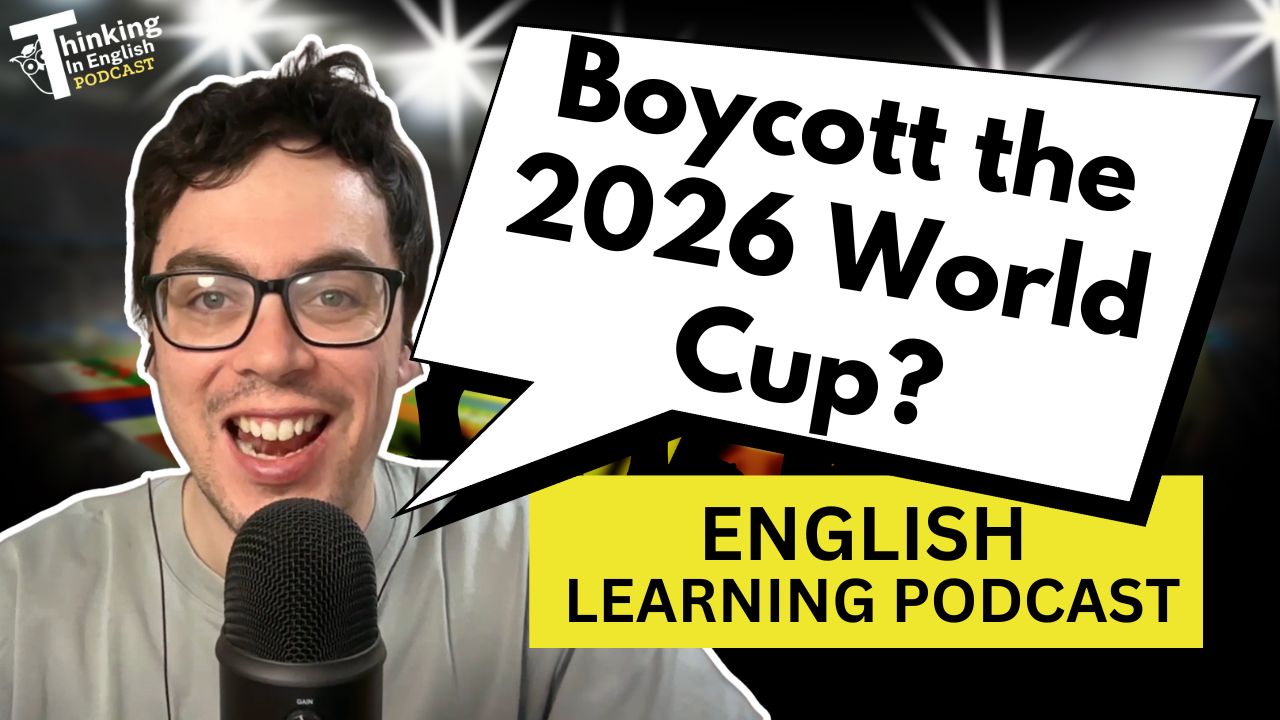
Four years ago, I made an episode titled “Should we boycott the Qatar World Cup?”
As you might remember, the tournament in Qatar was surrounded by criticism. There were concerns about human rights, especially the treatment of migrant workers who helped build the stadiums. There were some calls for fans, players, or countries to refuse to take part.
But despite all of that, the World Cup still went ahead. Millions of people watched, and Argentina beat France in the final.
Now, four years later, I want to ask the same question again… Should we boycott the 2026 World Cup?
The 2026 FIFA World Cup will be hosted across United States, Canada, and Mexico. It will be the biggest World Cup in history, as there are more teams, more matches, and more fans than ever before.
But once again, there have been some people asking for a boycott. This time the boycott is connected to politics, immigration, and questions about safety and freedom for fans travelling to the United States.
Should we boycott the 2026 World Cup? And maybe even more importantly… do boycotts actually work?
Let’s think about these questions while practicing our English listening comprehension and practicing our vocabulary!
Listen Here!
 Apple Podcasts
 Spotify
 YouTube
Interactive Transcript!
You Can Now Read and Listen at the Same Time With an Interactive Transcript!

Vocabulary
- boycott (n/v): refusal to participate in something as a form of protest
- Many fans decided to boycott the tournament.
- protest (n/v): showing strong disagreement, often publicly
- Thousands of people protested outside the stadium.
- participation (n): involvement in an activity or event
- Player participation in the event was lower than expected.
- withdraw (v): to remove support or involvement
- The team chose to withdraw from the competition.
- policy (n): a plan or set of rules by a government or organization
- The new immigration policy caused controversy.
- restriction (n): a limit or control placed on something
- Travel restrictions affected many fans.
- awareness (n): knowledge or understanding of an issue
- The campaign raised awareness about human rights.
2026 World Cup
The 2026 World Cup will be hosted across three countries: the United States, Canada, and Mexico. This will be the first time in history that the World Cup is shared between three different countries (although Japan and Korea did host for to across two countries in 2002).
Also, for the first time ever, the tournament will include [00:04:00] 48 teams instead of the usual 32. That means there will be more matches and more opportunities for countries that might never have qualified in the past. For example, Uzbekistan, Jordan, Cape Verde, and Curacao will take part for the first time in their footballing histories.
It also means the tournament itself will be bigger. It will be bigger in every sense. There will be more games, and these games will be played across more cities, spread over the entirety of North America. If you want to watch your country play all of their games in person, you want to go travel to the stadiums, you may need to travel to three different countries.
For the World Cup hosts, the US, Mexico, and Canada, the tournament should bring in billions of dollars through tourism and new [00:05:00] infrastructure, new stadiums, and new roads.
But despite all of this excitement, not everyone is happy.


What is a Boycott?
Before we talk about why people may be unhappy and why people are calling for a boycott… what is a boycott?
Well, a boycott is when people refuse to participate in something and they do this as a form of protest. The idea is that by not taking part in something, or by withdrawing your support, you can put pressure on a company or a government to change their behavior.
It is a non-violent way of protesting. You are protesting through your actions, or I guess more specifically your lack of action. You are not doing something.
Imagine a company behaves unethically by damaging the environment or by treating their workers badly. A [00:06:00] boycott would mean choosing not to buy that company’s products. In the context of sport, a boycott could mean refusing to attend an event or not watching the event on TV, or even a country deciding not to send one of their teams to compete in a tournament.
There are a few key words that are really important to understand here.
A protest is when you show strong disagreement with something often publicly. Pressure is the goal of a boycott. The goal is to create pressure. Pressure makes things difficult, and that can encourage governments to change or encourage companies to change.
A boycott works by reducing participation. With fewer people participating, fewer people watching, fewer people attending, fewer people supporting something, that increases the pressure, again.
Withdraw means to remove your support, and ethical relates to [00:07:00] ideas about what is right and wrong. Most boycotts are based on ethical concerns.

Why Boycott the 2026 World Cup?
So, why are people calling for a boycott of the 2026 World Cup?
Unlike the situation in Qatar where the focus was mainly on labor rights, human rights, the concerns this time are a bit more political and connected especially to the United States.
One of the biggest issues is Donald Trump’s immigration policy.
In June last year, Donald Trump announced a travel ban that affected 19 countries. This partially or fully banned people from those countries entering the USA. Then earlier this year, 75 countries were affected by a different restriction. People from those 75 countries are currently not able to apply for immigrant [00:08:00] visas to the USA. I think they can still apply for travel visas, tourist visas, but not immigrant visas.
What does this mean for the World Cup?
Well, Trump’s government has said that footballers and coaches from banned countries should be allowed to enter the US for the World Cup. But it is very likely that fans or media or other people from restricted countries will not be able to enter the USA.
Fans from Haiti, Iran, the Ivory Coast, Senegal (these are all teams who have qualified for the World Cup but are in the 19 fully banned countries from the USA) they won’t be able to watch their team play in the US.
There are lots of other teams in the 75 restricted countries, like Ghana, Morocco, and Uruguay. The restriction [00:09:00] probably doesn’t apply to tourist visas, so fans should be okay but things could change.
Furthermore, the US now requires people from certain countries to pay a $15,000 thousand dollar bond before they can get a visa.
This is some money that you give to a US government. They keep it while you are on your travels. When you leave the country, you should be given the money back. It’s basically a way of ensuring that you leave.
So, it will be really expensive for people from countries like Algeria or Cape Verde to attend, because these are countries that have to pay $15,000 in a bond to get a tourist visa.
This might even affect players and coaches. I think it’s unlikely, but no one has mentioned this at the moment from what I can see. The US government has not announced if players and coaches will not need to use the $15,000 [00:10:00] bond system.
One of the best parts of the World Cup is seeing fans from all across the world. Fans travel to watch their teams play and support, and it gives such a great atmosphere in the stadium. But we might not be able to see as much of this in the games that take place in the USA.
I should mention that there is actually a fully confirmed boycott of the US World Cup. Well, it’s confirmed right now.
Iran, which I’m sure you all know is currently at war with the US and Israel, was one of the first countries to qualify for the World Cup. They have announced that they will boycott matches in the US due to the war, and FIFA have rejected Iran’s request to play all of their games in Mexico.
There are other reasons people discuss boycotting the US matches.
There are concerns about how protestors might be treated during the tournament. Will ICE, the US [00:11:00] Immigration taskforce, be present at the games? How will the US police treat visiting fans? Will fans feel welcome? Will they feel safe?
That said, it is really important to keep perspective.
At the moment, other than Iran, no major national teams or football federations have boycotted the tournament and they probably won’t ’cause it’s the World Cup. It’s the most important tournament.
On top of that, FIFA, the organization that runs the World Cup will not change their plans. FIFA have actually been very close to the USA in recent years. They’ve hosted tournaments in the USA. And in December, for some reason, I don’t know why, FIFA gave Donald Trump the first ever FIFA Peace Prize. Not sure why they gave him that prize, but they did.

Historic Sports Boycotts
If countries or fans do choose to boycott the World Cup, though, [00:12:00] it wouldn’t be the first time. It wouldn’t be the first time that a major sporting event has been boycotted.
Probably the most well-known example is the 1980 Moscow Olympics.
This boycott was led by Jimmy Carter, the president of the United States at the time. It was in response to the Soviet Union’s invasion of Afghanistan. More than 60 countries chose to not attend those Olympics.
Four years later, it was the 1984 Los Angeles Olympics, and there was another boycott. This time it was led by the Soviet Union and their allies. They refused to participate in the games hosted in the United States.
A less known example of a boycott came during the 1976 Montreal Olympics. More than 20 African nations boycotted the games in protest against New Zealand. New [00:13:00] Zealand had strong sporting connections with South Africa and South Africa was supposed to be banned from all international competitions.
South Africa had been internationally isolated because it had a system of racial segregation known as apartheid. Many countries believe that allowing sporting contact or links with South Africa was supporting their racist government system. New Zealand’s rugby team, the All Blacks, maybe the most famous rugby team in the world, still chose to play matches in South Africa.
So when New Zealand was allowed to compete in the Montreal Olympics, a group of African countries chose to withdraw completely.
South Africa itself was banned from the Olympics for decades. They were banned because of apartheid, and they only returned [00:14:00] in the early 1990s when the system had ended.
More recently, there was a slightly different type of boycott during the 2022 Beijing Winter Olympics. Several countries announced what’s called a diplomatic boycott. This meant that government officials did not go to China, did not attend the Olympic games, as a form of protest against China, but athletes were still allowed to participate.

Do Boycotts Work?
So did these boycotts work? Do boycotts actually work?
The answer really depends on what you expect them to achieve. What is your goal? What’s your expectation?
Boycotts can be quite good at raising awareness and bringing attention to an issue. They can also apply some pressure if countries or individuals or organizations choose to not participate in an event. [00:15:00] That can be powerful. It can highlight some of the problems or issues that the boycott is aiming to remove or raise awareness for.
And even if the boycott doesn’t lead to change, it does send a message. It’s a way of saying, “I don’t agree with this” or “We don’t agree with this.”
But there are many arguments against boycotts, or maybe more specifically against the effectiveness of boycots.
They often have no real impact. No real world impact. Governments and large organizations tend not to respond to pressure, especially if it’s relatively small scale pressure.
Boycotts also end up punishing the wrong people a lot of the time. In sports, it’s usually the athletes who would suffer the most. They train for years, sometimes their entire lives, for the chance to compete on the world stage, whether it’s the Olympics or the World Cup, [00:16:00] but they would lose that opportunity because of politics. And politics and sports are supposed to be different realms.

So Should We Boycott
What does this mean for the 2026 World Cup?
Well, even if some countries or fans decide to boycott the tournament, it’s very unlikely that FIFA would change its plans. Similarly, it’s hard to imagine that the US government would change their policies as a result of a sporting boycott.
And most of us, most fans, would probably still watch the tournament anyway. The World Cup is one of the biggest global events and its popularity makes it really difficult to disrupt.
I personally disagree with a lot of the US government’s actions and policies, and I think it’s unfair that fans from lots of countries, especially parts of Africa and South America, will not be able to attend games.
But I will still watch the World [00:17:00] Cup, especially, I’ll watch England’s games. I will watch England lose in the quarterfinals like they always do.
But that doesn’t mean the idea of a boycott has no value. The fact that fans of some teams will not be able to attend matches and that the US is hosting an international tournament during a period of incredible anti-international feeling in the USA is an issue.
So while people might not actually boycott any games, simply talking about these issues could be important.

Final Thought
Should we boycott the 2026 World Cup? Well, the tournament will be bigger than ever. It will be hosted across the United States, Canada, and Mexico, and it is controversial.
Boycotts could raise awareness, they could send a powerful message. It probably won’t [00:18:00] lead to real change. And in sports, they often affect players and fans more than governments or organizations like FIFA.
And FIFA don’t necessarily have the best track record in choosing World Cup hosts based on human rights. So I think it’s unlikely that a boycott is going to make any difference.
And I’m not really in favor of boycotting a tournament like the World Cup, because I think the World Cup is a great tool to show the power of diversity and the power of different cultures. And it’s just an opportunity to demonstrate people getting along and people supporting their countries on the international stage, on the biggest stage.
But what do you think? Do you think people should boycott the World Cup? Or are you against the boycott? Do you think boycotts could make any difference? Is there a better way to respond?
Extended Vocabulary List
Become a Patreon Subscriber to Access the Extended Vocabulary List!


Vocabulary Games and Activities!
Learn and practice vocabulary from this Thinking in English episode.
Practice using 5 different study games and activities – including writing, listening, and memorisation techniques!
Flashcards
Matching Game
Learning Game
Test Yourself
Listening and Spelling
Do you want to Think in English?
I’m so excited that you found my blog and podcast!! If you don’t want to miss an article or an episode, you can subscribe to my page!
