

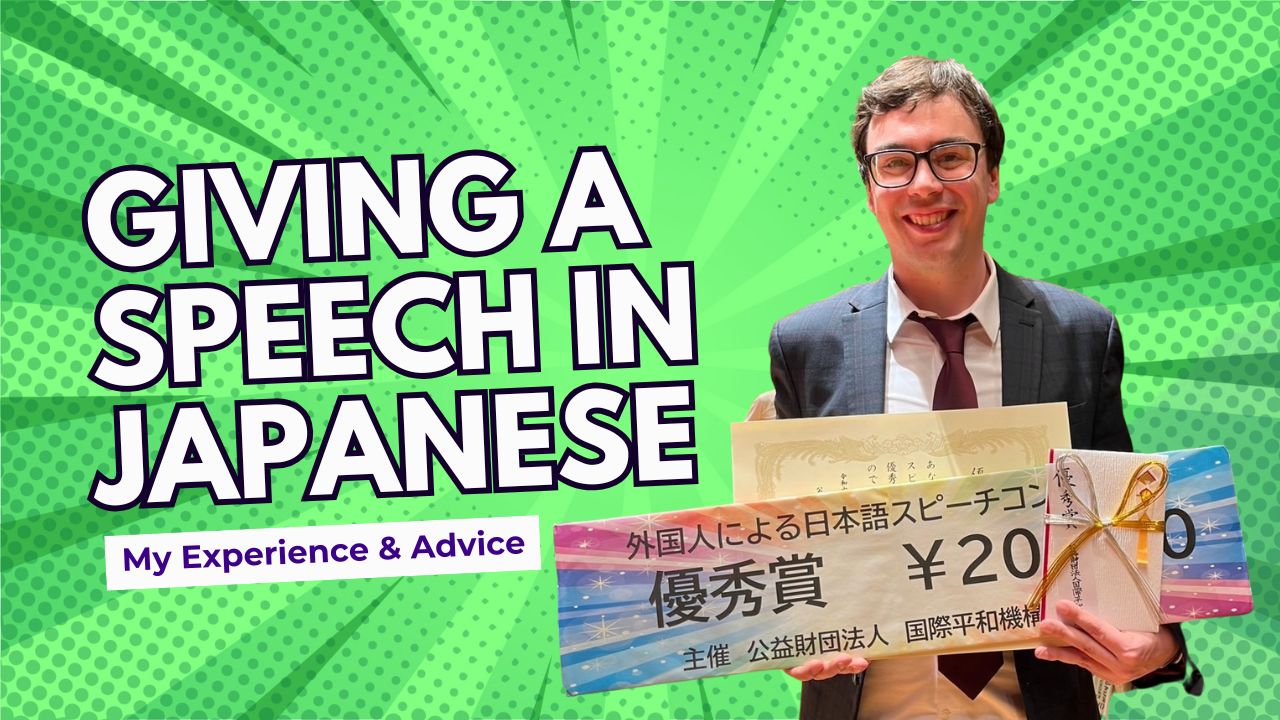
In December I competed in a Japanese language speech contest in Fukushima Japan, and I came second. I have since been given access to the full recording… so I thought I would share it with you!
I have translated and captioned the speech so you can all follow along. The below video contains an introduction from me, my speech contest introductory video, my speech, and then some analysis.
I hope you enjoy!
Full Video
 YouTube
Transcripts (Japanese and English)
I’ll also attach a full transcript of my YouTube video and (if you are interested) a copy of my Japanese speech transcript!
Full YouTube Video Transcript
[00:00:00] In December, I competed in a Japanese language speech contest. And I came second! It was an amazing experience. I was able to meet lots of interesting people, practice writing and delivering a speech in front of a crowd
And also just demonstrate to myself that my studying Japanese was worthwhile.
Over the past few weeks I’ve had lots of messages from Thinking in English podcast listeners curious about hearing my speech.
They want to listen to me speak in Japanese.
And now I can finally release the video. I’ve been given access to a high quality recording.
I’ve edited it. I’ve transcribed it. I have translated it into English, the subtitles, so you can follow along while I’m giving my speech in Japanese.
I hope you enjoy listening. Hopefully, it gives you some motivation to improve your own [00:01:00] public speaking.
After you’ve watched the video, I’ll come back and I’ll give you a few tips and a piece of advice on how to improve your English speaking as well. Here is the video.
My name is Thomas Wilkinson. I am 29 years old from England.
Last year, I moved to Aizuwakimatsu with my Japanese wife.
I enjoy my life in Fukushima very much. The scenery is beautiful, there are many delicious foods, and I am very interested in the history of this area.
I run a podcast called Thinking in English which has listeners from all over the world.
I usually edit episodes at local cafés, so if you see me, please say hello! [00:02:00]
Number 10, Thomas Wilkinson.
Hello, everyone. My name is Thomas Wilkinson. I’m from the UK. The title of this speech is One Step as a Volunteer Guide.
Last year, after I married my wife, I moved to Aizuwakamatsu City.
For the past year, I have been studying the history of this area. While I’ve lived in other parts of Japan, I feel the history and culture here is particularly [00:03:00] interesting. There are numerous historical sites in Aizuwakamatsu. Tsuruga castle is especially popular with tourists.
I am fascinated by the connection between Tsuruga Castle and the Boshin War. I often imagine what kind of feelings the samurai and their leaders experienced, stuck in the castle surrounded by the government’s army.
However, I wanted to know more.
While it was fun to go to museums and castles, I wanted a deeper understanding of local history. So, last year I joined a “Volunteer Guide Training [00:04:00] Programme”
The programme gathers people who are passionate about local history and want to communicate this with foreign visitors. This year we visited Tadami town. Tadami is a tiny town in the mountains of Fukushima, known for its beautiful railroad and snow.
Actually, Tadami was the location of a popular Taiwanese movie this year.
The aim of the programme is to learn how to introduce the landmarks of Tadami machi. I plan to continue studying the history of Aizu and Fukushima and want to introduce this region to people around the world. Thank [00:05:00] you.
So that was my Japanese speech.
the speech that came second in the Fukushima Prefecture Japanese speech contest.
There were about 14 people competing in three different categories and then an overall competition as well.
I came second overall. I won the adult who had lived in Japan for more than two years category.
Slightly long winded, confusing title, but that’s the one I competed in. And I was also given an award by local high school students. who enjoyed my speech the most, which I’m really proud about.
I was so happy with my results, so happy with my performance, and I just really enjoyed the entire experience of competing in a speech contest.
It’s not my first time to do a speech contest. [00:06:00] Eight years ago. And seven years ago, I competed in a Japanese speech contest in Ehime Prefecture in the south of Japan. at that time, I was a beginner. I was not a proficient Japanese speaker. I was barely conversational.
I released an episode of the Thinking in English podcast. in December called How to Give a Speech in English, which I recommend to you all to go and listen to.
I go into detail about my preparation, my actions before the speech, how I wrote the speech, and I give lots of great tips and advice.
So I really recommend you going over to Spotify or YouTube or wherever you listen to podcasts and checking out that episode.
However, just to end this quick video, I thought I’d leave you with some tips and some advice as well.
You saw the video of me speaking in front of an audience and you heard my voice.
Even if you [00:07:00] didn’t fully understand the words, hopefully you followed along with English, you could see that I was confident giving my speech.
I’ll let you into a secret if you don’t speak Japanese. I made a few mistakes. It was not a perfect speech at all.
But you did not see me panic.
You didn’t see me stop. You didn’t see me stutter.
I just carried on through the speech with a smile on my face and trying to deliver it as confidently as possible.
A few weeks before doing that speech, I actually practiced in a local Japanese class, I guess. It was a kind of practice speech contest.
And during that speech contest, I was so nervous. I hadn’t practiced enough.
I’ve lost the recording of the video unfortunately. But if you saw me speaking, you would notice one thing in particular.
My eyes going [00:08:00] into the back of my head. I was constantly looking up, trying to remember my words, or looking off to the side, trying to remember what I’m saying.
In my main speech contest performance, I was looking out at the crowd, speaking confidently, speaking clearly, and speaking powerfully. Even if I was wrong.
And that confidence came from repeated practice. By the time I got on the stage, I knew how to deliver my speech off by heart.
I didn’t need to think about my speech. As soon as the words came out of my mouth, I could do it.
And that’s what I think is an important lesson. Preparation is incredibly important.
The more you prepare, the better you understand your speech, or your presentation, or your PowerPoint. The more confident you become.
you will be, [00:09:00] and the more successful you will be as well.
If you’d like to hear more tips and advice about giving speeches in public, I recommend checking out my Thinking in English podcast episodes on the topic.
Thank you for watching this video and I’ll see you all next time. Goodbye.
Full Japanese Speech Transcript
皆さん、こんにちは。
私はトーマスウィークンソンと申します。 イギリス出身です。
このスピーチのタイトルはボランティアガイドとしての一方です。 よろしくお願いします。
去年妻と結婚した後、会津若松市に引っ越しました。 この一年間、この地域の歴史について深く学ぼうとしてきました。
過去に日本の他の街に住んだことがありますが、 福島県の歴史と文化は特に興味深いと感じています。
会津若松には有名な観光名所がいくつかあります。 例えば、鶴ヶ城は観光客に特に人気のスポットです。
私は鶴ヶ城の戊辰戦争とのつながりに魅了されます。 新政府軍にほいされたお城の中で、侍や大名たちがどのような想いを抱いていたのかをよく想像します。
しかし私はもっと知りたくなりました。
博物館、お城、飯盛山などを見に行くのが楽しかったものの、私は会津について更に深い知識を得たいと思いました。
そこで去年、会津若松市国際協会が募集していたボランティア外検診プログラムに参加しました。
このプログラムは、福島県の歴史に情熱を持ち、この知識を観光客に伝えたい人々が集めました。
今年私たちは只見町にお訪れました。 只見は福島の山中にある小さい町で、美しい鉄道や雪でも有です。
実は、今年公開された人気の台湾映画の舞台の一つでもあります。
私たちのガイド研修プログラムは、只見町や鉄道を紹介できるようになることを目的としていました。
これからも私は会津の歴史と福島の歴史を学び続け、この地域を世界中の人々に紹介していきたいと思っています。
スピーチありがとうございました。
Podcast Episode
I also released a podcast episode in December discussing my preparation for the speech contest in detail – I’d recommend listening!


