

When people think of the United Kingdom, they often think of England. Maybe, on a rare occasion, they might also think of Scotland. But the United Kingdom is made up of four historic countries, including the proud nation of Wales.
Wales is a small country with a big identity. It has its own language, culture, and its own parliament. Yet many people around the world know surprisingly little about it.
In today’s episode, we’re going to explore what Wales really is. We’ll discuss its geography, history, language, and culture.
Along the way, I’ll try to emphasise what makes Wales unique within the United Kingdom and introduce you to some new and useful English vocabulary!
Listen Here!
 Apple Podcasts
 Spotify
 YouTube
Interactive Transcript!
You Can Now Read and Listen at the Same Time With an Interactive Transcript!

Vocabulary
- sovereign state (n): A country that has full control over its government and laws.
- Japan is a sovereign state because it makes its own rules.
- geographical (adj): Related to the physical features or location of a place.
- Wales has many mountains and rivers, which are important geographical features.
- Celtic (adj): Related to the ancient people of Europe called Celts, or their languages and culture.
- Irish and Scottish Gaelic are Celtic languages.
- kingdoms (n): Countries or regions ruled by a king or queen.
- In the past, Wales had many small kingdoms.
- industries (n): Businesses and factories that make goods or provide services.
- Coal and iron were important industries in 19th-century Wales.
- self-government (n): The power to make decisions and run local affairs independently.
- Wales has self-government for education and health.
- nation (n): A group of people with a shared identity, culture, and history.
- Wales is a nation with its own language and traditions.
What is Wales?
I want to start by talking about the geography of Wales. Its location.
But to do that, I should probably define a few important terms: the United Kingdom, Great Britain, and the British Isles. These terms are often used interchangeably, but they are different.
The United Kingdom, or UK, is a country made up of four nations: England, Scotland, Wales, and Northern Ireland. It’s a sovereign state with one central government in London. Although Scotland, Wales, and Northern Ireland do have their own local parliaments or assemblies.
Great Britain is the name of the largest island in the British Isles. It does not include Northern Ireland. [00:04:00] It’s a geographical term, not a political one.
And the British Isles is a geographical term for the group of islands that includes Great Britain, Ireland (so both Northern Ireland and the Republic of Ireland) and over 6,000 smaller surrounding islands.
Be careful though, as the “British Isles” is controversial in Ireland because British implies UK ownership. So now we understand that a little better.


Where is Wales?
Wales is located in the west of Great Britain. It shares a long border with England to the east and is surrounded by the Irish Sea and the Bristol Channel on the other sides.
It’s a relatively small country, about the same size as New Jersey in the United States, but it’s full of dramatic [00:05:00] landscapes. Wales is famous for its mountains, valleys, and long, beautiful coastlines. Around a quarter of the country is protected as national parks.
The capital city is Cardiff, which is a modern, lively place known for its castle and Rugby stadium. Other important cities include Swansea and Newport, while Snowdonia National Park in the north is home to Mount Snowden, the highest mountain in Wales.
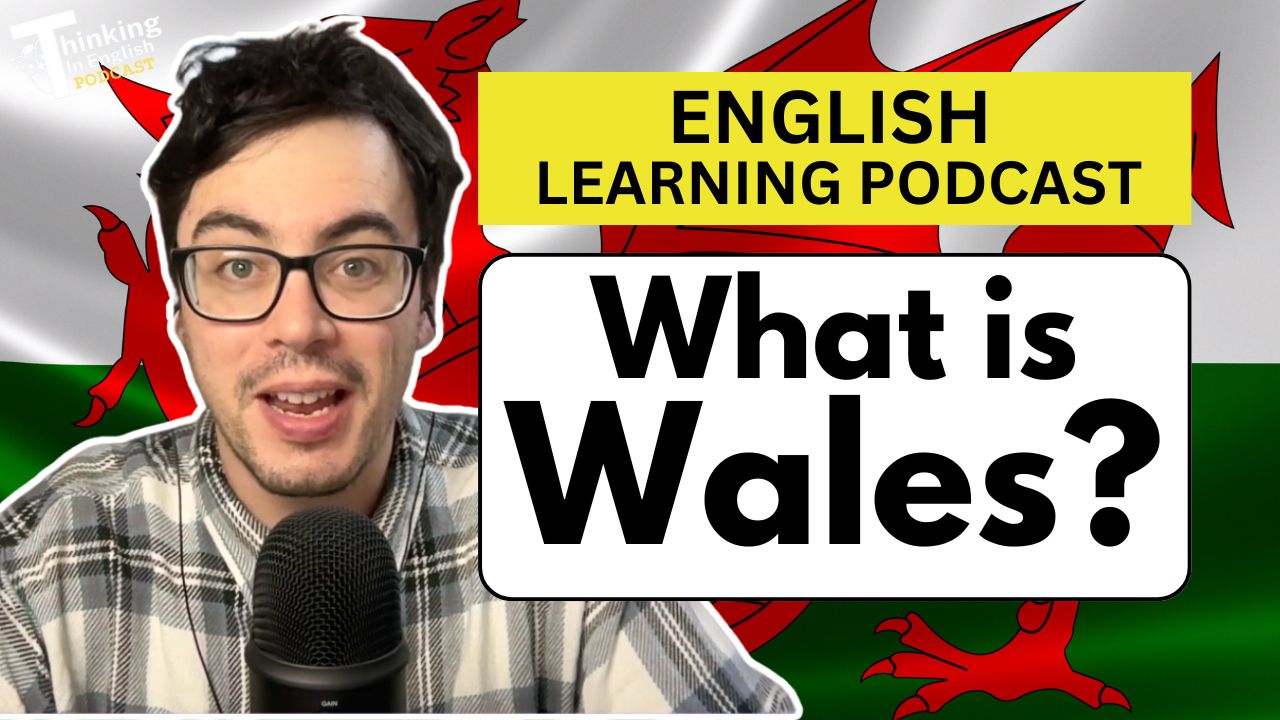
Wales also has some distinctive national symbols. The flag features a red dragon, one of the most unique flags in the world. And the country is also associated with daffodils, a type of flower, and leeks, a type of vegetable.
Also, importantly, the adjective for people or things from Wales is Welsh, and you’ll hear [00:06:00] me use this word a lot during the episode.

A Brief History of Wales
Wales has been home to humans for tens of thousands of years. Over time, Celtic tribes known as the Brythonic people arrived and became the ancestors of the modern Welsh.
In 43 CE, the Romans began their invasion of Britain. Despite strong resistance from the tribes of Wales, the Romans eventually established control. They founded towns in Wales including Caerleon and Caernarfon. The Romans introduced roads and forts and Christianity to the region, although Wales experienced less romanization compared to areas like southern England.
After the Romans left Britain around 410 CE, Wales entered a period of political chaos. Small kingdoms began to emerge, each ruled by local [00:07:00] kings. Among the most important were Gwynedd, Powys, Dyfed, and Gwent.
At the same time, tribes from Europe were settling in England. These tribes included the Angles and the Saxons. England became increasingly Anglo-Saxon and Germanic, and obviously very different from the Celtic peoples living in Wales.
The word Wales actually comes from the Anglo-Saxon term “Wealas”, meaning “foreigners“. In contrast, the Welsh called their country Cymru, meaning “fellow countrymen”.
By the ninth century, several Welsh kingdoms began to unite under powerful leaders. Rhodri Mawr, known as Rhodri the Great, brought together much of Northern and Western Wales. Later Hywel Dda, or Hywel the Good, became famous for creating a [00:08:00] legal system unique to Wales.
After the conquest of England in 1060 by the Normans, from Normandy in France, Norman Lords began pushing into Wales.
They built impressive castles such as Chepstow and Pembroke to secure their control. Despite their power, Welsh kingdoms continued to resist maintaining their culture and their independence whenever possible.
In the 13th century, leaders like Llywelyn the Great and his grandson, Llywelyn the Last, who was one of the last Welsh Princes of Wales, tried to unite the kingdoms of Wales under a single ruler, but they faced growing pressure from the English.
The conflict between England and Wales reached its peak under Edward I. In 1282, Llywelyn the Last was killed, and Wales was conquered by the [00:09:00] English. Edward built a series of massive castles, including Conwy and Caernarfon, to secure his rule.
In 1284, Wales was officially brought under English law and government. This was effectively the end of Welsh political independence, though Welsh culture and identity endured.
Even after the English Conquest Wales did not accept foreign rule quietly.
In 1400, Owain Glyndŵr led a major revolt against English control. He declared himself Prince of Wales, and won several battles, inspiring hope for potential independence.
The rise of Tudor Kings in England brought Wales closer to England. Henry VII, the first Tudor King, had Welsh ancestry. The Tudors included Welsh nobles into English politics, giving [00:10:00] them some influence and strengthening the connections between the two nations.
Under King Henry VIII, Wales was formally united with England through the Laws in Wales Acts. These laws made English, the official language of government and law in Wales.
During the 18th and 19th centuries, Wales became an industrial powerhouse. The country is rich in coal, iron, and stone, and saw rapid growth in industries and urban areas. Towns like Cardiff, Swansea and Merthyr Tydfil expanded quickly.
Work in these industries was often harsh and dangerous, but brought economic development and changed the culture of Wales.
By the 20th century, traditional industries like coal mining and steel production began to decline. Many mines and factories closed, [00:11:00] leading to economic struggles, unemployment and migration from industrial towns.
In 1962, the Welsh Language Society was founded to campaign for the protection and promotion of Welsh. And the Welsh Language Act of 1993 gave Welsh official status in government and public services.
In 1997, a referendum allowed Wales to establish its own parliament, the Senedd, the Welsh Parliament.
Today, the Welsh government has powers over health, education, the environment, and other areas, giving Wales some self-government while remaining part of the United Kingdom.
This was just a very brief and quick history of Wales.
If you want to know more about Welsh history, I recommend checking out the YouTube channel Cambrian Chronicles. It’s a fascinating channel focused [00:12:00] on Welsh history, and I watch every video they release.

Welsh Language and Culture
One of the most fascinating things about Wales, in my opinion at least, is its language known as Cymraeg or Welsh.
Welsh is one of the oldest living languages in Europe. It comes from the ancient Celtic languages spoken across Britain, long before the Romans arrived.
While English developed from Germanic Roots, Welsh is Celtic. It has unique sounds and spellings that make it obviously different from English.
For example, words like Cymru (Wales), cariad (love), and diolch (thank you), show how different Welsh is from English. There are currently only six Celtic languages still spoken today.
Welsh is one of these languages and [00:13:00] closely related to Cornish (from Cornwall in England) and Breton (spoken in Britney, France). The other three languages are Irish, Manx (from the Isle of Man), and Scottish Gaelic, which are quite different from Welsh.
For centuries, Welsh was the main language of daily life across Wales, but after Wales was joined with England in the 1500s, English became the language of government, law and education.
By the 19th century, speaking Welsh was punished in some schools. Children were sometimes forced to wear a wooden token called a “Welsh Not” around their neck if they spoke their native language.
As a result, the number of native Welsh speakers fell dramatically.
However, in the 20th century, a major revival began. Campaigners fought to protect the language.[00:14:00]
Today, Welsh is an official language of Wales alongside English. Road signs, public documents and government websites are bilingual. There are Welsh language TV and radio stations such as S4C and BBC Radio Cymru, and many schools now teach lessons entirely in Welsh.
About 18% of Wales claims to be able to speak Welsh fluently, especially in the rural areas, while even more people in the country have some ability to communicate in Welsh.
Another powerful symbol of Welsh identity is their national flag. The flag features a red dragon on a green and white background. It is definitely one of the most recognizable and unusual flags in the world.
The Red Dragon has roots in Welsh mythology, and has been used as a national symbol for more than a [00:15:00] thousand years. According to legend, the Red Dragon represents the Welsh people.
Interestingly, the Welsh flag does not appear on the Union Flag, the flag of the United Kingdom.
This is because historically, Wales was considered part of the Kingdom of England when the United Kingdom was formed, rather than a separate nation like Scotland or Ireland. The union flag is a combination of flags from England, Scotland, and Ireland.
And of course, Wales has a deep tradition of myths and legends. You’ve probably heard of King Arthur, and other tales about dragons, magical lakes, and heroic warriors are very common in Welsh folklore.

Wales in the UK and the World
Wales is part of the United Kingdom, officially called the United Kingdom of Great Britain and Northern Ireland.
But what exactly is Wales? Is it a [00:16:00] country? A principality? A nation?
Well, the answer is a little complicated.
Legally, Wales is one of the four countries that make up the United Kingdom, alongside England, Scotland, and Northern Ireland. However, it is not an independent country. It doesn’t have full sovereignty or international recognition in its own right. The UK is the state, and Wales is one of its parts.
You might also hear Wales described as a principality, a place ruled by a prince. Historically, this was sometimes true. The Princes of Wales ruled independent Welsh kingdoms before being conquered by England in the 13th century.
Since then, the title Prince of Wales has usually been given to the heir to the British throne, [00:17:00] the next king. Currently, the Prince of Wales is Prince William, the son of King Charles.
But today, Wales isn’t governed as a principality. The term is mostly ceremonial and historical.
And then there’s the idea of nation. This is more cultural than political. A nation is a group of people connected by shared identity, things like language, history and culture.
In that sense, Wales is absolutely a nation. It has its own flag, language, and a deep sense of national pride. Even if it isn’t a sovereign state.
Politically, Wales has a devolved government, meaning that some powers have been transferred from the UK Parliament in London to Wales itself.
It has some self-government. The Welsh Parliament, called Senedd Cymru, was [00:18:00] created in 1999 and has authority over areas like health, education, the environment and transport. But important matters such as defense, foreign policy, and taxation are still controlled by the UK government.
Outside of the UK, Wales has also had an influence on the wider world through migration. In the 19th century, thousands of Welsh people emmigrated overseas to the United States, Canada, Australia, and even Argentina. In Patagonia, a remote region in the south of Argentina, Welsh settlers established communities and towns. Amazingly Welsh is still spoken in Argentina by a small community of people.
Culturally, Wales has punched well above its weight. It’s produced world famous actors like Anthony Hopkins and Catherine [00:19:00] Zeta-Jones, singers such as Tom Jones and Shirley Bassey, and writers like Dylan Thomas.
At the same time, Wales faces challenges. The independence movement has grown in recent years, especially following Brexit and Scotland’s push for more autonomy.
Economically, Wales remains less wealthy than many parts of England and rural areas often struggle with limited opportunities.

Final Thought
The title behind the episode is “What is Wales?” or something similar to that. The reason I was interested in recording the episode is because, while I’m sure many of you knew that Wales is part of the United Kingdom, exactly what Wales is can be a little confusing.
Legally, Wales is one of the four countries that make up the UK, alongside England, Scotland, and Northern Ireland. But it’s not an independent country: it doesn’t have full sovereignty or international recognition.
Historically, it was a series of different kingdoms and principalities, ruled by its own Princes of Wales and Kings before English conquest in the 13th century.
Culturally, Wales has its own language, flag, myths, and traditions.
Politically, Wales has control over its own health, education, environment, and transport policies, but defence, taxation, and foreign policy remain the responsibility of the UK government in London.
Hopefully, you have found this episode interesting. Wales has a fascinating and long history, far longer than the history of England or the United Kingdom as countries. And hopefully I have made some of you more curious to visit and think about Wales!
What do you think? Have you ever visited Wales? Would you want to visit?
Extended Vocabulary List
Become a Patreon Subscriber to Access the Extended Vocabulary List!

Vocabulary Games and Activities!
Learn and practice vocabulary from this Thinking in English episode.
Practice using 5 different study games and activities – including writing, listening, and memorisation techniques!
Flashcards
Matching Game
Learning Game
Test Yourself
Listening and Spelling
Do you want to Think in English?
I’m so excited that you found my blog and podcast!! If you don’t want to miss an article or an episode, you can subscribe to my page!
