

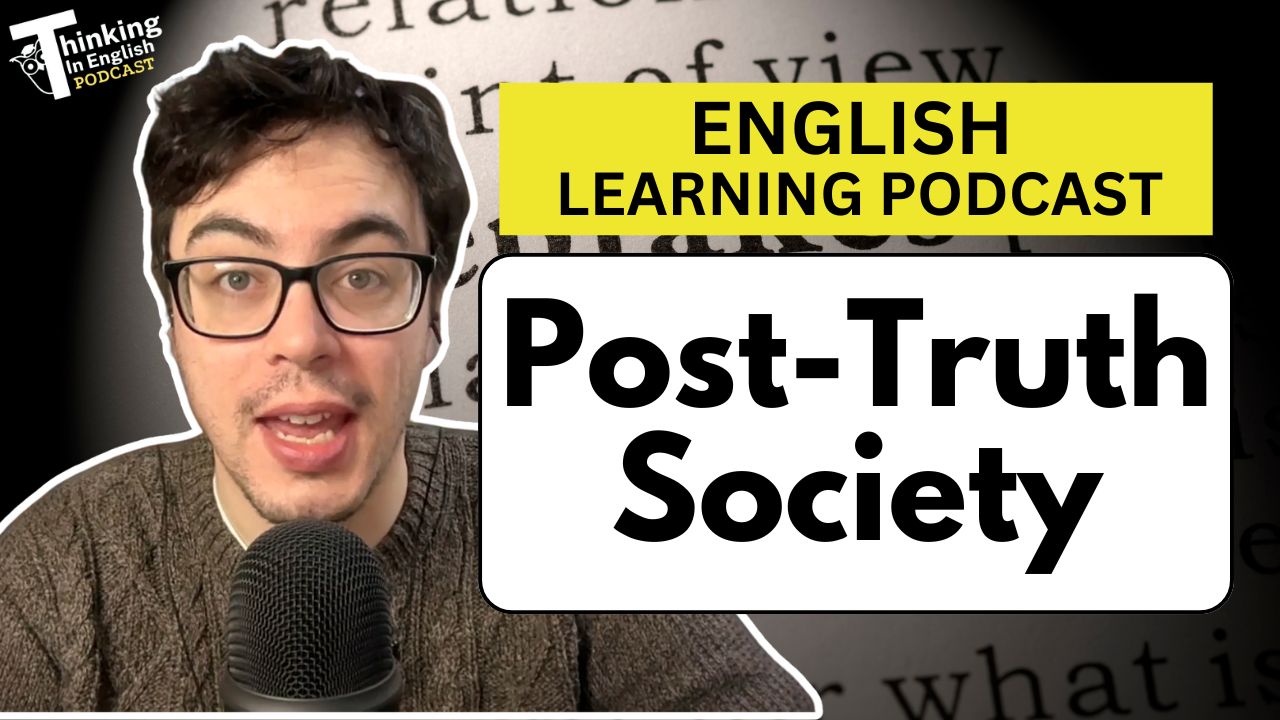
In a world of social media, fake news, and deepfakes… how can we know what’s true anymore?
The phrase “post-truth” has become one of the defining ideas of our time. Politicians lie without consequence, misinformation spreads faster than facts, and many people seem to trust their feelings more than solid evidence. As a result, truth itself seems less influential than emotion or personal belief.
In today’s episode, we’re going to explore what it means to live in a post-truth society…. a society where the line between fact and opinion is increasingly blurred, and where it can feel harder than ever to know what is real.
At the same time, I’ll introduce some new and useful vocabulary, and we will practice our English listening comprehension!
Listen Here!
 Apple Podcasts
 Spotify
 YouTube
Interactive Transcript!
You Can Now Read and Listen at the Same Time With an Interactive Transcript!

Vocabulary
- misinformation (n): False or incorrect information shared without checking accuracy.
- The rumour about the new law was actually misinformation.
- evidence (n): Facts or information that show something is true.
- The scientist presented strong evidence to support her claim.
- objective (adj): Based on facts, not feelings or personal opinions.
- Journalists should try to stay objective when reporting news.
- echo chamber (n): An online space where people only receive opinions they already agree with.
- Social media can trap users in an echo chamber.
- bias (n): An unfair preference for one side that affects judgement.
- The article showed clear political bias.
- fact-checking (n): The process of verifying whether information is true.
- Fact-checking is essential before sharing news online.
- media literacy (n): The ability to understand, evaluate, and question information in media.
- Schools now teach media literacy to help students spot false information.
What is “Post-Truth”?
What is the meaning of “post-truth“?
The term post-truth describes a situation in which objective facts and evidence become less influential in shaping public opinion than emotion, personal beliefs, and identity. In other words, in a post-truth world, what feels true becomes more important than what is true.
For example, a powerful emotional story can outweigh scientific data and people prioritize information that supports their existing worldview, even if that [00:04:00] information is incorrect.
This doesn’t mean we have no truth anymore. Facts still exist. Science still works. Evidence is still available. But truth has lost its central role in public debate.
It is competing against emotions and feelings and online information, and this information spreads faster and feels more satisfying than the truth.
The idea of post-truth became globally famous in 2016 when Oxford Dictionaries selected Post-Truth as the Word of the Year. The editors of the Oxford Dictionary noticed a dramatic increase in the use of the term, more than 2000% compared to the previous year.
Of course, lies and propaganda have existed for thousands of years. Ancient [00:05:00] leaders, medieval kings and 20th century dictators all used false information to influence people. But I think the current post-truth era is different for two reasons.
First, people now expect dishonesty. Many people, many citizens, assume politicians, influencers, or news sources will twist the truth, will be lying, will be dishonest.
They are not shocked by misinformation anymore.
Second, people care less about whether something is true. Because identity or emotion, maybe your personal values, have become more important than accuracy, the truth doesn’t always change minds. Fact checking doesn’t always change minds. You can show someone clear evidence and they may still prefer the [00:06:00] story that fits their feelings.


How Did We Get Here?
How did we find ourselves in this post-truth world?
The rise of a post-truth society didn’t happen suddenly. It came from technological changes, social changes, and political changes that have been building for decades.
One of the biggest transformations came with the rise of the internet and social media.
In the past, most people relied on a small number of trusted news sources: newspapers, television networks, or professional journalists. They checked information, edited articles, and tried to maintain certain standards of accuracy.
When the internet arrived, anyone could publish anything. Information started to spread instantly and globally without filters or fact [00:07:00] checking. This was empowering, but it also created a world where truthful, misleading, and completely false information existed side by side.
Social media platforms have made this problem worse. Their algorithms are designed to show users the posts most likely to attract their attention. Those posts are usually the ones that are emotional, surprising or controversial, not necessarily the ones that are true.
On top of this, personalized feeds like your TikTok feed or your Instagram feed, create echo chambers. Echo chambers are spaces where people mostly see content they already agree with. This reinforces pre-existing beliefs and makes it increasingly difficult for people to understand different perspectives.
At the same [00:08:00] time, trust in traditional institutions like governments, political parties, journalists, scientists, and universities has been declining for decades. Public scandals, corruption and bias have all contributed to this sense that the people in charge of our society are not always honest or reliable.
And when that trust collapses, people look for different sources of information. That might mean social media influencers. It could mean a charismatic political figure who sounds confident even when they’re not an expert. When people no longer know who to trust, they are more vulnerable to post-truth thinking.
Politics has also become more emotional. Many political movements now appeal directly to fear and [00:09:00] anger and frustration. Slogans like, Make Our Country Great Again or Take Back Control, are powerful, not because they’re factual, but because they speak to how people feel. They’re emotional.
Many people end up supporting ideas because they align with their identity or their group, not because they’re true or because they’re backed by evidence.
Modern media has played a role as well. News organizations are competing for views and money. And the pressure to get more views and earn more money encourages dramatic headlines and careless reporting.
Over time this has blurred the line between journalism, entertainment, and opinion. When everything looks like news, it becomes difficult to tell the difference between factual reporting, [00:10:00] political messaging, storytelling, and conspiracy theories.
And finally, psychology makes us vulnerable to a post-truth world. Humans naturally prefer simple explanation and ideas that agree with what we already believe. It’s natural.
The modern world is complex. Many global problems, climate change, immigration and economics, are complex as well. They’re difficult to understand.
So people turn to explanations that feel easier and satisfying. Even if they might oversimplify the truth.

Real Examples of Post-Truth Politics and Media
I’ve talked quite theoretically so far in this episode, so I guess we should look at some real examples of post-truth thinking.
One of the clearest examples comes from the 2016 Brexit Referendum in the United Kingdom. Throughout the campaign, voters were [00:11:00] repeatedly shown bold and dramatic claims. Many of which were either exaggerated or simply untrue.
The most famous example was the message printed on the side of a bright red bus, claiming that the UK sent £350 million a week to the European Union and that this money could be used instead to fund the National Health Service.
Economists and statistics experts repeatedly proved that the number was misleading and wrong, but the emotional impact of the claim had already taken hold. It didn’t matter that fact checkers disagreed. The slogan felt powerful. It promised control and financial security.
For many voters in the UK, the emotional appeal outweighed the actual truth.
We saw the [00:12:00] consequences of post-truth thinking again during the COVID-19 pandemic. Misinformation spread across the internet. False claims about vaccines, miracle cures, government conspiracies, and the origins of the virus circulated everywhere.
It was a struggle to know what to believe or who to believe. Even when official organizations provided evidence-based explanations, many people dismissed them, believing instead whatever aligned best with their fears or their political identity.
And now with the rapid growth of artificial intelligence, we face an even more complex challenge.
For example, deepfakes are videos or audio recordings or images that appear convincingly real, but are created by an AI. Political speeches, interviews, celebrity [00:13:00] statements, news footage. All of this can be created by AI in just seconds.
When anything can be faked, when anything can be made by a computer, people begin to doubt everything.

The Impact of a Post-Truth World
So what are the effects of living in a post-truth world?
One of the most serious effects is on democracy. In theory, democratic systems, democracy, depends on informed citizens. An informed citizen is a person who can evaluate evidence, compare arguments, and make choices based on facts or information.
But in a post-truth environment, voters are more likely to be influenced by emotion. This, in theory, will negatively affect democracy.
Education also has to adapt. In the [00:14:00] past, schools focused heavily on teaching information, dates, facts, and established knowledge. But students need new skills. How to evaluate sources. How to recognize bias. How to question what they read. How to distinguish evidence from opinion.
Critical thinking and media literacy is now essential. Without these skills, young people risk growing up, confused and unable to make sense of the world around them.
And the post-truth era affects our personal relationships. People increasingly associate with their own ideological group. Basically, they surround themselves with people who think like them, speak like them, and believe in similar things.
Families, friends and coworkers can find themselves in conflict [00:15:00] because they now live in different informational worlds. Every argument starts to feel like a threat to your own identity, to your own group. Conversations become more emotional and more defensive. And people start to believe that the other side is dangerous or immoral.
The result is a society that struggles to communicate.

Can We Fix It?
Can this be fixed? Is there a solution to the post-truth world?
One thing I think is really important is improving media literacy and critical thinking. If people learn how to evaluate sources, recognize bias and fact check information, they become less vulnerable to manipulation.
Schools and universities all have a role to play in teaching these skills.
In fact, I credit my [00:16:00] studies in History with building these skills while I was at university. My undergraduate degree, my history degree, was not really about learning specific dates and facts about history, but instead about reading reports, books, journal articles, and other sources, understanding the perspectives and biases of different historians and writers, and evaluating different arguments.
It taught me to be very critical and also that there is not just one true history and never one true story.
Another important tool is fact checking and verification. While technology can spread information, it can also help fight it when used responsibly.
Transparency is also essential. Transparency means that you can see inside something. For example, seeing inside [00:17:00] governments or companies.
In fact, governments, companies and other public figures must be held accountable for the accuracy of the information they share. When institutions are open and honest, it can help rebuild our trust and reduce the space for post-truth narratives.
And finally, there is a personal responsibility each of us carries. Before sharing a story or an article or a video, we can pause and ask ourselves…
Is this true? Where does it come from? Does it appeal to emotion more than evidence?

Final Thought
We may not be able to escape the post-truth world entirely, but I don’t think we are completely powerless [00:18:00] either.
I believe that facts still matter. Critical thinking still matters. And each of us can choose to slow down, question what we read, and look for reliable information. If we can strengthen our media literacy and become more aware of our own emotional reactions, then I think we can start to create a healthier and more informed society.
But I’d love to hear from you.
Do you think we live in a post-truth world. What sources of information do you trust the most? Have you ever believed something that later turned out to be false? And what skills do you think English learners need today to navigate misinformation?
Extended Vocabulary List
Become a Patreon Subscriber to Access the Extended Vocabulary List!


Vocabulary Games and Activities!
Learn and practice vocabulary from this Thinking in English episode.
Practice using 5 different study games and activities – including writing, listening, and memorisation techniques!
Flashcards
Matching Game
Learning Game
Test Yourself
Listening and Spelling
Do you want to Think in English?
I’m so excited that you found my blog and podcast!! If you don’t want to miss an article or an episode, you can subscribe to my page!
