

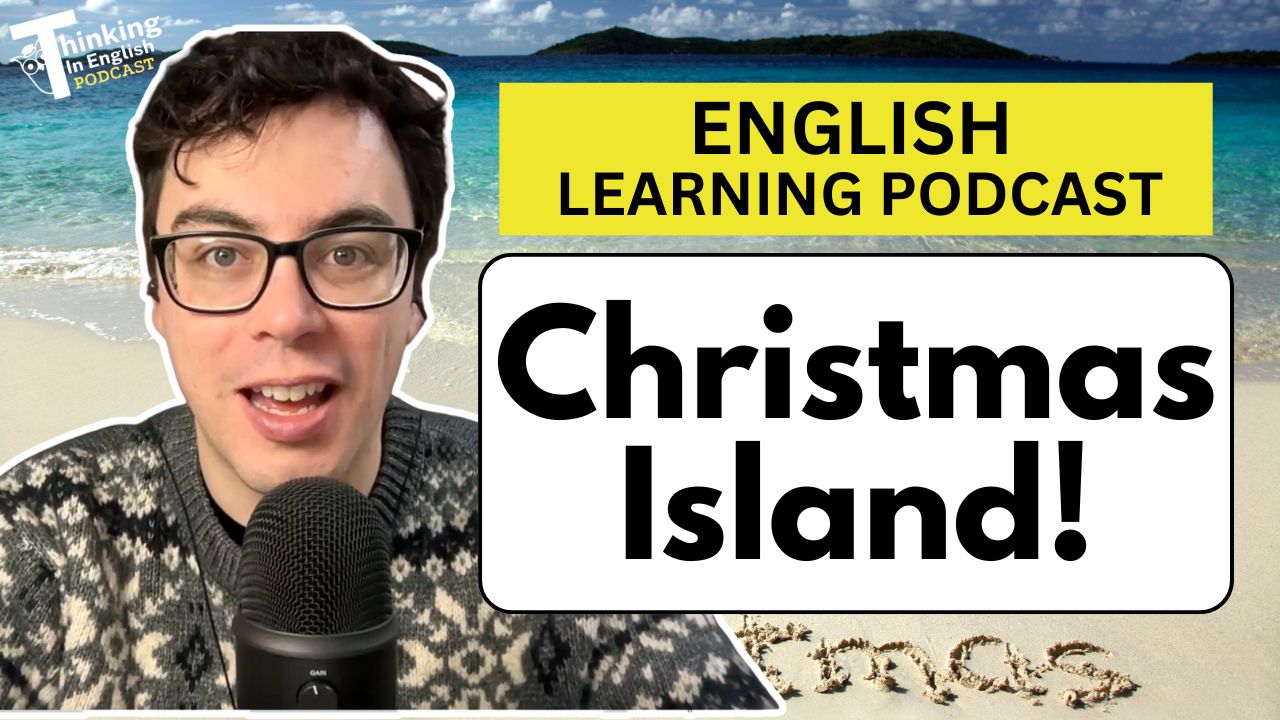
Welcome to a special Thinking in English Christmas episode!
Today’s lesson isn’t about Santa Claus, reindeer, Christmas trees, or anything you might normally expect at this time of year. Instead, I want to talk about a place that literally carries the name Christmas: Christmas Island.
Christmas Island sounds like a cheerful and festive place. Photos of the island show bright blue oceans, white beaches, tropical forests, and its famous red crabs that are often featured in nature documentaries.
But behind the beautiful scenery and joyful name lies a far more complicated, and often dark, history. Christmas Island has been home to exploited migrant workers, brutal colonial mining operations, Japanese wartime occupation, and, more recently, Australia’s controversial refugee detention centre.
So today, in this Christmas special, let’s explore why one of the world’s most festive-sounding islands has such a complex past, while learning some new English vocabulary!
Listen Here!
 Apple Podcasts
 Spotify
 YouTube
Interactive Transcript!
You Can Now Read and Listen at the Same Time With an Interactive Transcript!

Vocabulary
- Remote (adj): Far away from cities or other populated areas.
- The scientists set up a research station on a remote island in the Pacific Ocean.
- Migrant worker (n): A person who moves to work in a different area or country.
- Many migrant workers travel seasonally to pick crops in different regions.
- Phosphate (n): A mineral used in fertilisers for agriculture.
- Farmers rely on phosphate to keep their soil fertile and improve crop yields.
- Repatriate (v): Send someone back to their home country.
- After the war, the government decided to repatriate all foreign workers.
- Asylum-seeker (n): A person requesting protection in another country.
- The asylum-seeker waited for months while their application was processed.
- Territory (n): Land under the control of a country but not part of its main regions.
- Christmas Island is an Australian territory in the Indian Ocean.
What is Christmas Island?
Before we get into the historical and slightly more controversial issues with Christmas Island, I think it is important to give you all some context.
Actually, it is far closer to Indonesia [00:04:00] than to the Australian continent.
Today most of the island is protected as national parkland and covered in rainforest. Although geographically distant from Australia, Christmas Island has been an external territory of Australia since 1958. This means it is governed under Australian law, but it is not physically part of any Australian state.
It is also important to note that there is another Christmas Island. The other Christmas Island is located in the tiny Pacific nation of Kiribati. That island was named by Captain James Cook, and the two are often confused despite being thousands of kilometers apart in different oceans.
Christmas Island has a warm tropical climate all year round with a wet season and a dry season.
The island is [00:05:00] especially famous for its annual red crab migration. You might have seen this on the internet or on nature documentaries. The red crab migration is when tens of millions, really millions, of bright red crabs march from the rainforest into the ocean.
Beyond the crabs, the island is rich in wildlife, coral reefs, and rainforests.
Today, Christmas Island has a population of roughly 2000 people. Most residents are descendants of Chinese or Malay or Singaporean workers who were originally brought to the island for mining.


Early Discovery and Naming of Christmas Island
You might be thinking right now,
“Why is this remote island in the Indian Ocean named after the Christmas holiday?”
The answer to this question goes back to the discovery of the island by [00:06:00] European sailors. The first recorded European sighting of Christmas Island occurred in 1615 when a British ship passed by the remote uninhabited island. Uninhabited means that at the time no one was living there.
Although it may have been discovered earlier by people from the Indonesian islands, perhaps.
For decades, the island remained unvisited and uninhabited. But in 1643, Captain William Mynors of the British East India Company landed his ship there, on December 25th. In honor of that date, the 25th of December, he named it Christmas Island.
As I mentioned earlier, the island is often confused with another place of the same name. In 1777, so over a hundred years [00:07:00] later, Captain James Cook, famous for being the first British man to visit Australia also named an island Christmas Island, after he arrived there on Christmas Eve.
That island is now part of Kiribati in the Pacific Ocean and is completely different from the Australian Christmas Island.

Colonial Exploitation: Phosphate & Labour
For most of the 18th and 19th centuries, Christmas Island was still an uninhabited island far from anywhere else. But, deep beneath the forests where its famous red crabs live, the British discovered enormous deposits of something called phosphate. Phosphate is a very valuable mineral, which is used to make fertilizer.
Fertilizers are used by farmers to improve the growth of their crops. And in the 19th century, especially the late 19th century, when the world’s [00:08:00] population was growing rapidly and there was so much new technology revolutionizing farming, the global demand for phosphate soared.
The discovery of phosphate on Christmas Island transformed the island into an economic resource. By the late 1800s, the Christmas Island Phosphate Company had begun large scale mining operations.
As there was no one living on the island, they had to bring in workers. The Christmas Island Phosphate Company imported thousands of laborers. Most of these laborers were Chinese men, given the name Coolies. This name reflected their low status and harsh working conditions, and I think originated from Singapore.
One businessman Ong Sam Leong from Singapore built a powerful and exploitative [00:09:00] system around the Chinese labor force. In 1899, he secured a contract with the Christmas Island Phosphate Company to supply mining workers to the island.
His company had a monopoly over the workers and over the island. Basically, he controlled everything.
First, he supplied the workers. He took workers, often from Singapore, and moved them into the island.
He then started to sell opium and opened brothels and gambling dens on Christmas Island. This meant that when the men were paid for their mining work, they would basically be giving back their money to Ong Sam Leong’s companies, either by buying opium from him or using his brothels and gambling dents.
The laborers also worked long hours in dangerous conditions. There were frequent [00:10:00] accidents and no medical care. There were no hospitals or doctors on the island. These conditions had deadly consequences.
In 1901, there was an outbreak of a disease linked to malnutrition and vitamin deficiency. In fact, it killed more than a quarter of the island’s population.

Japanese Occupation
Christmas Island was drawn into global conflict during World War II.
Although the Japanese rule on Christmas island was harsh, it was not as deadly as many other occupations in Southeast Asia. There were beatings and intimidation, and women were forced back into the island’s brothel system, but large scale executions and mass starvation did not occur.
When the war ended in 1945, Christmas [00:11:00] Island returned to British control.

Becoming Australian
Then in 1948, the Australian and New Zealand governments purchased Christmas Islands’ phosphate mines and industries from the British. This gave Australia a growing economic stake, an economic interest, in the territory.
A decade later, in 1958, Christmas Island officially became an external territory of Australia.
This transition was not smooth for the island’s residents. Many long-term inhabitants, often the descendants of the original Chinese and Malay laborers, were forcibly repatriated, forcibly deported, to Singapore or Malaysia or China.
They were deported, they were repatriated, even if they considered Christmas Island to be their home. Only in the [00:12:00] 1970s did Australia introduce a scheme that allowed some residents more control over where they lived and their futures.
Throughout this period, phosphate mining continued to dominate the island’s economy, but by the 1990s the deposits of phosphate were largely exhausted, largely used up, and the mining operations were wound down.
The population also stabilized at around 2000 people, mostly living in small towns or villages across the island.

Immigration Detention and Asylum Seekers
The end of mining on Christmas Island did not mean the end of Australia’s interest in the territory though. Instead, they came up with another use of Christmas Island… as a immigration detention facility.
From 2001 onward, the island was used as a remote detention center for [00:13:00] asylum seekers arriving to Australia by boat. If you arrived anywhere in Australia by boat with the intention of being a refugee or claiming asylum, Australia would send you to a remote island to be processed.
They would not process your claim on the mainland. This was part of a government strategy to discourage illegal immigration, to discourage illegal arrivals by boat.
In fact, in addition to Christmas Island, they also used Nauru, which is a tiny country in the Pacific Ocean, which held asylum seekers to prevent them entering Australia and also Manus Island in Papua New Guinea.
At its peak, nearly 3000 irregular maritime arrivals were held on Christmas Island, often in difficult conditions. In fact, [00:14:00] sometimes tensions erupted. In 2011, detainees set fire to an accommodation block, and in 2014 hundreds of people went on hunger strike to protest their treatment.
The detention center was officially closed in 2018, though it remains ready to be reopened if needed.
The island actually made international headlines again in 2020, during the Coronavirus outbreak. Australia offered to quarantine citizens returning from China on Christmas Island.

Christmas Island Today
Today, Christmas Island is a largely peaceful place. It’s also often featured in documentaries for its unique natural environment. It has tropical rainforests, coral reefs, and also that famous red crab migration.
You really have to go check out a video of the thousands, millions, of crabs walking through the [00:15:00] streets of Christmas Island. These things attract many visitors interested in wildlife and diving.
The population is still very small. Around 2000 residents with a multicultural mix of Chinese and Malay and European heritage.
And although the detention center has been closed since 2018, it remains ready to reopen if Australia needs to or wants to accommodate asylum seekers or other arrivals on a distant island.

Final Thought
Christmas Island is a tropical paradise with a history of colonial exploitation, forced labor, wartime occupation, and a controversial refugee detention program. Hopefully you’ve learned something new and found this episode interesting.
[00:16:00] Rather than a traditional Christmas special episode, I thought it would be more interesting to discuss a topic loosely connected to Christmas, but with a fascinating historical and political story.
But what do you think? Had you heard of Christmas Island before this episode? Should remote islands ever be used for quarantine or detention? How do we reconcile a place’s natural beauty with its troubled history?
Extended Vocabulary List
Become a Patreon Subscriber to Access the Extended Vocabulary List!

Vocabulary Games and Activities!
Learn and practice vocabulary from this Thinking in English episode.
Practice using 5 different study games and activities – including writing, listening, and memorisation techniques!
Flashcards
Matching Game
Learning Game
Test Yourself
Listening and Spelling
Do you want to Think in English?
I’m so excited that you found my blog and podcast!! If you don’t want to miss an article or an episode, you can subscribe to my page!
