

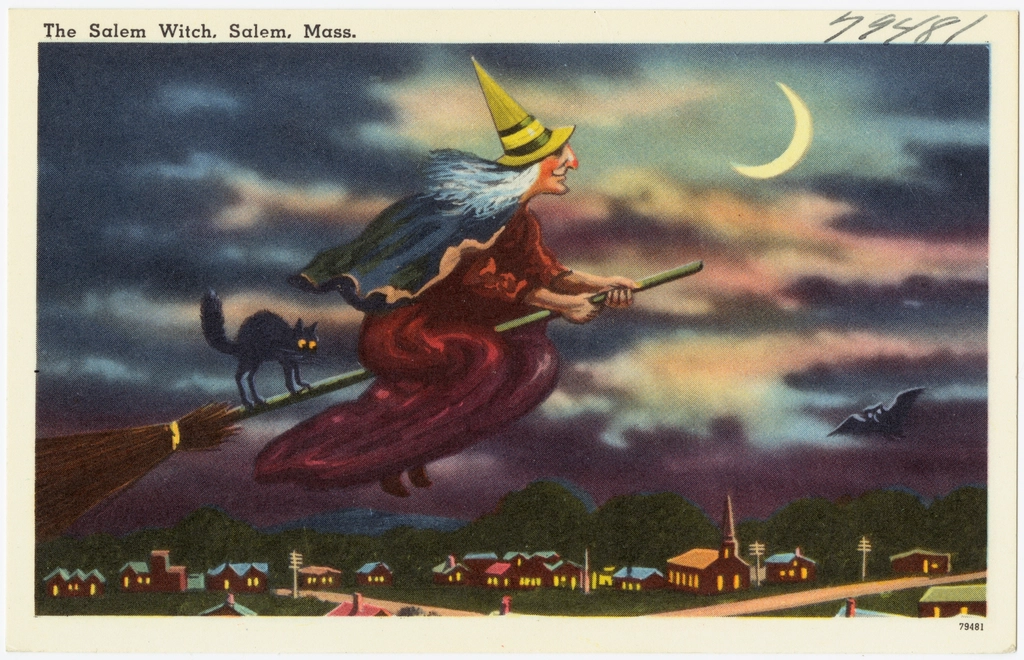
In 1692, the village of Salem in Massachusetts was the location of the infamous Salem witch trials. Hundreds of innocent people were accused of witchcraft and being witches. People were executed, tortured, and imprisoned.
In this Halloween special episode of Thinking in English, we are going to explore the history, causes, and legacy of the infamous witch hunt!
Listen Here!
 Apple Podcasts
 Spotify
 YouTube
Interactive Transcript!
You Can Now Read and Listen at the Same Time With an Interactive Transcript!

Vocabulary
- Infamous (Adjective): Well-known for a bad reason.
- The Salem Witch Trials are infamous for the wrongful persecution of innocent people.
- Witchcraft (Noun): The practice of magic or sorcery, especially for evil purposes.
- Many women were accused of practicing witchcraft during the trials.
- Accusation (Noun): A claim that someone is guilty of something.
- The accusation of witchcraft ruined reputations.
- Mass hysteria (Noun): Collective fear or panic spreading through a group of people.
- The fear of witches led to mass hysteria throughout the small town.
- Interrogation (Noun): The process of questioning someone intensely.
- The accused were subjected to harsh interrogation.
- Contort (Verb): To twist or bend something out of its normal shape.
- His face contorted with pain.
- Fair trial (Noun): A legal process that is impartial and just.
- Many historians argue that the accused were denied a fair trial during the witch trials.
Introduction
In January 1692, two young girls from the village of Salem in the colony of Massachusetts started to display some strange behaviour. They started to have “fits”. They were screaming, making strange sounds, and their bodies were contorting into unnatural shapes.
The father of one of the girls, the Reverend of the local church, took his daughter to a doctor who blamed the strange behaviour on the supernatural. After another girl in the village displayed similar symptoms, a court in Massachusetts blamed three women for cursing them or afflicting them with the illness.
These women were accused of witchcraft.
Between February 1692 and May 1693, over 200 people were accused of being witches in what became known as the Salem witch trials. Thirty people were found guilty of witchcraft and nineteen of these were executed by hanging. Another man died under torture before being found guilty, and at least five people died waiting for trial.
The Salem witch trials were one of the most infamous witch hunts in history and have had a lasting impact on North American culture. Today, let’s take a deeper look at witchcraft and witch hunts in this Halloween episode of Thinking in English!


Witches and Witch Trials
What is Witchcraft?
The fear of witches and witchcraft is common in many cultures around the world.
While definitions vary, a witch is traditionally believed to be a person, often a woman, who practices magic or sorcery. In many cultures, witches were thought to have powers that could harm others, such as causing illness, bad luck, or natural disasters.
Witchcraft refers to the use of magical practices or spells. It could include things like casting curses, making potions, fortune-telling, or controlling nature. While some cultures saw witches as healers or wise individuals, others associated them with evil and used witchcraft as a way to explain unexplainable events or crises.
European Witch Hunts
From the 1400s until the 1600s, Europe underwent periods of witch hunts and witch trials. Across Europe, the fear of witches grew rapidly. Witches were thought to be connected to the Devil and were working against Christianity.
Across regions including France, Germany, and Switzerland, hundreds of thousands of people (often women) were accused of being witches and practicing witchcraft. Between 40,000 and 60,000 people were executed, killed, for being witches during this period.
Many of the women accused of being witches were healers, midwives, or elderly women living alone. These individuals often became scapegoats for unexplained events, such as failed harvests or plagues.
These witch trials were brutal. Women and men were regularly tortured until they admitted to being a witch or knowing a witch. One of the most famous tests of witchcraft was throwing an accused witch into water – floating was seen as a sign of witchcraft.

Witchcraft in Early Colonial America
When European settlers moved to North America, they took with them both their religious practices and their fear of witchcraft. This was especially true for the Puritans – a group of English Protestants who fled persecution of their religion and settled in the New England region of North America.
Puritans viewed the world as a battleground between God and Satan. They believed that any sign of disorder – illnesses, social conflict, or natural disaster—was evidence of the Devil’s work. As life was tough in the North American colonies, with a lot of disease and harsh weather, the Puritans were constantly concerned about the influence of the Devil.
Before the infamous events in Salem, smaller witch trials had already occurred in colonial America. In places like Connecticut and Massachusetts, individuals were occasionally accused and punished for practicing witchcraft. However, these trials involved only a handful of people, unlike the mass hysteria that would erupt later in Salem.

The Salem Witch Trials
The Salem Witch Trials took place in 1692 in Salem Village (now called Danvers), Massachusetts, and remain one of the most infamous examples of a witch hunt. As I mentioned at the beginning of the episode, the panic in Salem started with two young girls exhibiting strange symptoms.
Unable to explain the cause of the girls’ symptoms, the local doctor diagnosed them as being “bewitched.” The suggestion of witchcraft created a wave of fear across the community.
More young girls began to show similar symptoms, and a search began to find the witches living in the community. Some of the girls started to accuse people living in the village, and the first arrests were made in February 1692.
The first three women who were accused were Tituba, a slave originally from the Caribbean, Sarah Good, a homeless woman, and Sarah Osborne, an elderly woman who didn’t attend the local church. These women were easy targets due to their low social status.
After intense questioning, Tituba became the first person to confess to being a witch – this just inspired more and more accusations. While they started with people of low social status, eventually more respected community members were accused!
Once accused, the alleged witches had to face trial. The trials were not fair. They were presumed guilty from the beginning. They accepted controversial forms of evidence: including something called spectral evidence which allowed people to accuse spirits of tormenting them. Even things like warts, moles, or marks on the skin were accepted as evidence of being a witch.
Over the period of a year, hundreds of people were accused, 19 people executed, one person died from torture during interrogation, and more died waiting in prison.

Why Did it Happen?
Why did the Salem witch trials and the panic over witchcraft happen? Was it really because the men and women were witches practicing dark magic? Almost certainly not.
There are a few different factors and theories which could explain the events of 1692.
It is an example mass hysteria. The fear of witches spread rapidly. As more people were accused, the panic increased, and community members became afraid they would also be implicated and accused of being witches. The fear became out of control.
At the same time, the people of Salem’s religious beliefs were a factor. They were deeply Christian Puritans, who believed that they were living in a dangerous, Godless world. They believed the Devil was always around, and witchcraft was a real threat.
Also, many of the accused were women who did not follow social expectations. Single, elderly, or independent women were particularly vulnerable to accusations. In some cases, accusations may have been driven by personal arguments or disputes over property.
I took the time to read a few historical journal articles written by historians about the Salem witch trials. The theories behind this hysteria tend to fall into two different categories.
Some historians believe the hysteria was caused by economic factors. Emily Oster, for example, argues that the “Little Ice Age” (a strangely cold period between 1550–1800) caused food shortages and economic decline, leading to scapegoating in Salem.
Scholars Paul Boyer and Stephen Nissenbaum argue in Salem Possessed that conflict between the farming focused Salem Village and wealthier Salem Town fuelled accusations.
Other historians suggest illnesses could have caused the initial symptoms that started the panic. Linnda Caporael suggested that ergot fungus, found in grains, might have caused hallucination in some of the accusers. Other historians suggest that the girls were suffering from a type of brain inflammation.

Impact and Legacy of the Salem Witch Trials
End of the Trial
The Salem witch trials came to an end in 1693.
Senior legal figures in Massachusetts started asking questions about the type of evidence being accepted in Salem. As more and more people were accused, and important and respected people also started to be accused of witchcraft, it quickly became clear that the situation was out of control.
By May 1693, all remaining accused witches were pardoned and people still in prison were released. In the years after the trial, a number of the young girls who had accused community members being witches admitted they had lied and made up their evidence.
Some of the key figures involved in the witch trials publicly apologised for their roles. For instance, Judge Samuel Sewall issued a public apology in 1697, asking for God’s forgiveness for his role in the trials. Similarly, the Reverend Samuel Parris was forced to leave Salem after community members grew resentful of his involvement.
In 1711, the Massachusetts government reversed the convictions of many of the victims and awarded compensation to their families. It wasn’t until 2022, 329 years after she had been found guilty, that the final convicted Salem witch (Elizabeth Johnson Jr) was officially pardoned.

Cultural Legacy
The Salem Witch Trials have left a cultural legacy, influencing literature, theatre, media, and tourism. Their story has become a metaphor for fear, scapegoating, and injustice.
For example, the term “witch hunt” is now widely used to describe unjust persecution or the targeting of individuals based on fear and suspicion rather than facts.
In 1953, Arthur Miller wrote a play, The Crucible, which used the Salem Witch trials to make a comment about the persecution of socialists and communists in 1950s USA.
And Massachusetts has made its connection to the witch trials a major component of its identity and tourism industry, with Halloween festivals, tours, and museums.

Modern Relevance
The Salem Witch Trials are still relevant today because they highlight issues that continue to affect us today.
The trials are an example of how fear and panic can make people act irrationally. We saw signs of this hysteria in the pandemic and in conspiracy theories.
The Salem trials are also a reminder that vulnerable people can be unfairly targeted during times of fear and panic. The first people accused during the Salem witch hunt were minorities, the poor, and people who didn’t conform to social expectations.
And one of the most important legacies of the witch trial was the legal influence. It contributed to the development of Massachusetts modern legal system – after the events in Salem actions were taken to better evaluate evidence and give people a fair trial.
Despite taking place over 300 years ago, the Salem witch trials are still relevant today!

Final Thought
This Halloween special of Thinking in English has looked at the Salem witch trials, one of the most infamous examples of mass hysteria in North American history.
I discussed the background of witches and witch trials, the events in the village of Salem, some theories over its causes, and the legacy.
What do you think?
Extended Vocabulary List
Become a Patreon Subscriber to Access the Extended Vocabulary List!


Vocabulary Games and Activities!
Learn and practice vocabulary from this Thinking in English episode.
Practice using 5 different study games and activities – including writing, listening, and memorisation techniques!
Flashcards
Matching Game
Learning Game
Test Yourself
Listening and Spelling
Do you want to Think in English?
I’m so excited that you found my blog and podcast!! If you don’t want to miss an article or an episode, you can subscribe to my page!
