

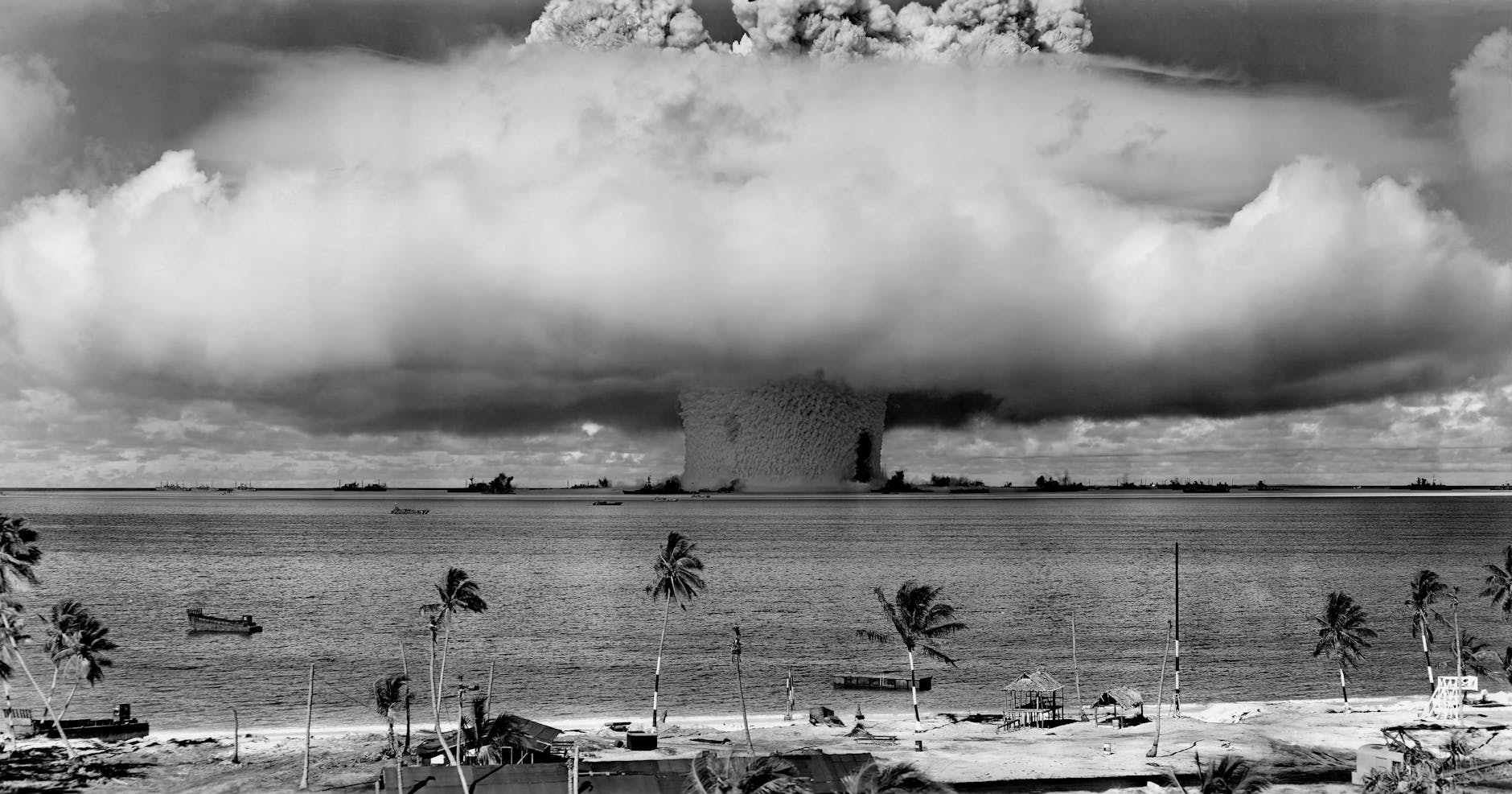
Nihon Hidankyo, an organisation formed by survivors of the atomic bombs dropped on Japan in 1945, have been awarded the 2024 Nobel Peace Prize for their efforts to raise awareness and create the nuclear taboo.
Today, I want to talk about the nuclear taboo and other theories that try to explain why nuclear weapons have not been used since 1945!
Let’s learn about international relations and learn some vocabulary at the same time.
Listen Here!
 Apple Podcasts
 Spotify
 YouTube
Interactive Transcript!
You Can Now Read and Listen at the Same Time With an Interactive Transcript!

Vocabulary
- Nuclear Weapon (Noun): A bomb or missile that uses nuclear energy to cause an explosion.
- The threat of a nuclear weapon being used during the Cold War kept many nations on edge.
- Awareness (Noun): Knowledge or perception of a situation or fact.
- Campaigns aim to raise public awareness about the dangers of climate change.
- Taboo (Noun): A social or cultural prohibition or restriction on a particular action or behaviour.
- In many cultures, discussing personal finances is considered a taboo topic.
- Deterrence (Noun): The act of discouraging an action through fear of the consequences.
- The military uses the concept of deterrence to prevent enemy attacks by maintaining a strong defence.
- Conventional (Adjective): Based on or in accordance with what is generally done or believed; ordinary or traditional.
- Although emails are convenient, many people still prefer sending conventional letters for formal communication.
- Devastation (Noun): Severe destruction or damage.
- The earthquake caused devastation across the city, leaving many buildings in ruins.
- Annihilation (Noun): Complete destruction or obliteration.
- The explosion led to the annihilation of everything within a five-kilometre radius.
2024 Nobel Peace Prize Winner
The Nobel Peace Prize is an international award given annually to individuals or organisations that have made significant contributions to promoting peace.
Past winners of the prize include The World Food Programme for its efforts to combat hunger and prevent to use of hunger as a weapon, Malala Yousafzai for advocating girl’s education, and the Tunisian National Dialogue Quartet for promoting democracy in Tunisia.
This year, the Peace prize has been awarded to Nihon Hidankyo for their efforts to eliminate nuclear weapons and raising awareness.
The Nihon Hidankyo is a group made up of survivors of the atomic bombs dropped on the Japanese cities of Hiroshima and Nagasaki in 1945. It was founded in 1956 and sends survivors of the atomic explosions around the world to share their stories. The aim is to raise awareness of the devastation and destruction caused by nuclear weapons.
An estimated 140,000 people died in the Japanese city of Hiroshima on the 6th August 1945 after the US dropped a uranium filled atomic bomb on the city. Another bomb was dropped on the city of Nagasaki two days later, leading to the eventual Japanese surrender that ended the second world war.
Nihon Hidankyo’s aim is to demonstrate to the world that nuclear weapons are terrifying, devastating, and horrific. They advocate for the banning of nuclear weapons.
While the 1945 bombs were incredibly destructive, they are relatively weak when compared to the immensely powerful advanced weapons that exist today. The USA, Russia, China, the UK, France, India, Pakistan, North Korea, and Israel, are the nine countries known to possess nuclear weapons at the moment. With many of these countries involved in conflicts, disputes, and wars, often with each other, it is incredibly important that we try to avoid the use of nuclear weapons at all costs.
The Nobel Committee, when announcing that Nihon Hidankyo were the 2024 winners, credited the group with helping prevent the use of nuclear weapons. They stated that the group has “contributed greatly to the establishment of the nuclear taboo.”
In the rest of this episode, I want to talk in more detail about the idea of a nuclear taboo. This was actually one of my research interests as a student – I took classes and wrote numerous papers on the theories behind the use (or non-use) of nuclear weapons. Let’s talk about this in more detail!


The Nuclear Taboo
Despite nine countries currently possessing nuclear weapons, and more with the ability to make such weapons if they wanted, they have not been used since 1945. No country has used a nuclear weapons or atomic bomb in war or conflict since 1945. Why?
There are a number of different theories about why nuclear weapons have been developed but not used over the past seven decades. One of the most popular theories is known as the nuclear taboo.
A taboo is something that people avoid doing or talking about because it is seen as wrong, embarrassing, or forbidden.
The nuclear taboo, therefore, refers to the idea that the use of nuclear weapons has now became “taboo” – something that is seen as wrong, embarrassing, or forbidden.
The political scientist Nina Tannenwald is credited with popularising the nuclear taboo theory. She argues that since 1945, the world has developed moral and ethical restraints against deploying nuclear weapons. According to Tannenwald, the taboo operates as an informal rule based in the belief that using such weapons is inherently unacceptable.
The idea behind the nuclear taboo is that after the USA used the weapons in 1945 the world was shocked at their power and destruction. Over time, through stories from survivors (like Nihon Hidankyo) and further research on the long-term effects of radiation poisoning, a taboo developed on their use. These weapons are so terrible that most people don’t want to use them anymore.
Perhaps the reason the taboo is so powerful is that nuclear weapons are different from conventional or normal weapons. Nuclear weapons could kill millions, even billions of people, if they were used in a conflict. They are a threat to humanity.

Other Theories for Nuclear Non-Use
The nuclear taboo is a powerful argument. It is the reason why the Nihon Hindakyo have been given the 2024 Nobel Prize. Many political scientists and activists believe that a taboo can be a useful tool in stopping a country from using such weapons in the future.
However, the taboo is not the only theory on why nuclear weapons have not been used since 1945. In fact, many of the other theories are more popular and arguably more convincing.
The nuclear taboo suggests that countries, especially nuclear countries, no longer want to use nuclear weapons because they are so terrible. Yet, these countries are not against doing terrible things themselves. Countries go to war, use illegal and morally reprehensible tactics like torture and chemical weapons, and do things that don’t make moral sense.

Deterrence Theory
Looking back at a paper I wrote on this topic 8 years ago, I argued that “deterrence” theory was more convincing that the nuclear taboo in explaining nuclear non-use. While I’m not so sure now, I still think deterrence theory is a very useful perspective.
Deterrence theory suggests that nuclear weapons haven’t been used due to the fear of mutually assured destruction (MAD). If one state launches a nuclear strike, the targeted state will retaliate with equal force, resulting in catastrophic losses for both sides.
Let me explain in simpler English. During the cold war both the USA and Soviet Union followed MAD policies. They built enough nuclear weapons to completely destroy each other, and then put these nuclear weapons in secret locations around the world (including on submarines under the ocean).
If the USA was to drop a nuclear weapon on Russia, Russia would respond by launching nuclear weapons at the USA. The USA would then fire more, and so would Russia. The result would be the complete destruction, the total annihilation, of both countries. This is obviously not what either country wants.
The fear of mutually assured destruction is a powerful deterrent. It ensures that no rational leader would ever initiate a nuclear conflict.
The problem with this theory is that it assumes that the leaders of countries are always rational and thinking clearly. I’m not sure if this is always the case.

Other Theories
There are other theories why nuclear weapons haven’t been used.
Some argue that there hasn’t been a clear reason or opportunity to use them since 1945. While there have been wars, nuclear weapons probably wouldn’t have changed the direction of these wars. They are risky weapons that would damage reputations, and often conventional weapons are more effective.
Others argue that the treaties and international agreements made in recent years have been useful at stopping the use of nuclear weapons. These include the Non-Proliferation Treaty (NPT) and the Comprehensive Nuclear-Test-Ban Treaty (CTBT). While they are not legally binding and definitely not super effective, they are a signal that the international community is against these weapons.
One of my favourite political science papers I read as an undergraduate student was by the famous scholar Kenneth Waltz. He argued that nuclear weapons create stability and peace.
Countries with nuclear weapons are very cautious, because they know that a wrong move could put them in the middle of a nuclear war. He argues this is why wars like the Vietnam war and the Korean war did not lead to an active war between the USA and the Soviet Union.
Waltz’s most controversial suggestion was allowing Iran to develop nuclear weapons.
There are currently 9 nuclear powers. The USA, UK, and France are allied together and balance against Russia and China. North Korea is the newest nuclear power but have the lowest capabilities and the USA is a strong supporter of their rivals South Korea and Japan. And India and Pakistan balance against each other.
These countries are unlikely to use nuclear weapons in a conflcit involving another major power because they are cautious.
The ninth country, however, is Israel. Israel doesn’t have a nuclear-powered rival. Waltz argued in his paper Why Iran Should Get the Bomb, which was written in 2012, that if Iran became a nuclear power it would lead to stability in the middle east. He suggests that a nuclear-armed Iran would create a balance of power with Israel.
I’m not fully convinced by this argument, but I think it is a really interesting perspective. Nuclear weapons are so powerful that they can create stability.

Will Nuclear Weapons Be Used in the Future?
As I’ve already mentioned, nuclear weapons have not been used in a conflict since 1945. Will this always remain the case? Or will nuclear weapons be used again in the future?
In awarding the Nobel Peace prized to Nihon Hidankyo, Nobel Committee Chair Joergen Frydnes said that the “nuclear taboo” was now “under pressure.” The number of people with a memory of the devastating consequences of nuclear weapons is reducing every year, and the taboo is also weakening.
Does this mean nuclear weapons will be used in the future? No one is sure. If you ask an international relations scholar, the answer they give you will depend on the theory of non-use they believe in.
A deterrence theorist would argue that mutually assured destruction will stop major powers using nuclear weapons against each other, but if there is an opportunity to use them without starting an all-out war a country might. Or if a country without a rational leader gets nuclear weapons, they might also use them.
North Korea is often mentioned in this case. They are more unpredictable than the other nuclear powers and have a single powerful leader.
Perhaps we just haven’t had a war recently in which nuclear weapons would be useful. If China decides to invade Taiwan, or Russia gets increasingly frustrated in Ukraine, or India and Pakistan enter a full-scale war, perhaps the use of nuclear weapons would be more likely.

Submarine B-59
There are also worries about accidents. Weapons launched or used based on misleading information or by an accidental push of the button. This actually nearly happened in 1962.
The Soviet submarine B-59 was equipped with nuclear torpedoes. During the Cuban Missile Crisis, the submarine was positioned around Cuba. The USA, knowing there was a Soviet submarine somewhere in the area, began dropping explosives known as depth charges into the water.
Submarine B-59 had no contact with Moscow and could not receive orders. They also were too deep in the ocean to listen to news bulletins from the USA or nearby countries. They had no idea what was happening.
The captain assumed that the depth charges being dropped by the USA were a sign that a full-scale, all-out nuclear war had started between the USA and Soviet Union.
On a normal Soviet submarine, the captain and the political officer had to both give their permission to launch a nuclear torpedo. And on B-59, both of them did so. The captain and the political officer both gave their permission to use a nuclear weapon against an American ship.
Fortunately, however, on board the submarine was Vasily Arkhipov, an officer equivalent in rank to the captain but serving as first officer. Due to his rank, he also had to give permission for the torpedo to be launched, but he refused without a direct order from Moscow. Without him the world may have entered a period of nuclear war.
I think this story shows how miscommunication and a lack of information could lead to the accidental use of nuclear weapons.

Nuclear Terrorism?
There is also the possibility of nuclear terrorism. While we often think of nuclear weapons being used by countries, what happens if a non-state actor gets a nuclear bomb? Usually nuclear weapons are very tightly controlled, but not always.
Both the USA and Soviet Union have lost nuclear weapons. There is an American nuclear missile somewhere in the Mediterranean Sea after two of their planes crashed. 3 bombs were recovered but one is still missing.
And when the Soviet Union broke up in the 1990s, we are unsure whether Russia managed to get back every single weapon that was once kept in Ukraine, Belarus, and Kazakhstan, or whether some went missing.
If a terrorist organisation were to find some nuclear weaponry, and work out how to use it, traditional theories like deterrence and nuclear taboo wouldn’t apply.
However, this doesn’t mean that nuclear weapons definitely will be used again in the future. Public opinion in most countires is against nuclear weapons and their use. And the number of weapons held by Russia and the USA has fallen dramatically (at least officially). In 1967 the US reported 32,000 nuclear warheads compared to 5000 this year, while the Soviet Union peaked at 46,000 warheads in 1975 compares to 5,500 in Russia at the moment.
Hopefully the taboo or deterrence that has long prevented the use of weapons, combined with tighter controls on the technology, will prevent any future conflicts using nuclear bombs!

Final Thought
I believe that the 2024 Nobel Peace Prize has been given to a deserving organisation. The work of Nihon Hidankyo to raise awareness and tell the world about the terrors of nuclear weapons has been important.
In this episode, I’ve talked a little about Nihon Hidankyo and then delved into the theories behind the use and non-use of nuclear weapons. I’ve discussed the nuclear taboo, deterrence, and other theories.
And I ended with a discussion over the future of nuclear weapons in war.
What do you think? Do you think Nihon Hidankyo deserves the Nobel Peace Prize? Why do you think nuclear weapons have not been used since 1945? Do you think they will be used again in the future?
Extended Vocabulary List
Become a Patreon Subscriber to Access the Extended Vocabulary List!

Vocabulary Games and Activities!
Learn and practice vocabulary from this Thinking in English episode.
Practice using 5 different study games and activities – including writing, listening, and memorisation techniques!
Flashcards
Matching Game
Learning Game
Test Yourself
Listening and Spelling
Do you want to Think in English?
I’m so excited that you found my blog and podcast!! If you don’t want to miss an article or an episode, you can subscribe to my page!
