

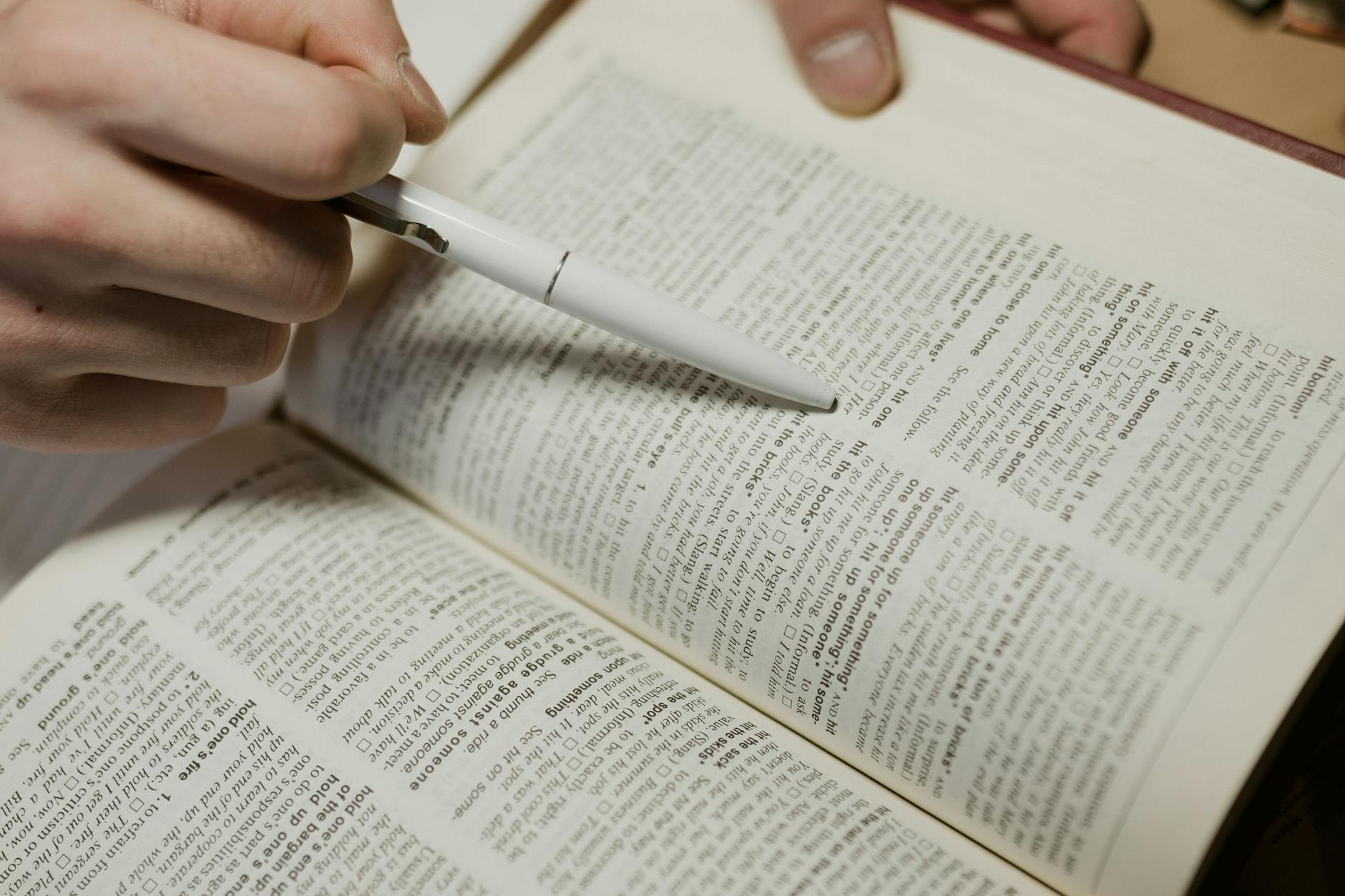
Today I want to discuss Noah Webster, the man who played a major role in creating American English.
We’ll talk about his life and motivations, his famous dictionary, and some of the words and spellings he changed. I’ll end by discussing whether there is a correct form of “English.”
Listen Here!
 Apple Podcasts
 Spotify
 YouTube
Interactive Transcript!
You Can Now Read and Listen at the Same Time With an Interactive Transcript!

Vocabulary
- Standardisation (Noun): The process of making things conform to a standard.
- Webster was a key figure in the standardisation of American English.
- Identity (Noun): The qualities and beliefs that make a person or group different from others.
- Webster was influenced by the idea of American independence and identity.
- Adopt (Verb): To start using a particular method or idea.
- Webster’s spelling changes were adopted across the United States.
- Reflect (Verb): To show or represent something.
- Webster wanted spelling to reflect American pronunciation.
- Simplify (Verb): To make something easier to understand.
- Webster aimed to simplify English spelling.
- Convention (Noun): A traditional or widely accepted way of doing something.
- Many American writers still followed British spelling conventions before Webster’s changes.
Introduction
I think one of the most popular topics covered by English content creators, YouTubers, and podcasters, is the difference between British and American English. People love to learn about the differences in vocabulary, idioms, spellings, and even grammar between English dialects.
Less common, however, is to talk about why British and American English are different.
Over years, languages naturally change and evolve new vocabulary and pronunciations. The way people talk slowly shifts and eventually dialects form.
This is mainly true in the case of British and American English, but there is another factor in the story: Noah Webster.
Webster created the first American English dictionary, was a key figure in the standardisation of American English and personally changed many English spellings to better reflect the way North Americans spoke.
Today we are going to investigate Noah Webster. We’ll discuss who he was, what he did, the words he did (and didn’t) change, and discuss whether there is a proper or correct form of English!


Who Was Noah Webster?
Noah Webster was born in Connecticut in 1758. This was a period of great change in North America. The British Colonies in the Americas were about the descend into revolution.
Webster, like many young men at the time, was influenced by the idea of American independence and identity.
He studied at Yale University, graduating during the American Revolutionary War. He went on to study law and teach in schools. While teaching, he became incredibly frustrated by the textbooks that were being used in schools.
The USA was now an independent country, but schools were still using British textbooks. These textbooks were created for British children and focused on British life and language.
Webster believed that the USA needed a new educational system, new curriculums, and most importantly a new version of English.
This was the goal that Webster focused on for the rest of his life – educating people in, and documenting, American English.

What Did Webster Do?
In 1783, Webster published “A Grammatical Institute of the English Language.” This was a book designed to teach spelling, pronunciation, and grammar in a way that reflected American English speech.
Webster believed in teaching language as it was spoken, rather than based on arbitrary rules. People in the USA didn’t speak like the people in London, so Webster created a textbook specifically for Americans.
His book, “A Grammatical Institute of the English Language,” is one of the most successful books of all time. Estimates suggest it has sold over 100,000,000 copies.
The success of the Institute pushed Webster to focus on a more ambitious goal – creating an American dictionary.
He spent decades compiling words, researching their origins, and deciding how American English should be spelled and pronounced. In 1828, after nearly 20 years of work, he published “An American Dictionary of the English Language.” It contained over 70,000 words, many of which were uniquely American or had spelling changes designed to simplify and distinguish them from British English.
Webster’s dictionary became the foundation of American English spelling. His changes – such as removing unnecessary letters and simplifying complex words – were adopted across the United States. Over time, his Dictionary helped create the American English you know.
Webster passed away in 1843, but his name is still known thanks to the Merriam-Webster dictionary, one of the best-known English dictionaries in the world.

Webster’s American English Words
Let’s take a deeper look at the changes Webster made to British English.
He believed that English spelling was overly complex, inconsistent, and, in many cases, illogical. His reforms aimed to make words easier to spell and pronounce, and more accurate to the way Americans used them.
At the time Webster was working on his American Dictionary of the English Language, English spelling was not standardised. Different spellings of the same word existed across regions, and many American writers still followed British spelling conventions.
Webster saw an opportunity to change English spellings to reflect pronunciation and American English.
Let me mention some of the most significant spelling changes introduced by Webster.

Removing the Letter “U” from Words Ending in -OUR
Webster thought that the -our endings in words like “colour” and “favour” were unnecessary. This spelling (like many I’ll mention today) was introduced to English from Old French but by the 18th century the “u” was no longer pronounced.
Webster dropped the “u”, making the words shorter and easier to spell.
For example, the words “colour”, “honour”, and “favour” are spelled without the “u” in American English.
I think this is one of the most recognisable differences between the two main English dialects.
Changing -RE to -ER
Another key change Webster introduced was reversing the order of -re endings, making them -er. He believed this better reflected the natural pronunciation of these words in American speech.
Words like theatre and centre end in “re” in British English, but Webster changed this in his dictionary.
Dropping Silent Letters
Webster also wanted to simplify words by removing silent letters that had no effect on pronunciation. His reasoning was that if a letter isn’t pronounced, it shouldn’t be written.
This is why British English spells programme, p-r-o-g-r-a-m-m-e, while in American English it is p-r-o-g-r-a-m. The “me” at the end of the words is silent, so Webster removed it.
Another example is catalogue which ends in a silent “ue” in British English, but not in American English.
Replacing “C” with “S” in Some Words
Webster also replaced -ce endings with -se in certain words, making them more phonetic. The letter “c” in English is actually a pointless letter – it doesn’t have a unique sound. It can either be replaced by a “s” or “k” in most words (apart from when it is next to an “h”).
Webster removed the “c” from words like “defence” and “pretence”, and instead spelled them with the letter “s” (defense and pretense).
This change was not applied to all words—words like “advice” remained unchanged.
Removing the Double “L” in Some Words
In British English, verbs that end in -l often double the letter when adding a suffix (e.g., “travelling,” “cancelled”). Webster removed the double “l” in most cases.
This change applied mostly to verbs, while nouns like “cancellation” still retained the double “l.”
Other Simplified Spellings
Webster also introduced a number of miscellaneous spelling changes that made words easier to read and write.
He changed the spelling of words like grey/gray, cheque/check/, and enquire/inquire.

Words He Changed That Didn’t Catch On
It is important to point out that not all of Webster’s spelling changes and suggestions were adopted or accepted. Webster believed that English spelling should be simpler, more phonetic, and logical, but some of his ideas were just too unfamiliar or strange for people to adopt.
He suggested changing the spellings of words like tongue (t-u-n-g), machine (masheen), daughter (dawter), and give (giv).
His most successful reforms worked because they were small and logical adjustments, but his more radical proposals failed because they were too different.

Is There a “Correct” Form of English?
One of the most common questions I get is whether there is a single “correct” form of English, or at least a “better” form of English to learn.
I don’t think there is a “better” type of English.
Language is constantly evolving and changing. The English we speak today is very different from the English spoken 500 years ago, and it will continue to change in the future.
There is also no single “English” language. There are many different varieties spoken around the world. Each variety has its own unique vocabulary, grammar, and pronunciation.
The idea that one version of English is “correct” and others are “wrong” ignores the reality of how people actually use the language.
Is there a correct form of English?
Technically, this depends on the context.
If you are writing English in a formal setting (for example an academic journal or a government report), you should follow the language rules of that publication.
In everyday conversation, different dialects and accents are natural.
The key is to adapt your English depending on the situation.

Final Thought
Noah Webster played a major role in shaping American English. He introduced spelling changes that simplified and standardised the language.
His influence is still seen today, especially in the differences between British and American spelling.
As language continues to evolve, there is no single “correct” form of English—only variations shaped by history and context. Whether you prefer British or American English, the most important thing is effective communication and adaptability in different situations.
What do you think? Do you use American or British spellings?
Extended Vocabulary List
Become a Patreon Subscriber to Access the Extended Vocabulary List!

Vocabulary Games and Activities!
Learn and practice vocabulary from this Thinking in English episode.
Practice using 5 different study games and activities – including writing, listening, and memorisation techniques!
Flashcards
Matching Game
Learning Game
Test Yourself
Listening and Spelling
Do you want to Think in English?
I’m so excited that you found my blog and podcast!! If you don’t want to miss an article or an episode, you can subscribe to my page!
