

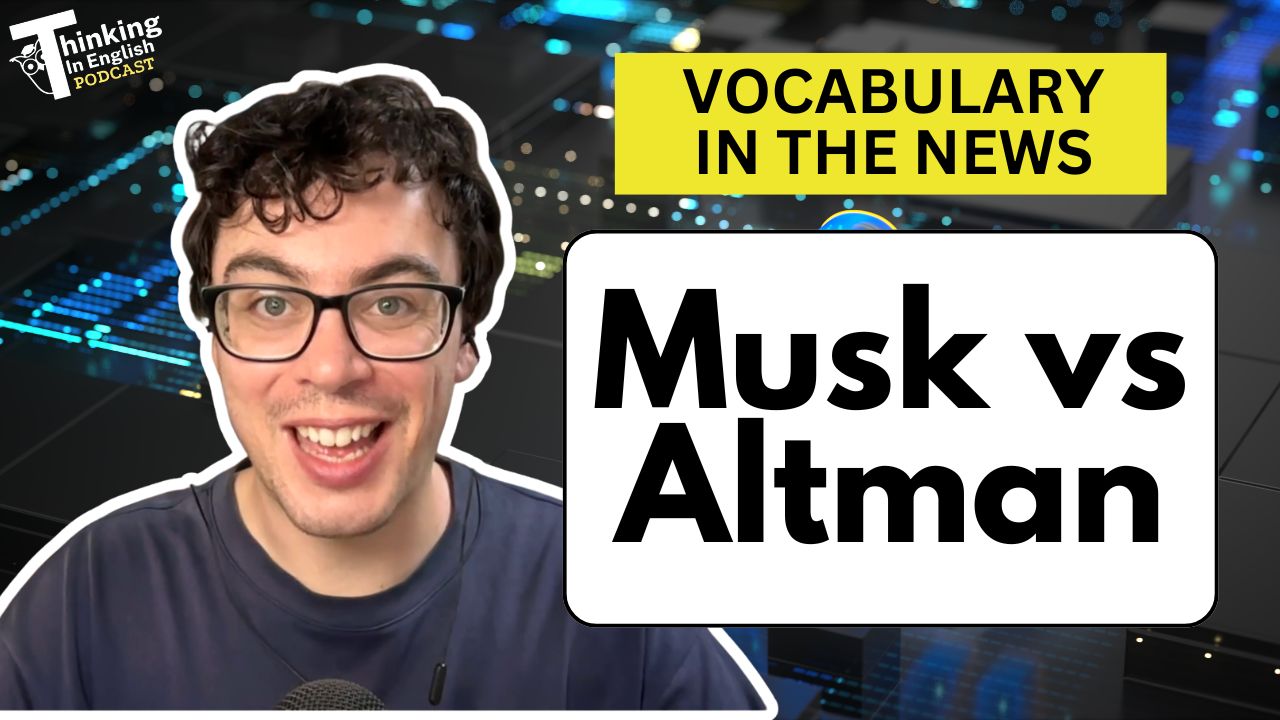
Two of the biggest names in technology and artificial intelligence have been facing each other in court recently.
Elon Musk (known for Tesla, SpaceX, Twitter, and his role in US politics) and Sam Altman (known for OpenAI and ChatGPT) were once collaborators. They once worked together.
Both men were early figures behind OpenAI. OpenAI originally aimed to develop AI technology for the benefit of humanity, not for profit. But over time, the organisation changed. OpenAI introduced a commercial side, started moving away from its not-for-profit status, and is now the biggest, or one of the biggest, groups in the global AI industry.
Elon Musk has acceused OpenAI of betraying its original mission as a non-profit organisation. He argues that the company has moved away from its founding principles. OpenAI claims that Musk is acting out of self-interest and trying to damage a competitor (Musk now owns the competitor xAI).
In this episode of Thinking in English, instead of focusing on the complex legal details of this case, I want to use this story as a way to learn some advanced vocabulary. This is the kind of language you’ll hear in news reports about business, law, and technology.
Unlock the full episode and join the conversation by becoming a Patreon member today!
Watch Here
 Spotify
 Patreon
Transcript
Hey, everyone! This week I want to try something different in our bonus episode. I have an idea of a potential new series. Maybe it would be a YouTube series, or maybe I’ll keep it on Patreon, and I want to get your feedback and ideas.
The concept is that I will take a recent news article or story and focus on introducing the advanced vocabulary used in the article. The episode will also end with a quiz.
So let me know what you think after listening.
Musk vs Altman
Hello, I’m Tom Wilkinson from Thinking in English, and welcome to an episode of Vocabulary in the News, where we learn English from some of the biggest news stories of the week.
Two of the biggest names in technology and artificial intelligence have been facing each other in court recently.
Elon Musk, known for Tesla, [00:01:00] SpaceX, Twitter, and his role in US politics, and Sam Altman, known for OpenAI and ChatGPT, were once collaborators. They once worked together. Both men were early figures behind OpenAI.
OpenAI originally aimed to develop AI technology for the benefit of humanity, not for profit. But over time, the organization has changed. OpenAI introduced a commercial side, started moving away from its not-for-profit status, and is now the biggest or one of the biggest groups in the global AI industry.
Elon Musk has accused OpenAI of betraying its original mission as a nonprofit organization. He argues that the company has moved away from its founding principles.
OpenAI claims that Musk is acting [00:02:00] out of self-interest and trying to damage a competitor. Musk now owns the competitor xAI.
So in this episode of Thinking in English, instead of focusing on the complex details of the case, I want to use this story as a way to learn some advanced vocabulary. This is the kind of language you’ll hear in news reports about business, law, and technology.
In fact, all of the terms I’m going to introduce to you have come from a BBC News article that I will link in the description of this episode.
So let’s get started and look at some advanced vocabulary.
Vocabulary in the News
Lawsuit
A lawsuit is a formal legal dispute or argument or a legal case brought into a court. It usually begins when one side [00:03:00] (the plaintiff) claims that another side (the defendant) has caused harm in some way or acted unfairly or broken an agreement.
Lawsuits can involve individuals, companies, governments, charities, and they usually try to solve a disagreement over issues like money or contracts.
In this case, Elon Musk has filed a lawsuit against OpenAI. His claim is that the company has violated its original purpose as a non-profit organization.
This makes the lawsuit a little bit unusual as it kind of is both legal and ideological. Of course it’s about money, but it’s also about principles.
To Take the Stand.
To take the stand means to give evidence in court. It is when you speak in front of the judge and jury. [00:04:00] When someone takes the stand, they sit in a specific place called the witness stand and answer questions from lawyers. Their statements can be challenged or questioned.
Musk has taken the stand in this lawsuit to explain his perspective on OpenAI’s transformation. This is significant because it shows Elon Musk is personally involved in the case. He is so involved in it that he appeared in court himself.
Charity.
A charity is an organization that aims to help people or society and does not try to make a profit.
For instance, charities focus on poverty or education or healthcare. Charities rely on donations and are expected to use their resources and their donations responsibly for the public good.
The idea of what a charity is or the idea of charity is [00:05:00] at the center of the arguments between Elon Musk and Sam Altman.
Musk claims that OpenAI was originally structured like a charity. Its goal was to serve humanity. Its goal wasn’t to make money. His accusation is that the company has moved away from that purpose.
To Loot.
To loot means to steal. It’s especially used during chaotic or lawless situations like wars or disasters. You’ll often see reports about looters stealing things during major protests. They are looting.
However, loot can also be used metaphorically. In this case, Musk uses the word loot to suggest that OpenAI has taken something valuable, its original mission or its resources, in a dishonest way.
This is a very powerful and emotional choice of language. He could have said “misuse” [00:06:00] or “mismanage”, but loot makes the accusation sound far more serious and dramatic.
Competitor.
A competitor is any individual or organization that is trying to achieve the same goal as another. In business, this means companies competing for customers or market share or influence.
Pepsi is a competitor of Coca-Cola. They both sell sweet soda products, so they are constantly trying to attract customers from each other.
OpenAI describes Musk as a competitor. This is important because it changes how you interpret his actions or how you judge his actions. If he is a competitor to OpenAI in the AI space, then his lawsuit could just be a way to weaken one of his rivals.
To Kneecap.
Literally, to kneecap someone means to shoot them in the knee. [00:07:00] This is an incredibly violent act which is intended to permanently disable someone.
As you might imagine, the metaphorical meaning is also very strong.
In business or politics or in this metaphorical sense, to kneecap means to seriously weaken, damage, or limit the ability of someone to succeed.
OpenAI is suggesting that Musk is trying to kneecap the company. In other words, they believe he is using the legal system as a way to harm their progress in the AI industry.
To Take an Oath.
To take an oath means to make a formal and legally binding promise. The promise is usually to tell the truth or act honestly.
In a courtroom, witnesses and jurors must take an oath before participating. Sometimes you can take an oath on a religious book like the [00:08:00] Bible.
In this case, the jurors and witnesses have been reminded that they have taken an oath to remain neutral and fair. Breaking an oath can also have serious legal consequences.
To Regulate.
To regulate means to control or supervise an activity through rules and laws. It is usually a government or an official authority that regulates something. Regulation is especially important in industries that can have major social or economic influence, like finance and healthcare and technology.
There is a concern that governments are not doing enough to regulate AI. AI is developing rapidly, and many people believe stronger regulation is needed to prevent misuse and harm.
Non-profit (adj)/ Nonprofit (n).
A non-profit organization is an organization that does not distribute profits to owners [00:09:00] or shareholders. Instead, any money it earns is reinvested into its mission or goals.
Most companies or normal companies, if they make a profit, they will give some of that profit to the people who own the company, the shareholders or the investors. In a nonprofit, any money the company makes stays inside the company to help keep it growing.
OpenAI began as a nonprofit. Its purpose was supposed to benefit humanity, research AI, create AI products that were going to help the world. It wasn’t designed to generate a profit for people who own the company.
Elon Musk’s argument in the lawsuit is based on the idea that the original structure of OpenAI, being not-for-profit, has been compromised.
Commercial Arm.
A commercial arm is a division of an organization that focuses on [00:10:00] generating revenue. Non-profit organizations, even though their purpose is not to make money, sometimes create commercial arms to fund their activities.
In this case, OpenAI created a commercial arm to develop and sell AI products like ChatGPT.
This decision is one of the reasons for the conflict. Musk argues that making a commercial arm is a move away from the organization’s original mission.
Wrongful Gains.
Wrongful gains refers to money earned or obtained through illegal, unethical, or unfair means. This is a formal legal term often used in lawsuits involving financial disputes.
Elon Musk is asking for billions of dollars in what he calls wrongful gains. He believes that OpenAI has profited in a way that goes [00:11:00] against its original purpose.
Breach of Trust.
A breach of trust happens when someone breaks a responsibility or some confidence placed in them. For example, if a company promises to act in a certain way but doesn’t, that could be seen as a breach of trust.
Elon Musk, in his lawsuit, is arguing that OpenAI has committed a breach of trust. OpenAI promised to act in the public interest, but later changed direction.
Unjust Enrichment.
Unjust enrichment is a formal legal concept. It means benefiting unfairly at someone else’s expense. For example, if a company makes money through unethical behavior, it might be accused of unjust enrichment.
Musk’s legal team argues that OpenAI has been unjustly [00:12:00] enriched. Meaning it has gained financially in a way that is unfair.
This is quite advanced legal vocabulary, but it does appear frequently in business and legal contexts.
To Derail.
To derail originally means for a train to leave its tracks. When a train derails, it will cause an accident.
Metaphorically, to derail means to disrupt or completely stop progress.
OpenAI is accusing Musk of trying to derail the company’s development. They believe he is attempting to stop their success and actively interfere with their future.
Questions and Reflection
Before we move on to the quiz, let’s take a moment to reflect and use some of the ideas we’ve just discussed. Here are a few questions for you to think about. Maybe you can pause the episode and answer them out loud, or leave a comment, or just think about your ideas.
[00:13:00] First, should AI companies be non-profit or commercial? Do you think organizations developing powerful technology should focus on helping society? Is it acceptable for them to try and make money?
You could also think about whether a mix of both is possible, like having a non-profit mission but a commercial arm.
Second, do you personally trust big tech companies?
OpenAI now has a huge influence in many people’s lives. They own ChatGPT. Do you think big companies act responsibly? Or do you think they are mainly focused on profit and competition?
Is competition always a good thing?
Competition can drive innovation and improvement, but it can also lead to aggressive behavior, like trying to kneecap competitors or dominate a market.
But what do you think? Is competition always [00:14:00] positive? Or are there situations where it causes more harm than good?
Vocabulary Quiz
- Musk filed a ________ against OpenAI.
a) competitor
b) lawsuit
c) oath - In court, Musk decided to ________ and explain his version of events.
a) take the stand
b) derail
c) regulate - A ________ organisation focuses on helping society rather than making profit.
a) commercial
b) competitor
c) charity - The government is trying to ________ AI technology with new laws.
a) influence
b) regulate
c) loot - Some people believe Musk is trying to damage a ________.
a) charity
b) competitor
c) oath - The company created a ________ to start making money from its technology.
a) breach of trust
b) commercial arm
c) lawsuit - If a company earns money in an unfair or illegal way, it may be accused of making ________.
a) wrongful gains
b) an oath
c) influence - Breaking a responsibility or promise is known as a ________.
a) unjust enrichment
b) breach of trust
c) competitor - If someone tries to stop a project from succeeding, they are trying to ________ it.
a) derail
b) regulate
c) take the stand - In court, jurors must ________ to be fair and honest.
a) loot
b) kneecap
c) take an oath
Final Thought
How did you do in the quiz? Leave a comment and let me know!
Vocabulary Games and Activities!
Learn and practice vocabulary from this Thinking in English episode.
Practice using 5 different study games and activities – including writing, listening, and memorisation techniques!
Flashcards

Matching Game
Learning Game
Test Yourself
Listening and Spelling
