

In August I travelled to Thailand for a vacation (my first real vacation for a long time)!
One of my favourite experiences in Thailand was exploring the ancient city of Ayutthaya. Walking through its ruins felt like stepping back in time and I loved learning about the history of Southeast Asia.
If you’re interested in history, culture, and architecture, Ayutthaya should definitely be on your travel list.
Vocabulary for English Learners
- 1. Capital (Noun): The city that serves as the centre of government for a country or region.
- Example: Ayutthaya was once the capital of the Kingdom of Siam.
- 2. Prosperous (Adjective): Wealthy, successful, or flourishing.
- Example: Ayutthaya became one of Asia’s most prosperous cities due to trade.
- 3. Merchant (Noun): A person who buys and sells goods for profit, especially internationally.
- Example: Merchants from Europe and China visited Ayutthaya to trade.
- 4. Flourish (Verb): To grow or develop successfully.
- Example: The city flourished culturally and economically during its peak.
- 5. Hub (Noun): A central place where many activities or exchanges occur.
- Example: Ayutthaya was a hub for trade and diplomacy in Southeast Asia.
- 6. Architecture (Noun): The design and style of buildings and structures.
- Example: Ayutthaya’s architecture reflects a blend of Khmer and Thai styles.
- 7. Khmer (Adjective/Noun): Related to Cambodia or its people and culture.
- Example: Khmer influence is evident in Ayutthaya’s temples and towers.
- 8. Wat (Noun): A temple in Thailand or Cambodia.
- Example: Ayutthaya is known for its many beautiful wats.
- 9. Prang (Noun): A tower-like structure common in Thai temples, often influenced by Khmer design.
- Example: The prangs in Ayutthaya resemble spires and symbolize Mount Meru.
- 10. Stupa (Noun): A dome-shaped structure used as a place of meditation or a reliquary in Buddhism.
- Example: The bell-shaped stupas in Ayutthaya contain sacred relics.
- 11. Cosmology (Noun): The study or understanding of the origin and structure of the universe.
- Example: Prangs represent Mount Meru in Hindu and Buddhist cosmology.
- 12. Relic (Noun): An object of historical or religious significance, often linked to a saint or spiritual figure.
- Example: Many stupas in Ayutthaya contain ancient relics.
- 13. Invasion (Noun): The act of entering a place by force, often by an army.
- Example: Ayutthaya faced several invasions from neighbouring Burma.
- 14. Sack (Verb): To destroy and loot a city, typically by an invading army.
- Example: Burmese forces sacked Ayutthaya in 1767, leaving it in ruins.
- 15. Ruins (Noun): The remains of a building or structure that has been destroyed.
- Example: Visitors to Ayutthaya can explore the ancient ruins.
- 16. Archaeological (Adjective): Related to the study of ancient societies through their artifacts and ruins.
- Example: Ayutthaya is now an archaeological site and a UNESCO World Heritage Site.
- 17. UNESCO (Noun): A United Nations agency responsible for promoting cultural heritage and education.
- Example: Ayutthaya has been recognized as a UNESCO World Heritage Site.
- 18. Scenic (Adjective): Offering beautiful views of nature or landscapes.
- Example: A boat tour offers scenic views of the ruins and rivers around Ayutthaya.
- 19. Reflect (Verb): To show an image or represent something.
- Example: The calm waters reflected the surrounding temples and trees.
- 20. Tumultuous (Adjective): Full of conflict, disorder, or chaos.
- Example: The peaceful ruins contrast with Ayutthaya’s tumultuous history.
- 21. Contrast (Verb): To compare two things in order to highlight their differences.
- Example: The serene atmosphere contrasts sharply with the city’s violent past.
- 22. Diplomacy (Noun): The management of relationships between countries or organizations.
- Example: Ayutthaya was a centre of diplomacy in Southeast Asia.
- 23. Spire (Noun): A pointed, tower-like structure, often found on top of a building.
- Example: The prangs resemble spires that reach toward the sky.
- 24. Reflect on (Phrasal Verb): To think deeply about something.
- Example: Visiting Ayutthaya made me reflect on its historical significance.
- 25. Bygone (Adjective): Belonging to a time long past.
- Example: The ruins of Ayutthaya offer a glimpse of a bygone era.
- 26. Relic (Noun): An old object or part of something that has survived from the past.
- Example: Many stupas in Ayutthaya contain relics from ancient times.


The Kingdom of Siam
Ayutthaya was once the capital of the Kingdom of Siam, founded in 1350 by King Uthong. During its peak, it became one of Asia’s largest and most prosperous cities.
It was known for having a strategic location and thriving trade. Merchants from Europe, China, India, Japan, and beyond travelled to and settled in Ayutthaya, contributing to its development and wealth.
The city’s prosperity allowed it to flourish culturally and architecturally. It soon became famous for its stunning palaces and religious monuments.
Ayutthaya’s Unique Architecture
The architecture of Ayutthaya is a blend of styles.
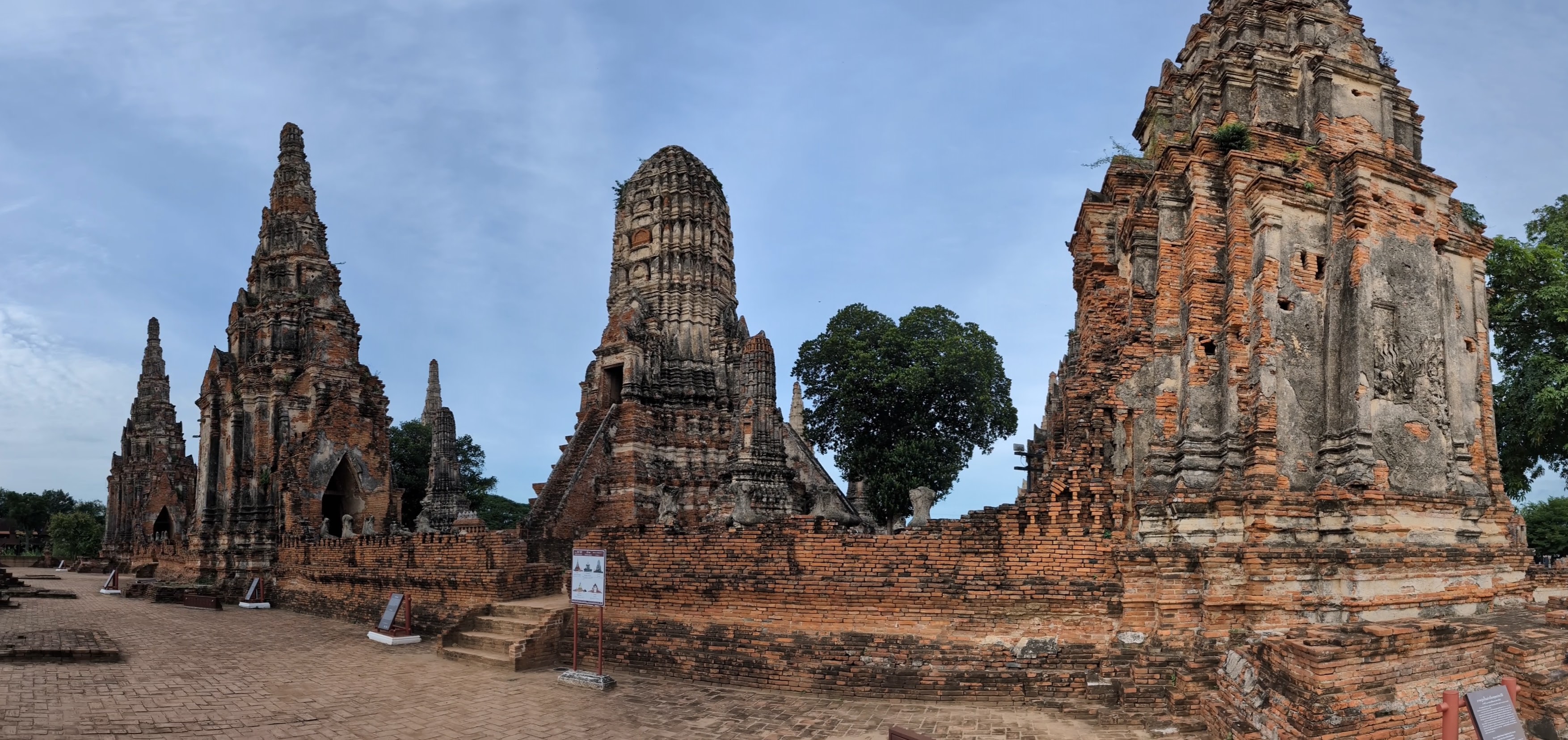
Khmer (Cambodian) influence is particularly prominent, reflecting the historical connections between Siam and the Khmer Empire. Many of the temples, or wats, feature towering prangs—towers that resemble spires—and stupas shaped like bell towers.
These towering structures are not just beautiful but also symbolic. Prangs often represent Mount Meru, the centre of the universe in Hinduism and Buddhism. The bell-shaped stupas often contain sacred artefacts or the ashes of important figures.
While walking through these ancient ruins, we were immersed in the history of the Ayutthaya period. Some of the most iconic temples include Wat Phra Si Sanphet, known for its three large stupas, and Wat Mahathat, known for the famous Buddha head entwined in tree roots.


The City and Conflict
Ayutthaya’s wealth and importance made it a target for invasions.
Throughout its history, it faced several conflicts, particularly with the neighbouring Burmese Kingdom. These conflicts culminated in an invasion in 1767 when Burmese forces sacked the city, burning much of it to the ground and leaving it in ruins.
The destruction of Ayutthaya was the end of the Kingdom of Siam’s golden age. Many structures were lost to fire, and the capital was moved to present-day Bangkok. What remains of Ayutthaya today are ruins.
Ayutthaya Today
Despite the destruction, Ayutthaya remains a must-see destination for anyone visiting Thailand. It has also been recognized as a UNESCO World Heritage Site.
Visitors can explore the archaeological park, with its ancient temples, palaces, and statues. My wife and I joined a tour (it was actually a tour in Japanese) so we could see as much as possible and learn about the history from the expert tour guide!
Another option is to rent a bicycle or take a boat.
One of the highlights of my visit was simply wandering through the temples and imagining what life might have been like in the capital centuries ago.
Final Thoughts
Visiting Ayutthaya was one of the most memorable parts of my trip to Thailand. If you ever find yourself in Thailand, I highly recommend taking a day or two to explore this fascinating ancient city.
Follow Me on Instagram
This blog post was inspired by a recent Instagram post on the Thinking in English account. Out of all social media platforms, I am most active on Instagram.
Do you want to Think in English?
I’m so excited that you found my blog and podcast!! If you don’t want to miss an article or an episode, you can subscribe to my page!
