

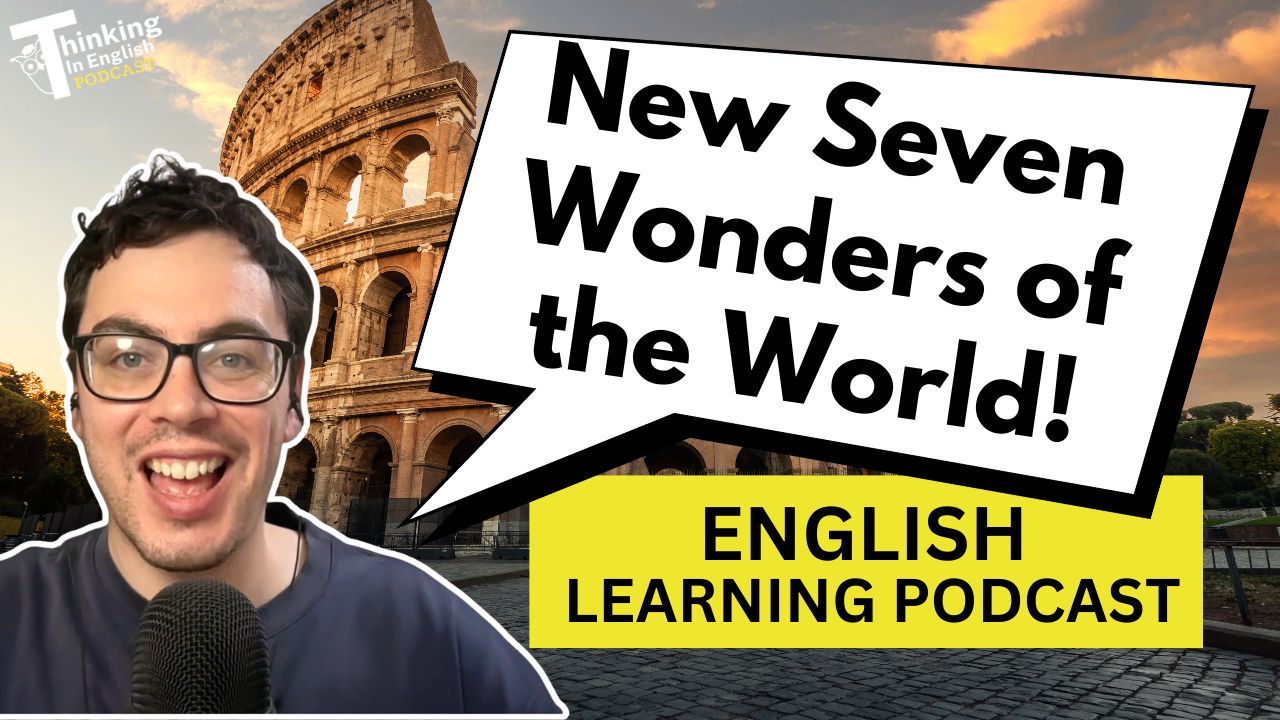
Thousands of years ago, Ancient Greek travellers created a list of the most extraordinary sights they encountered: the Seven Wonders of the Ancient World.
These included places like the Hanging Gardens of Babylon, the Lighthouse of Alexandria, and the Colossus of Rhodes. Today though, only one still survives: the Great Pyramid of Giza in Egypt.
So, in the early 2000s, a huge international campaign called the “New Seven Wonders of the World” aimed to create a modern list of wonders.
Some governments launched campaigns encouraging citizens to vote for their country’s monument. Critics argued that countries with larger populations had an unfair advantage. And UNESCO, the United Nations organisation responsible for protecting world heritage sites, was not involved in the project.
So today, I want to explore the story behind the New Seven Wonders of the World. What are they? Why were they chosen? And do they really deserve the title of “wonder”?
And we will do all of this while learning some new vocabulary and practicing your English listening comprehension.
Listen Here!
 Apple Podcasts
 Spotify
 YouTube
Interactive Transcript!
You Can Now Read and Listen at the Same Time With an Interactive Transcript!

Vocabulary
- wonder (n): something that causes great admiration because of its beauty, scale, or remarkable achievement
- “These places were considered wonders because of their size, beauty, or engineering.”
- nominated (v): officially put forward as a candidate for selection or recognition
- “More than one hundred famous monuments and historical sites were nominated from around the world.”
- UNESCO (n): the United Nations Educational, Scientific and Cultural Organisation, responsible for protecting world heritage sites
- “UNESCO publicly said that cultural heritage should not be decided through popularity contests or commercial campaigns.”
- heritage (n): the traditions, monuments, and values passed down from previous generations as part of a culture’s history
- “UNESCO selects heritage sites based on historical and cultural significance.”
- democratic (adj): based on equal participation and voting by ordinary people rather than by experts or officials
- “This new version of a list would be decided democratically by ordinary people.”
- criticism (n): the expression of disapproval or the identification of faults in something
- “From the very beginning, the campaign faced criticism and questions over whether the competition was really fair.”
- controversy (n): prolonged public disagreement or debate about something, often involving strong opposing opinions
- “Christ the Redeemer is probably the most controversial of the choices on the New Seven Wonders list.”
Ancient Wonders
The original Seven Wonders of the Ancient World [00:04:00] came from the writings of ancient Greek travelers and historians.
As Greeks traveled around the Mediterranean and the Middle East, they wrote about the most extraordinary things they saw. The Ancient Greek word for these things was the ‘Theamata‘, which I probably pronounced wrong, but ‘Theamata‘ roughly means “things worth seeing“.
So these wonders were basically ancient tourist attractions. They were places that Greek travelers believed were worth visiting.
The list changed slightly over time, but several monuments regularly appeared in ancient Greek writings.
There was the Great Pyramid of Giza in Egypt, which was the enormous tomb built for a pharaoh thousands of years ago. There were the Hanging Gardens of Babylon, which may or may not have actually existed. There was the Colossus of Rhodes, which was a giant bronze statue that stood near a harbor in [00:05:00] Greece. And also the Lighthouse of Alexandria, which guided ships safely into the ancient city of Alexandria.
These places were considered wonders because of their size or their beauty or their engineering.
The ancient wonders reflected the lives of these educated Greek people living and traveling around the Mediterranean. They knew little about East Asia or Sub-Saharan Africa, and they knew nothing about the Americas. So all of these wonders were in their small world.
Over time, though, most of these ancient wonders disappeared. Earthquakes destroyed some. Wars damaged others. Only one still survives: the Great Pyramid of Giza.


New Seven Wonders Vote
Around the year 2000, an idea for a New Seven Wonders of the World list began to develop.
An organization called the New7Wonders Foundation was founded. [00:06:00] This project was created by Bernard Werber from Switzerland, who wanted to create a modern version of the ancient wonders list.
He believed that the world needed a new list of wonders that reflected the achievements of different places around the world, not just the ancient Mediterranean region. This new version of a list would be decided democratically by ordinary people voting on monuments or sites that still exist.
More than 100 famous monuments and historical sites were nominated from around the world.
These included castles and temples. There were statues, pyramids, and ancient cities. People could vote online or by phone for the monuments they believed deserved to be one of the New 7 Wonders.
And this campaign became enormous. The organizers claim that tens of millions of people participated [00:07:00] worldwide. Governments and tourism boards and media organizations all became involved.
Some countries launched major advertising campaigns encouraging citizens to vote for their national monument.
The final results were announced on July 7th, 2007, written numerically as 07/07/07, for the Seven Wonders.
The winners were the Great Wall of China, Petra in Jordan, Machu Picchu in Peru, Chichén Itzá in Mexico, the Colosseum in Italy, the Taj Mahal in India, and Christ the Redeemer in Brazil.
The Great Pyramid of Giza was also given honorary status as the only surviving ancient wonder.
But despite the excitement around this campaign, there was also a lot of confusion about who exactly was behind it. In fact, there’s still confusion about it today.
Many people assume this project [00:08:00] was connected to UNESCO. UNESCO is the United Nations organization responsible for protecting important historical and cultural sites. But UNESCO was not involved. They had no connection to the New Seven Wonders campaign.
In fact, UNESCO publicly stated that cultural heritage should not be decided through voting or commercial campaigns. People were also uncomfortable with the fact that the New7Wonders Foundation was a private organization.
The distinction between UNESCO heritage sites and the New Seven Wonders is important. They’re not the same thing. UNESCO selects its heritage sites based on the historical and cultural significance of the site, while the New Seven Wonders were chosen through public voting and media campaigns.
Let’s take a deeper look at each of the wonders, starting with the Great Wall of [00:09:00] China.

Great Wall of China
I think the Great Wall of China is one of the most recognizable structures on the planet. I’m sure you all know what it is, but if you don’t… it’s a large wall.
The Great Wall was constructed over many centuries by different Chinese dynasties. Some early sections were built more than two thousand years ago, while later parts were expanded during the Ming dynasty between the fourteenth and seventeenth centuries.
Rather than being one continuous wall, it’s probably better to think about the Great Wall as a network of different walls and watchtowers and fortresses and defensive barriers which stretch all across northern China.
Altogether, the Great Wall is over a thousand kilometers long.
The main purpose of the wall was defense. Chinese rulers wanted protection against invasions and raids from groups living to the north, particularly the nomadic tribes that were [00:10:00] living on the Mongolian Steppe. The wall helped soldiers monitor borders and slow down enemy attacks.
Building such an enormous structure required a lot of labor, a lot of money, and really difficult organization. So the wall was also used to demonstrate the strength of an emperor, the strength of the Chinese state. And today, the Great Wall still has a lot of cultural significance in China itself.
There is also mystery and myths around the Great Wall. Perhaps the most famous myth is that it can be seen from space with the naked eye, but this is not necessarily true under normal conditions.
Few human construction projects match the size or the ambition of the Great Wall, which I think makes it an obvious choice to be on the New Wonders list.

Petra
Next up is Petra, an ancient city hidden among the desert mountains of modern-day Jordan in [00:11:00] the Middle East.
Petra is famous for its buildings carved directly into pink and red sandstone cliffs. It was built by the Nabataeans, an Arab civilization that became wealthy through trade more than 2,000 years ago.
The city was located at an important location. It connected Arabia to Egypt and the Mediterranean. Merchants traveling through the desert carried valuable goods like spices and precious metals, and Petra became rich by controlling these trade routes.
One of the most famous structures in Petra is called The Treasury, which is a huge carved facade that appears dramatically at the end of a canyon.
The Nabataeans were highly skilled engineers. They developed systems to collect and store and transport water. Without this technology, without these systems, a city like Petra could never survive [00:12:00] in the hot desert conditions of the Middle East.
Over time, Petra declined, and eventually much of it was abandoned.
For a long time, Petra remained relatively unknown outside of the region. Then in 1812, a Swiss explorer named Johann Ludwig Burckhardt introduced Petra to the wider world. He secretly traveled there in disguise and then publicly told stories about a lost city in the desert to European newspapers, and this story became really popular.
Archeologists continue to discover new things in Petra today, and actually large parts of the ancient city may still be unexplored. There’s still a lot to discover there.
I think Petra is a great candidate to be one of the New Seven Wonders. It combines many things that people associate with being a wonder.
It has incredible history. It’s [00:13:00] ancient. Amazing, beautiful architecture and engineering skills. And it’s also mysterious… this incredible feat of architecture from thousands of years ago, which was then abandoned… is just mysterious.

Machu Picchu
The next wonder I think has some similarities. It’s Machu Picchu, the famous Incan city high in the mountains of Peru. It’s high in the mountains, surrounded by green peaks and often covered in mist.
Machu Picchu was built in the fifteenth century, I think, during the height of the Inca Empire. This was the largest empire in the Americas before the arrival of Europeans.
The Incas controlled territory across much of West and South America. And they were great engineers and builders, despite the fact they lacked some really important technology. The Incas didn’t have iron tools or wheeled transport, but they still created these incredible cities.
[00:14:00] Machu Picchu is more than 2,000 meters above sea level in the Andes Mountains. Transporting stone and building large temples in such a difficult environment is a challenge. They must have had great organization skills and lots of labor.
The Incas also designed the site with precision. The city included agricultural sites, temples, homes, storage areas, water channels.
To be honest, historians are not completely certain why Machu Picchu was built. Some believe it might have been a royal estate for an Incan emperor. Others think it had more religious or ceremonial purposes.
And one of the reasons why Machu Picchu is still there, is because it was never discovered by the Spanish conquerors during the colonial period. The fact that the Spanish never discovered it helped preserve much of the site. Machu Picchu remained hidden in the mountain for [00:15:00] centuries while most other Incan cities were destroyed or heavily altered.

Chichén Itzá
Another new wonder is Chichén Itzá, which is one of the most famous cities built by the Maya civilization in present-day Mexico.
The Maya developed advanced cities across Central America and southern Mexico. They had complex writing systems, accurate calendars, and Chichén Itzá became one of their most important sites.
It’s best known for its enormous pyramid called El Castillo or the Temple of Kukulcan. The pyramid was carefully designed to align with the movement of the sun. So during the spring and autumn equinoxes, which is when the day and night are equal, the sunlight creates a shadow on the staircase that resembles a serpent, a snake, moving down the pyramid.
This effect was connected to Kukulcan, who was a feathered serpent deity worshiped by the [00:16:00] Maya.
Chichén Itzá was also a large and complex city. There were temples and pyramids, also markets, ceremonial spaces, and actually one of the largest ball courts in the ancient Americas. The Mayans famously had their own sport, a type of ball game which has some basic similarity with sports like football.
Historians believe the city was a major center for politics, trade, and religion around a thousand years ago, between the 8th and 13th centuries.
Like many ancient civilizations, the Maya experienced political instability and decline. By the time Spanish explorers arrived in the region, Chichén Itzá had already lost much of its former power.
Today, it still attracts millions of tourists each year and is probably the most famous symbol of old civilizations in the Americas, other than Machu Picchu.

Colosseum
Moving to Europe, the [00:17:00] Colosseum in Rome was also voted as a new wonder. I think the Colosseum is the most famous surviving building from the Roman Empire.
Nearly 2,000 years ago, the Romans built an enormous amphitheater in the center of their capital city. It was capable of holding tens of thousands of spectators.
The Colosseum was designed for public spectacles. It was designed for crowds to gather there and watch gladiator fights or animal hunts. They used to host mock battles, executions, and dramatic performances inside the Colosseum.
Architecturally, the Colosseum was an extraordinary achievement. The Romans had advanced engineering techniques… forms of concrete that are just as effective as modern concrete, arches, different types of support systems.
The Colosseum had multiple levels of seating. It had underground tunnels, entrances and [00:18:00] exits, and systems to control crowds. Today’s sports stadiums and arenas still use similar ideas to manage their audiences.
Many of the spectacles at the Colosseum were very violent. Gladiators fought to the death, and prisoners were executed in public.
The Colosseum has survived earthquakes, fires, theft, the collapse of the Roman Empire, and centuries of damage. Parts of it have fallen down, and some of its material was reused in other buildings across Rome, but a lot of the structure still stands today.
By the time the New Seven Wonders vote took place, the Colosseum was already one of the world’s most recognizable historical monuments and one of the world’s most popular tourist attractions.
And I think as a symbol of the Roman Empire, it was a good choice to be one of the New Seven Wonders.

Taj Mahal
Another monument chosen as one of the New Seven Wonders was the [00:19:00] Taj Mahal in India. This is the only new wonder on the list that I have visited.
The Taj Mahal was built in the 17th century by the Mughal Emperor, Shah Jahan, after the death of his wife, Mumtaz Mahal.
The emperor was devastated by her death, and he ordered the construction of an enormous mausoleum to honor her memory.
Architecturally, the Taj Mahal is amazing. It’s constructed from white marble and decorated with intricate carvings, calligraphy, and precious stones. It combines elements of Islamic, Persian, Indian, and Central Asian architecture.
The building is famous for its near-perfect symmetry. It looks similar wherever you look at it. It has gardens and pools and different structures carefully arranged around the tomb.
There is also a popular myth that they were planning to construct a second [00:20:00] building across the river from the Taj Mahal that would have been identical apart from being constructed out of black marble, but I’m not sure how true this myth actually is.
The Taj Mahal demonstrated the immense wealth and power of the Mughal Empire. It required enormous resources and labor. Thousands of workers and craftsmen participated in the project over many years.
By the 20th and 21st centuries, the Taj Mahal had become one of the most internationally recognized landmarks in the world.
I think it might be India’s strongest cultural symbol, and when I visited, I thought it was spectacular.

Christ the Redeemer
The next wonder on the list, the final one I’m going to talk about today, is Christ the Redeemer. Christ the Redeemer is an enormous statue of Jesus Christ overlooking the Brazilian city of Rio de Janeiro. And probably it is the most controversial of the choices I’ve [00:21:00] talked about today.
Why controversial?
Well, most of the wonders are ancient, mysterious, unique, or incredibly impressive engineering challenges. Christ the Redeemer doesn’t really fit with these things.
Construction began in the 1920s, and the statue was officially completed in 1931. It’s less than 100 years old, right? It makes it far younger than ancient sites like the Colosseum, or Petra, or the Great Wall of China, and even quite a lot younger than the Taj Mahal or Machu Picchu, which are relatively more recent compared to the other things.
Brazil has the largest Catholic population in the world, so they wanted a large Christian monument, and placing it in the hills of Rio de Janeiro was a really popular idea. The statue stands on top of Corcovado Mountain, high above Rio, with its arms stretched open [00:22:00] wide. It’s definitely one of the most iconic statues in the world, of course.
Over time, Christ the Redeemer has become, I guess, the global symbol of Brazil. You’ll see images of the statue whenever Brazil is mentioned on TV or in tourism adverts. And I think it instantly represents Rio de Janeiro and Brazilian culture.
Still, its inclusion on the New Seven Wonders list is controversial. It’s relatively young and, (sorry to all the Brazilians listening), but in my opinion, it’s less impressive than the other monuments and less impressive than some that failed to make the list.
So why did it make the list?
The answer is… Brazil.
Remember that this list of wonders was chosen by a public vote. Well, Brazil, the country, launched a massive campaign to get Brazilian people to vote for Christ the Redeemer.
Brazil’s telecom companies let [00:23:00] people call the voting phone lines for free if they were voting for Christ the Redeemer or text for free. Most other countries didn’t do this. It cost money to vote.
This meant it was easier for Brazilian people to vote in the competition.
The campaign in Brazil was sponsored by massive Brazilian companies who spent millions of dollars. There were TV infomercials on Rio’s TV channels. People were reminded to vote for Christ the Redeemer when they got on buses, and they were sent text messages telling them how to vote for Christ the Redeemer for free.
In the end, around 10 million Brazilians voted in the poll, and they overwhelmingly voted for Christ the Redeemer.
The New7Wonders Foundation never publicly announced how many people voted in the poll, but the suggestions are tens of millions of people. 10 million Brazilians voting is a very high percentage of all the people who voted in the poll. Perhaps [00:24:00] maybe 20%, 30%, 40% of all people who voted in the poll were Brazilian, and they voted overwhelmingly for their national monument.

Criticism and Fairness
Of course, though, not everyone agrees with the results of the New7Wonders project, and from the beginning, it faced criticism and questions over whether it was fair.
One important issue involved the Great Pyramid of Giza in Egypt. It’s the only surviving wonder from the original Ancient Seven Wonders list, and it had held legendary status for thousands of years. It’s far older than all the other wonders on the list, actually.
Eventually, the organizers gave the pyramid an honorary position. Instead of forcing it to compete in the vote, they said that the pyramid was an honorary wonder because it already had that status.
But if the pyramid was too historically important to compete in the competition, what exactly did winning the New7Wonders [00:25:00] title really mean?
Another criticism involved the voting process itself. The organizers wanted a democratic project. They wanted people to vote in the poll.
But access to the internet in 2007 was far from equal. This meant that wealthier countries or more connected countries had a better advantage, and countries with huge populations had more potential voters.
It might have been fairer if they did something like… for example, in Europe, they have the big singing competition called the Eurovision, and you’re not allowed to vote for your own country. Perhaps it would have been fairer if you were not allowed to vote for your own country’s monument.
Some governments treated the competition extremely seriously. There were several countries that had large promotional campaigns encouraging their cities to vote for their national monument. As a result, the competition basically rewarded your ability to get [00:26:00] votes rather than the historical or cultural importance
And making a list of just seven wonders misses a lot of things. Places that missed out include Angkor Wat in Cambodia, the Acropolis of Athens, or Hagia Sophia in Turkey.
There were also concerns about commercialization. The New7Wonders Foundation was a private organization, and the voting system was connected to paid telephone services and commercial partnerships.
As I mentioned at the beginning of the episode, many people mistakenly believed UNESCO had organized this campaign because UNESCO is associated with cultural heritage. But UNESCO was not involved at all.
The organization argued that cultural heritage should not be decided through voting. A monument’s importance does not increase because millions of people vote for it online.
When people were voting in this competition, were they choosing the [00:27:00] greatest monuments in human history, like the idea originally was? Or were they just choosing monuments they knew? They recognized? Were they voting based on greatness or based on other factors?

Final Thought
In today’s episode, I have introduced the New Seven Wonders of the World: the Great Wall of China, Petra, Machu Picchu, Chichén Itzá, the Colosseum, the Taj Mahal, and Christ the Redeemer.
I also tried to emphasize how this list was basically a large advertising campaign voted on by people around the world.
It’s really difficult to make a list of just seven wonders. In fact, I think comparing places like Christ the Redeemer to Petra in Jordan, just doesn’t seem right.
This is not to say that Christ the Redeemer is not impressive or not a wonder. It is. It’s an amazing statue. But you’re [00:28:00] comparing two different things, right?
Petra is a 2,000-year-old ancient city carved into stone. Christ the Redeemer is an impressive statue from the 20th century. They should be in different categories.
Perhaps Christ the Redeemer should be in a modern wonders category, whereas Petra should be in an ancient cities category.
Comparing cities like Machu Picchu and Petra, to architecture like the Great Wall of China and the Colosseum, to statues like Christ the Redeemer, or pyramids like Chichén Itzá and the Pyramid of Giza. These are all different things. They’re different categories. It’s really hard to compare.
But I really want to know what you think.
Which of the New Seven Wonders would you like to visit the most? Did the right monuments win? And what famous place do you think was unfairly left out? And if you created your own list today, what would be included?
Extended Vocabulary List
Become a Patreon Subscriber to Access the Extended Vocabulary List!

Vocabulary Games and Activities!
Learn and practice vocabulary from this Thinking in English episode.
Practice using 5 different study games and activities – including writing, listening, and memorisation techniques!
Flashcards
Matching Game
Learning Game
Test Yourself
Listening and Spelling
Do you want to Think in English?
I’m so excited that you found my blog and podcast!! If you don’t want to miss an article or an episode, you can subscribe to my page!
