

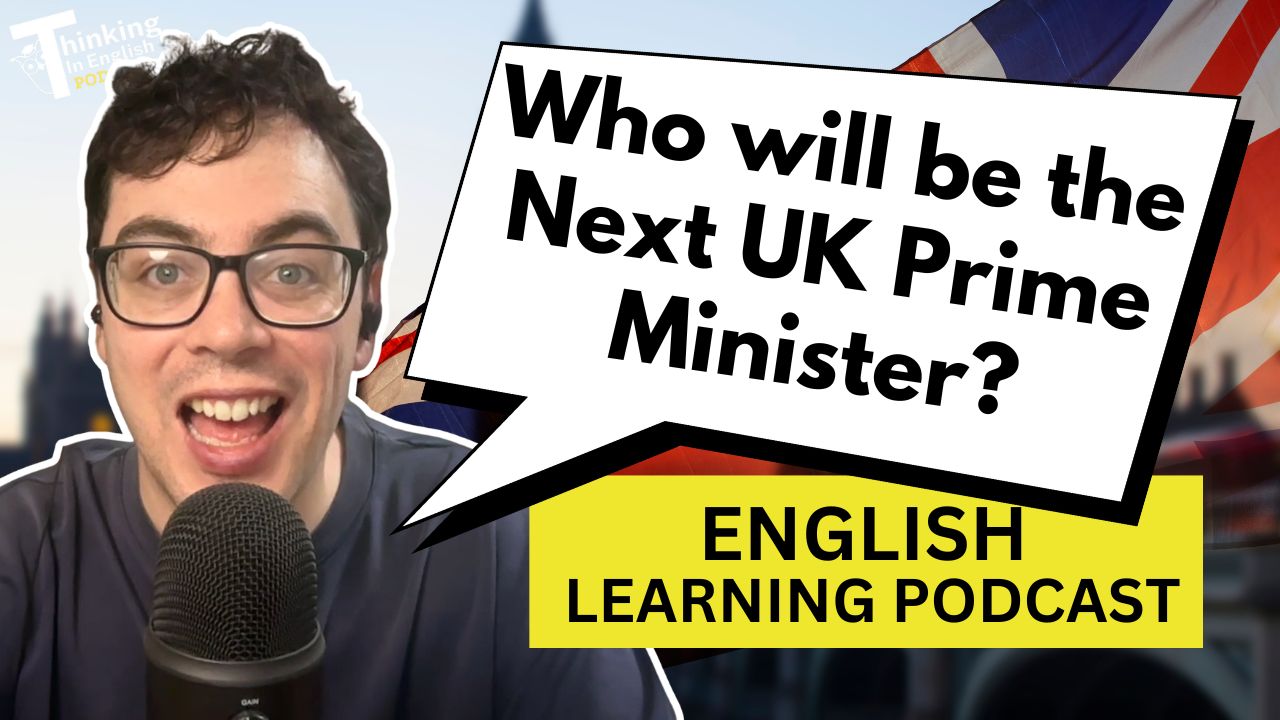
In 2024, Keir Starmer became the Prime Minister of the United Kingdom after leading the Labour Party to one of the biggest election victories in modern British history.
Just two years later, he has announced his resignation… and Britain is once again preparing for a new leader.
Since the Brexit referendum in 2016, the UK has gone through an unusually high number of prime ministers. Each has promised to solve the country’s problems, but then ended up leaving their role earlier than expected.
In fact, this is now the third time I’ve made an episode asking the question, “Who Will Be the Next Prime Minister of the UK?” Episode 161 explored the race to replace Boris Johnson back in 2022, and Episode 302 looked at what might happen if the Conservatives lost power before the 2024 election. We’re asking exactly the same question again in this episode, but this time, it’s the Labour Party looking for a new leader.
So, what happened? Why has Keir Starmer resigned after such a convincing election victory? Who is Andy Burnham, the politician many people expect to replace him? What kind of prime minister might he become? And why has British politics become so unstable over the past decade?
Let’s find out, and at the same time learn some new English vocabulary and practice your English listening comprehension.
Listen Here!
 Apple Podcasts
 Spotify
 YouTube
Interactive Transcript!
You Can Now Read and Listen at the Same Time With an Interactive Transcript!

Vocabulary
- Prime Minister (PM) (n): The head of government in a parliamentary system, responsible for leading the country and the government.
- The Prime Minister announced his resignation after losing support from his party.
- Member of Parliament (MP) (n): A politician who has been elected to represent a constituency in the House of Commons.
- Every constituency in the UK elects one Member of Parliament.
- Resignation (n): The act of officially leaving an important job or position.
- Her resignation came after months of political pressure.
- Referendum (n): A public vote in which citizens decide an important political question directly.
- In the 2016 referendum, UK voters decided to leave the European Union.
- Austerity (n): A government policy of reducing public spending to lower debt.
- Many public services were cut during the years of austerity.
- Constituency (n): The geographical area that an MP represents in parliament.
- Andy Burnham won the by-election in the constituency of Makerfield.
- Devolution (n): The transfer of political powers from a national government to regional or local governments.
- Burnham supports devolution so cities have more control over local transport.
Starmer Victory to Resignation
When Keir Starmer led Labour to victory in the 2024 general election, many people thought Britain had entered a new political era. After 14 years of Conservative governments, Labour won a huge parliamentary majority.
Actually, here I should probably say that in the UK, instead of saying the Conservative Party or the Labour Party or the Liberal Democratic Party, we like to abbreviate it to just Conservatives, Labour, Lib Dems, Reform, Greens. So we like to abbreviate our political parties.
Keir [00:05:00] Starmer won the election in 2024 for Labour, and he promised that he was going to deliver change. He was going to bring back trust in British politics, and maybe bring back some stability to the country.
Since 2016, UK politics has been a mess. It’s been struggling with arguments about Brexit, economic issues and inflation, and then various different political scandals.
And Keir Starmer did have some success. He introduced more rights for workers, he strengthened the UK’s immigration system, and introduced more support for children. But he is resigning, after less than two years. Why?
There wasn’t one single event that has caused Starmer to resign. Unlike previous prime ministers, including Boris Johnson, whose leadership was damaged by the Partygate scandal, or [00:06:00] Liz Truss, who had terrible economic policies that caused chaos, Starmer’s downfall, Starmer’s path to resigning, was slower. It was the result of different problems that gradually built up.


Economy Austerity Fallout
The biggest challenge was the economy.
When Labour came to power, when Labour was elected, they inherited an economy that had experienced years of slow growth. The UK has high public debt, and our public services have been struggling.
The previous conservative governments followed a policy known as austerity. Austerity is an economic policy where governments cut spending and sometimes raise taxes to reduce debt.
So after years of austerity under conservative governments, many voters voted for Labour because they wanted more investment in healthcare, transport, [00:07:00] housing, public services. They wanted the government to stop cutting spending and to start spending more.
But Starmer’s government had issues. Basically, there wasn’t enough money to do everything that people wanted without borrowing more money or raising taxes. So Labour often appeared quite cautious. They didn’t seem very ambitious.
Several government decisions were very unpopular as well. Labour supporters were angered by plans to reform disability benefits. The government was criticized for their plans to change certain benefits for old people.
And then there were some big political controversies.
Starmer was criticized for accepting gifts from wealthy donors, and his decision to appoint Peter Mandelson as Britain’s ambassador to the United States was really criticized [00:08:00] because Mandelson was quite associated with the infamous Jeffrey Epstein.
None of these issues alone would be enough to force a prime minister to resign, but together they contributed to a feeling that Starmer’s government, that the Labour government, was in trouble.

Identity Crisis and Local Losses
Starmer never had a political identity.
Margaret Thatcher had Thatcherism. Tony Blair had the Third Way. Boris Johnson, even though he wasn’t particularly good as a prime minister, he was associated with the idea of getting Brexit done.
Starmer didn’t really have anything. There’s nothing to really think about as a purely Starmer policy.
But the biggest blow to Starmer’s government came a few months ago, during the UK’s local elections. Labour’s results were really disappointing. These were local elections, elections for local town councils or city [00:09:00] councils or local mayors.
Labour did not do well. Reform UK, which is the right-wing populist party led by Nigel Farage, performed really well. So pressure was growing on Starmer.
Eventually, he accepted that many of his own MPs, many of his own Members of Parliament, no longer trusted him to lead the Labour Party. He announced that he would resign as both Labour leader and prime minister once his successor, the next leader of Labour Party, had been chosen.

How a New PM Is Chosen
Here is an important point to remember, though. Labour has a large majority in Parliament and Britain is not holding an election.
The UK is a parliamentary political system. It’s not a presidential political system. This means to choose the next prime minister, the Labour Party simply chooses a new [00:10:00] leader, and the new leader of the Labour Party will automatically become prime minister because Labour controls Parliament.
You can find out more about the difference between prime ministers and presidents in my bonus episode that I will be releasing on Friday, so later this week. That’s on Patreon if you’re interested.

Meet Andy Burnham
But this brings us to the man who is almost guaranteed to take over from Keir Starmer as prime minister: Andy Burnham.
Andy Burnham was born in Liverpool in 1970 and then grew up in Cheshire, close to Liverpool. He has often said that he became interested in politics as a teenager after watching a BBC drama called Boys from the Blackstuff, which focused on unemployment and poverty in Liverpool during the 1980s.
Burnham studied English at the University of Cambridge, but he has spoken about [00:11:00] feeling like an outsider there. In his book called Head North, he described suffering from “imposter syndrome”. Imposter syndrome is the feeling you don’t really belong or deserve your success.
After graduating, he worked briefly as a journalist before going into politics. He was a parliamentary researcher, then a special advisor, and then he was elected as the Labour MP, the Labour Member of Parliament, for Leigh in Greater Manchester in 2001.
He served in several different government positions under Prime Ministers Tony Blair and Gordon Brown. He was the UK’s Health Secretary and also the Culture Secretary.
In 2009, he attended a memorial service marking 20 years since the Hillsborough disaster. Hillsborough was a disaster in which 97 Liverpool football [00:12:00] fans lost their lives during a stadium crush in 1989.
Burnham was loudly heckled by members of the crowd. Heckled means they shouted at him, they abused him, they booed him. Hillsborough was a seriously controversial issue in the UK, and especially in Liverpool, because many families believed the truth had been covered up for years.
Unlike other politicians, Burnham listened to the criticism. He pushed for another inquiry into the disaster, and many Liverpool supporters and people in Liverpool now credit him with helping keep political pressure on the issue.
His popularity increased significantly.
But despite becoming one of Labour’s most recognizable politicians, Burnham twice failed to become the leader of the party. After Labour lost the 2010 general election, he [00:13:00] stood for the party leadership, but he finished fourth behind Ed Miliband. Five years later, he tried again, but then lost to Jeremy Corbyn, and Jeremy Corbyn’s politics completely transformed Labour.

Mayor of Manchester Era
In 2017, he left Westminster to become the directly elected mayor of Greater Manchester.
Actually, Westminster is something called a metonym. A metonym is where we use a place to refer to something bigger. For example, the White House refers to the President. Wall Street refers to the economic center of New York, the financial district. And Westminster refers to the UK Parliament. If you want to refer to the UK government, the civil service, more specifically, you can say Whitehall. So Westminster and Whitehall.
But Burnham left Parliament in 2017, and he went to be the [00:14:00] mayor of Manchester. This could have been seen as a big step down. He left national politics to go and run a city in the north of England.
But it actually strengthened his image, and he wasn’t the only Member of Parliament to go and run a city. Boris Johnson was a Member of Parliament. He quit to become mayor of London, and he went back to Parliament and became prime minister. Andy Burnham has done something similar.
As Mayor of Manchester, Burnham has had quite a good reputation. He’s had a reputation as someone who cared about the problems in the city.
His biggest achievement has been the creation of the Bee Network. The Bee Network is an integrated public transport system that combines buses, trams, cycling, and walking.
Greater Manchester also became the first area outside of London to bring the bus services back [00:15:00] under public control. So instead of being private, they are now publicly owned.
He also became really well known during the COVID-19 pandemic. When Boris Johnson’s government introduced lockdowns, Burnham publicly challenged the government over the levels of financial support being offered to towns in northern England.
This earned him the nickname the King of the North. He was a politician standing up for the north of England.

By-Election Back to Parliament
I mentioned a few minutes ago that Andy Burnham is almost guaranteed to be the next leader of the Labour Party and the next prime minister of the United Kingdom. Of course, things could change after I’ve recorded this episode, but he is almost guaranteed to be the next leader.
But he can’t do this as the mayor of Manchester.
As mayor of Greater Manchester, Burnham left Parliament a decade ago, and under [00:16:00] Britain’s political system, the prime minister is almost always an MP sitting in the House of Commons. If Andy Burnham wanted to become Labour Party leader, he would need to get back into Parliament.
How could he do this? We don’t have a general election for another three years probably.
Well, in order to give Burnham a chance to enter Parliament, the Labour MP Josh Simons stepped down from Parliament. He stepped down to give Burnham a chance.
By stepping down, by quitting, he triggered a by-election in the constituency of Makerfield near Manchester. A by-election is a special election held to fill a parliamentary seat that becomes vacant, empty, between general elections. Instead of the whole country voting, only the people living in that constituency, that [00:17:00] area, choose a new MP.
Burnham was selected as Labour’s candidate, and then he comfortably defeated Reform UK, increasing Labour’s number of votes compared with the last election. And he returned to Parliament for the first time since 2017.
Just days later, he traveled to Westminster, where he was officially sworn in as the MP for Makerfield. On the same day he became an MP, Keir Starmer resigned.
Burnham’s position became even stronger when Wes Streeting, who is one of Labour’s most senior politicians and someone widely expected to enter the leadership race himself, endorsed Burnham. To endorse means give your support. This removed his biggest competitor.
So now Andy Burnham is a member of Parliament, and he will almost certainly be the next leader of [00:18:00] the Labour Party, which means he will be the next Prime Minister.

Burnham as Prime Minister
What would he be like as a prime minister?
Well, no one exactly knows what kind of leader a prime minister will be until they take office, until they become the prime minister. Politicians usually say one thing when they’re campaigning for elections, and then they do something different when they are elected.
But we can make some guesses about what Andy Burnham will focus on as the PM. Throughout his time as Mayor of Greater Manchester, he has argued repeatedly that too much power is in London. He believes that cities and regions in England should have greater control over their transport, housing, education, healthcare, economic plans.
If he becomes prime minister, many people think he is going to push for the biggest transfer of political power in [00:19:00] decades. Instead of making every decision in London, his government could give more responsibility and more funding to regional mayors and local authorities, local councils, across England.
I’m saying England because Scotland, Wales, and Northern Ireland already have their own power. But in England, all of the power is in London.
In fact, Andy Burnham is likely to be the first prime minister since Harold Wilson in the 1970s to not live at Number 10 Downing Street. Number 10 Downing Street is the traditional home of the prime ministers in Central London.
He has said that he’s going to continue living in Wigan in Greater Manchester, and he will split his work week between Manchester and London. To do this, he has proposed creating a permanent government office in Manchester, nicknamed the Number Ten North.
This, I think, would actually [00:20:00] be quite a welcome change. Most of the UK feels that the government focuses far too much on London. And Keir Starmer, our most recent prime minister, is from London. He was born and raised in London. People perhaps want a non-London focused government.
Another likely thing that Andy Burnham will focus on is probably public services. When he was the mayor of Manchester, his biggest creation was the Bee Network, that network that combined cycling and buses and trams and walking. He could propose similar things in other cities, maybe encourage it nationwide.
Rather than talking about economic statistics a lot, Burnham tends to speak about whether people can go to work easily or find affordable homes or receive good healthcare. He seems to be more interested in outcomes than statistics. But obviously [00:21:00] that could change when he is the prime minister.
But one thing that will be different is his communication style. He speaks very differently to some of our previous prime ministers.
Keir Starmer was very cautious, methodical. Before he was prime minister, he was a human rights lawyer. He’s a very lawyer-like prime minister.
Burnham is seen as warmer and more emotional. During COVID-19, he became nationally known for challenging Boris Johnson, and he presented himself as someone willing to fight for Manchester.
Politically, Burnham is what is called a pragmatist. A pragmatist is a person who focuses on solving problems or making decisions based on real world results rather than theories or ideologies or ideals.
You might confuse pragmatism for populism. A populist focuses on doing what makes them popular. Simple answers to difficult [00:22:00] questions is the basic definition of a populist. Whereas a pragmatist, like a populist, maybe doesn’t always stick to an ideology, but they’re doing things to solve problems.
Earlier in his career, he was associated with Labour’s more moderate or center-right side. But over time, he has supported policies like bringing buses under public control or increasing public investment in local services.
Some people have criticized him, saying this is a bit populist. But others say, “Well, actually, this was the best solution for Manchester at the time.”
Having public services meant that Manchester was in a better situation.
Of course, Burnham’s going to have challenges. Britain still faces slow economic growth. The public services are struggling across the country, especially our healthcare system. There’s high government debt, housing shortages, and now the rise of the Reform UK political party. And these problems will not [00:23:00] be solved overnight.

Why Politics Got Unstable
If Andy Burnham does become the prime minister, he will be the seventh Prime Minister of the United Kingdom since the Brexit referendum in 2016. That’s unusual for the UK.
Margaret Thatcher was prime minister for 11 years. Tony Blair was prime minister for over 10 years. David Cameron, whose resignation began this period of instability, was prime minister for six years.
So what changed?
Obvious answer is Brexit. The UK voted to leave the European Union in June 2016, almost exactly 10 years ago, and that revealed some deep divisions in British society. British people disagreed over immigration. They disagreed over what it means to be British, over economic policy, globalization, what kind of country the UK should be.
And these [00:24:00] disagreements didn’t go away after the referendum. They became worse. The UK became more divided.
David Cameron was the prime minister who let the referendum happen. He campaigned for Britain to stay in the European Union, and then he resigned the morning after the Leave campaign won the vote.
His successor was Theresa May. She promised to deliver Brexit, but after years of negotiations with the EU, she failed to get her Brexit deal approved by the UK Parliament. Eventually, members of her own political party lost confidence, and she resigned in 2019.
Boris Johnson was next. He won a huge election victory by promising to get Brexit done, but his government was full of scandals. The most famous scandal was Partygate, where the government held parties during the COVID lockdown for their staff while the public was being told [00:25:00] to stay at home. Johnson eventually resigned after dozens of ministers, senior politicians, quit his government.
His replacement was Liz Truss. Liz Truss is famously the worst prime minister in British history, perhaps. She lasted just 49 days as prime minister. Her first policy was massive tax cuts. This caused the UK’s financial markets, actually, the international financial markets, to panic. The value of the British currency fell, and her government had to abandon all of those plans instantly. She resigned in just 49 days, making her the shortest serving prime minister in British history.
Up next was Rishi Sunak, who inherited a divided Conservative party. His political party were really unpopular, and then they suffered a historic defeat in the 2024 election. So after 14 years of Conservative governments, [00:26:00] they lost.
Next up was Keir Starmer and the Labour Party, but less than two years later, he is resigning as well. And Andy Burnham will be the seventh prime minister.
Why has this kept happening?
Well, as well as the Brexit referendum, Britain has other challenges. Economic growth is weak. Public services are struggling, and there’s a lot of pressure because the population is getting older. Housing is unaffordable.
Politics in the UK is really fragmented at the moment. For decades, there were basically only two political parties people voted for: Labour, Conservatives. But today, people spread their votes across more parties. The Liberal Democrats have done quite well in recent elections. The Green Party, the Scottish National Party, Plaid Cymru (the Welsh Nationalist Party), and now Reform UK as well.
This makes it harder for any leader to build broad support.[00:27:00]
Social media has also changed politics. Every single mistake the government makes is instantly reported, analyzed, criticized, and shared with millions of people. This didn’t happen 30 years ago.
If Andy Burnham does become prime minister, one of his biggest challenges will be proving that Britain’s revolving door of prime ministers, Britain’s constant changing of prime ministers, can finally stop.

Final Thought
Britain is once again getting a new prime minister. Whoever takes over, probably Andy Burnham, will face the same difficult problems that previous prime ministers have faced: slow growth, pressure on public services, rising defense spending, housing shortages, divided politics.
Since the Brexit referendum in 2016, the UK has gone through a lot of prime [00:28:00] ministers, and each new leader has promised stability, but failed every time.
Can Andy Burnham change this? Or is political instability now normal in Britain?
Well, I’m not sure. I hope he does well. I hope he’s a good prime minister for the sake of the United Kingdom. But let’s see. Let’s see how he does.
But what do you think? Are frequent changes in leadership healthy for a democracy? Or do they make it harder for the government to solve problems?
Actually, how does your country choose its leader? Do you have a prime minister? Do you have a president? How often do your country’s leaders change?
Extended Vocabulary List
Become a Patreon Subscriber to Access the Extended Vocabulary List!


Vocabulary Games and Activities!
Learn and practice vocabulary from this Thinking in English episode.
Practice using 5 different study games and activities – including writing, listening, and memorisation techniques!
Flashcards
Matching Game
Learning Game
Test Yourself
Listening and Spelling
Do you want to Think in English?
I’m so excited that you found my blog and podcast!! If you don’t want to miss an article or an episode, you can subscribe to my page!
