

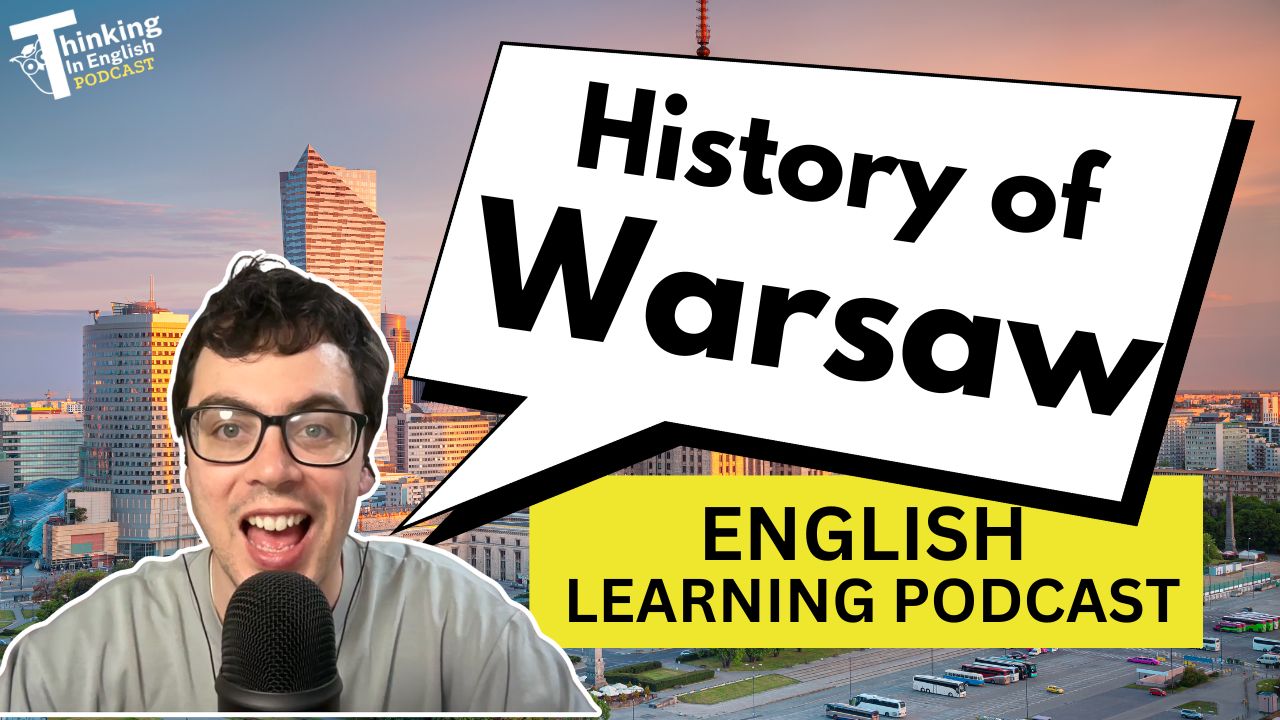
Today, we’re going to talk about Warsaw. Warsaw is the capital of Poland and one of Europe’s most resilient cities.
If you visit Warsaw today, you’ll find a modern and quickly developing European capital. There are skyscrapers, busy shopping streets, trendy cafés, and a growing economy. But history of city is dramatic and tragic.
In this episode, I am going to explore the fascinating history of Warsaw. We’ll look at its rise as Poland’s capital, periods of foreign occupation and division, the devastation of World War II, communist rebuilding, and the modern city we see today.
And we will learn some new vocabulary and practice our English listening comprehension at the same time!
Listen Here!
 Apple Podcasts
 Spotify
 YouTube
Interactive Transcript!
You Can Now Read and Listen at the Same Time With an Interactive Transcript!

Vocabulary
- resilient (adj): able to recover quickly from very difficult conditions
- Warsaw is one of Europe’s most resilient cities.
- partition (n): the division of a country’s territory among foreign powers
- In a series of events known as the Partitions of Poland, the territory was gradually split between Russia, Prussia, and Austria.
- uprising (n): a rebellion or revolt against a ruling authority
- Jewish fighters inside the Warsaw Ghetto launched an uprising in 1942.
- siege (n): a military operation in which forces surround a city to cut it off and force it to surrender
- Warsaw was surrounded by German forces during a period known as the Siege of Warsaw.
- atrocity (n): an extremely cruel or shocking act, especially one committed during wartime
- Under Nazi occupation, Warsaw became the site of some of the worst atrocities of the war.
- reconstruction (n): the process of rebuilding something after destruction
- The reconstruction of Warsaw’s Old Town was so remarkable that UNESCO has recognised it as an example of near-total historical reconstruction.
- regime (n): a government in power, often with the suggestion of authoritarian control
- A new communist regime took power, supported politically and militarily by Moscow.
Warsaw’s Beginnings
Warsaw wasn’t always a capital city. Actually, before we get into the main part of the episode, I should probably mention that I’m going to use the British English pronunciation for most of these Polish place names.
Polish and English are very different languages, so the pronunciations can be quite different. And I’m also not using the American English pronunciations, but the British pronunciations. So I will be saying Warsaw to refer to the capital of Poland.
But for a long time, [00:04:00] Warsaw was just a modest community of fishermen and traders living behind the Vistula River. The Vistula River is the longest river in Poland.
The community was in a strategic position between Eastern and Western Europe. Merchants traveling across the region would sometimes pass through Warsaw.
During the Middle Ages, it gradually became an important town. The population increased, and the settlement grew. Although cities like Krakow were far more powerful and far more influential, Warsaw was beginning to establish itself as an important place.
Today, we think of roads or railways as the main ways to transport people and goods. But during the Middle Ages, rivers were the equivalent of highways. If you could travel by water, it was much faster and much [00:05:00] more efficient, especially as most of the continent, most of Europe, was covered by forests and didn’t have nice roads or paths to go between different cities.
Cities located next to major rivers were often the cities that became wealthy and politically important. Merchants used rivers to transport food, wood, salt, cloth, any other products between different parts of the continent.
You’ll know this if you’ve listened to my previous episodes on the history of various cities. New York, London, Istanbul, Rome, Berlin, Nagasaki, all of these places are built on important rivers or important coastlines.
Warsaw’s location on a river was therefore very important.


Legends and Folklore
And like many old European cities, Warsaw has some fascinating legends and folklore about its name’s [00:06:00] history.
One famous story explains the origin of the city’s name through two characters called Wars and Sawa. I think that’s how you pronounce them.
In some versions of the story, Wars was a fisherman and Sawa was a mermaid. In others, they were a normal couple who welcomed a traveling prince. Over time, their names were supposed to combine to create Warszawa, which is kind of like the Polish name for Warsaw. Sorry, I’ve mispronounced it probably.
Another famous symbol in the city is the Warsaw mermaid. Statues of the mermaid can be found throughout the city. And according to legend, the mermaid was supposed to protect the people of Warsaw.
Stories like this give us a chance right now to talk about myths, legends, and folklore.
A myth is usually a traditional story involving gods or supernatural explanations of the [00:07:00] world. A legend is typically connected to real places and historical figures, although parts of the story might not be true. And folklore is a broader term that includes stories, customs, beliefs, and traditions held by people.

Becoming Poland’s Capital
As I said before, Warsaw wasn’t always the capital of Poland. For a long time, that was Kraków.
Kraków is a southern city that was the royal capital of the Polish kingdom. Polish kings were crowned there, and it was considered one of the most important cities in Central Europe.
In the late 1500s, the king decided to transfer the royal court from Kraków to Warsaw. The move was completed in the beginning of the 17th century, around the year 1611. Technically, though, Warsaw didn’t officially become the named capital until later, but it was functionally the [00:08:00] capital once the king moved there.
Warsaw was located more centrally within the Polish-Lithuanian Commonwealth. This was an enormous political union that connected the Kingdom of Poland and the Grand Duchy of Lithuania.
At its height, the Polish-Lithuanian Commonwealth was one of the largest and most powerful states in all of Europe. It included parts of Poland, Lithuania, Belarus, Latvia, and Ukraine.
Because the state was so large, governing it from Kraków in the far south was a bit inconvenient. Warsaw’s more central location made ruling the Commonwealth a bit easier. Warsaw is also between the cities of Kraków and Vilnius. Vilnius is the historical capital of Lithuania, so choosing Warsaw as the capital meant that it was kind of in the middle, a [00:09:00] compromise.
The Polish-Lithuanian Commonwealth was an unusual political system for its time. Unlike many European countries which were ruled by strong, absolute monarchs or strong kings and strong queens, the Commonwealth gave most of its power to the nobility.
Kings were elected rather than automatically inheriting power, and the important decisions made in the Commonwealth often required approval from a kind of parliament.
Of course, it was not a democratic system by what we now understand as democracy, but compared to many other European countries at the time, the Commonwealth was considered relatively open especially for noble people.
It was also very multicultural and multiethnic. Poles, Lithuanians, Jews, Ukrainians, Germans, Armenians, and many other communities lived inside the Commonwealth. [00:10:00] This meant there were multiple languages, religions, and traditions.
Warsaw became the capital of this enormous state. The population grew. Wealthy nobles built grand palaces and elegant residences in Warsaw. And the city hosted royal ceremonies, diplomatic events if other countries’ leaders came to visit.

Partitions and Russian Rule
Gradually though, the Polish-Lithuanian Commonwealth became weaker, especially during the 1700s. At the same time, nearby countries like Russia and Prussia and Austria were becoming more and more powerful, and more and more ambitious.
Eventually, these countries decided to divide Poland among themselves. In a series of events known as the Partitions of Poland, the territory of the Commonwealth was gradually split between Russia, Prussia, and [00:11:00] Austria. There were three separate partitions in 1772, 1793, and 1795.
After the final partition, Poland disappeared. Poland completely disappeared from the map of Europe. For more than 100 years, there was no independent Poland. No Polish state.
This is one of the most fascinating, extraordinary parts of Polish history. Imagine your country suddenly no longer exists. It no longer has a place on the map of the world. Well, this happened to Poland.
Warsaw eventually ended up in the Russian Empire. The Russian Empire ruled a lot of central and eastern Poland during the 19th century.
Many Polish people strongly opposed Russian rule, and different uprisings broke out against Russian authorities. Two of the most famous rebellions were the [00:12:00] November Uprising of 1830 and the January Uprising of 1863. Both of these were ultimately unsuccessful.
The Russian Empire responded harshly. They attempted to suppress, to stop, Polish nationalism and Polish resistance movements. They did this by using severe punishments and restricting political freedoms.
For example, they limited the use of Polish language in schools and some government institutions.
But despite this, Polish identity survived. Polish people worked hard to keep their culture, and Warsaw was a big part of this Polish identity.

Independence and Interwar Hopes
After more than 100 years of foreign occupation, Poland finally regained independence at the end of World War I. This new period of independence was known as the Second Polish Republic, and [00:13:00] Warsaw officially became the capital of this new republic.
The interwar period, which means the years between World War I and World War II, was a time of optimism in . It was also a difficult time. There was enormous excitement about rebuilding the country, but so many challenges.
Poland had to unite parts of the country that had been controlled by different empires for more than a century. The economy was unstable, and there was political arguments quite often. Also, the country faced tensions with some of the neighboring countries.

World War II
And then, in September 1939, Germany invaded Poland. The invasion happened with shocking speed and violence. German forces attacked from the west. They used tanks, aircraft, and rapid military movement to [00:14:00] quickly invade Poland.
Warsaw became one of the main targets for the German attacks. Within days, the city had been heavily bombed from the air. Buildings collapsed. Fires spread throughout the neighborhoods. Thousands of people were killed or injured.
Polish soldiers and normal people resisted, but Warsaw was surrounded by German forces. This period became known as the Siege of Warsaw. For several weeks, the city continued fighting under constant attacks, but they started to run out of food, and the city was becoming more and more damaged. Eventually, the Germans captured Warsaw at the end of September 1939.
Under Nazi occupation, Warsaw became the site of some of the worst atrocities of the war.
In 1940, the Nazis ordered Jewish residents of [00:15:00] Warsaw to move into a sealed part of the city, which had been surrounded by walls and guarded checkpoints.
This was known as the Warsaw Ghetto. More than 400,000 Jewish people were forced into an extremely overcrowded area with terrible living conditions. Families separated, people starving, diseases spreading through the area.
Beginning in 1942, hundreds of thousands of Jewish residents were transported from the ghetto to Nazi death camps. Most were murdered shortly after they arrived as part of the Holocaust.
Yet, even in these conditions, people resisted. In 1943, Jewish fighters inside the ghetto launched what became known as the Warsaw Ghetto Uprising. They had no chance of victory. They had no weapons, and they were up against [00:16:00] much stronger German military, but they chose to resist. They chose to fight, instead of just accepting their deaths and deportation.
For nearly a month, the fighters held out against German forces. Eventually, the uprising was crushed, and much of the ghetto destroyed.

1944 Warsaw Uprising
In 1944, another major uprising began, the Warsaw Uprising. This uprising was organized mainly by the Polish resistance movement, known as the Home Army. Their goal was to save Warsaw from German occupation before Soviet forces entered the city.
They hoped that they could regain control of Warsaw and demonstrate that Poland could be an independent country after the war.
On August 1st, 1944, thousands of resistance fighters launched attacks across the city. Ordinary [00:17:00] people built barricades and supported resistance fighters, but they lacked weapons and they lacked supplies, and Germany responded with overwhelming violence, overwhelming brutality.
Fighting consumed the city for 63 days.
Meanwhile, Soviet forces had arrived in the area. They remained across the river and did not intervene in time. Historians still debate today why the Soviet Army didn’t help the people of Warsaw. For many Polish people today, the lack of Soviet assistance during World War II is a painful part of the war.
Eventually, the uprising failed. It collapsed. After defeating the resistance the German army carried out a near total destruction of Warsaw. They destroyed everything. Historical [00:18:00] buildings, homes, libraries, churches, they were all intentionally demolished. By the end of the war, around 85% of Warsaw had been destroyed. It had been almost completely erased.

Communism
When the war ended in 1945, Warsaw barely existed. It barely existed as a functioning city. At the same time, Poland entered a completely new era.
Although the war was over, Poland did not become independent in the way that people had hoped. Instead, the country fell under Soviet influence and gradually became a communist state aligned with the Soviet Union.
A new communist regime took power, and they were supported politically and militarily by Moscow. Under this system, Poland had to rebuild, and [00:19:00] especially they had to rebuild Warsaw.
In some places, this meant rebuilding entire new districts. In other areas, especially in the historical center, they tried to recreate the old districts, recreate the old city, as accurately as possible. They carefully rebuilt many of Warsaw’s historic streets.
One especially important source of information to help them base their designs on were the detailed paintings of an 18th-century artist called Bernardo Bellotto. His artworks captured the appearance of Warsaw before it was destroyed.
Today, if you go to Warsaw and you walk around Old Town, it feels like you’re surrounded by medieval or early modern architecture. But actually, what you’re seeing was almost entirely rebuilt after 1945.
The [00:20:00] reconstruction was so remarkable that UNESCO recognized Warsaw Old Town as an outstanding example of near total historical reconstruction.
But of course, Warsaw’s post-war identity, Warsaw’s story, was deeply influenced by communist politics.
On the one side, Warsaw had lots of reconstructed churches and historical squares and streets. But on the other side, there were massive socialist buildings. Those big apartment blocks and socialist architecture designed to symbolize communist power and communist modernization.
The Palace of Culture and Science is an example. It was completed in the 1950s, and a gift from the Soviet Union to the Polish people. The building dominated Warsaw’s skyline, but it has always been controversial.
Life in communist Poland was [00:21:00] complex. The country was rebuilt and industry expanded, but freedom was heavily, heavily restricted. The communist government-controlled media, closely monitored public life. There were also economic problems becoming quite serious in the 1970s and ’80s.

Solidarity and 1989 Change
Resistance to communism grew across Poland. One of the most important developments was the rise of the Solidarity movement in the 1980s.
Solidarity was originally an independent trade union formed in the shipyards of Gdansk, and it quickly became a massive social and political movement, demanding workers’ rights, reforms, and greater political freedom.
By the late 1980s, communist governments across Eastern Europe were becoming weaker. The Soviet Union was struggling, economically and politically, [00:22:00] and there was this new pressure for reform.
In 1989, Poland held partially free elections. This was the beginning of the end of communist rule. Poland was one of the first countries in the Eastern Bloc, the countries influenced by the Soviet Union, to move away from communism peacefully.

Modern Warsaw Today
Today, Warsaw is one of the fastest-growing cities in Central Europe.
Global corporations have opened offices in Warsaw. There are cafes and museums, tall skyscrapers. The city now attracts international students and international workers. Tourism has grown as people have become more interested in Poland.
In fact, I could do an entire episode, I might do an entire episode, on the rise of Poland. Poland is one of the success stories of countries that used to be aligned with the Soviet Union.
I think [00:23:00] what makes Warsaw fascinating is that it has this mixture of histories. There are carefully rebuilt historical sites from the medieval period, and then communist-era massive apartment buildings which represent life between 1945 and 1990, and then the modern skyscrapers that exist today.
Warsaw also represents something more. Warsaw was occupied, divided, almost completely destroyed, rebuilt under communism, and now modernizing again after the end of the Cold War.

Final Thought
Warsaw’s history is one of the most interesting stories in Europe. It has survived foreign occupation, disappeared politically for more than a century, experienced the horrors of World War II, [00:24:00] and was almost completely destroyed.
But it rebuilt itself, and now the city is modern, international, and in Poland. Poland is one of the most exciting and quickly growing countries in Europe.
But what do you think? Have you visited Warsaw? Would you like to visit? How should cities remember traumatic events like war and occupation? And what city should I cover next in this series?
Extended Vocabulary List
Become a Patreon Subscriber to Access the Extended Vocabulary List!


Vocabulary Games and Activities!
Learn and practice vocabulary from this Thinking in English episode.
Practice using 5 different study games and activities – including writing, listening, and memorisation techniques!
Flashcards
Matching Game
Learning Game
Test Yourself
Listening and Spelling
Do you want to Think in English?
I’m so excited that you found my blog and podcast!! If you don’t want to miss an article or an episode, you can subscribe to my page!
