

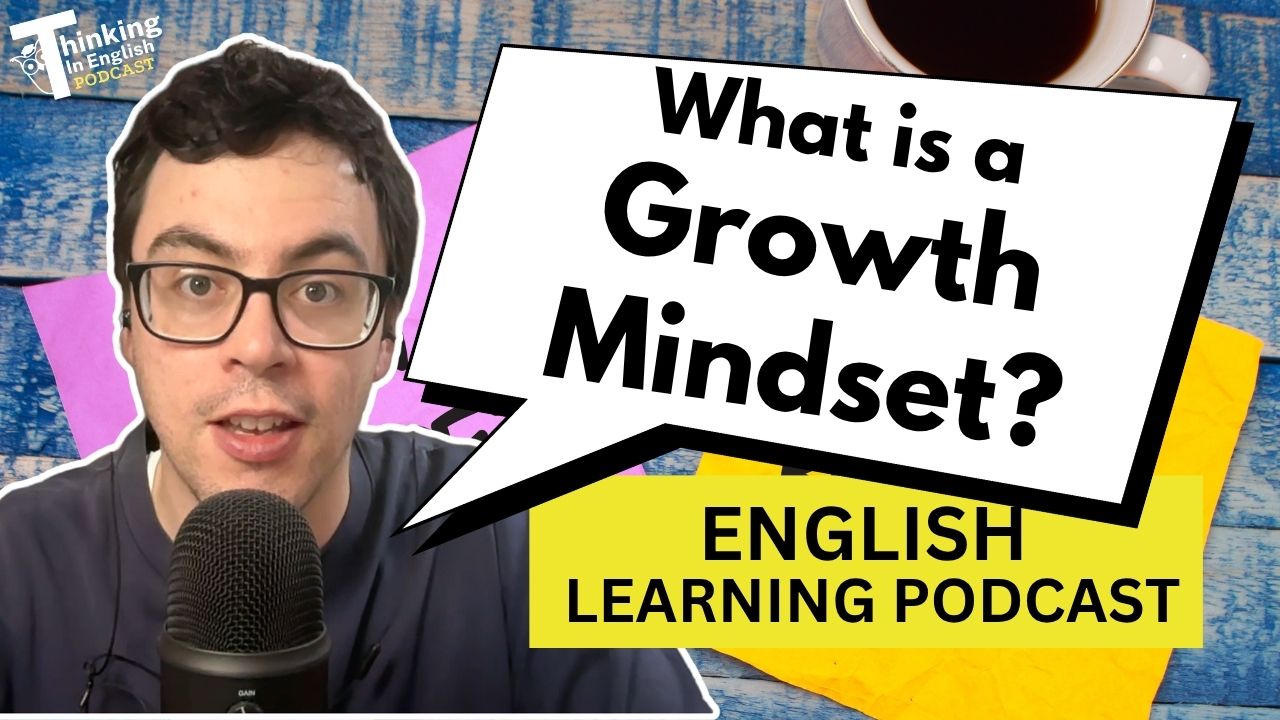
Some people see failure as proof that they aren’t good at something. Others see it as an opportunity to improve. Why?
Today I want to try and answer this question by thinking about “growth mindsets”. The growth mindset concept suggests that our abilities aren’t completely fixed, and that we can improve through practice and effort.
We are going to look at what a growth mindset means, how it affects learning, and why it can be particularly important when learning a language. And at the same time, we will practice our English listening comprehension and learn some new vocabulary!
Listen Here!
 Apple Podcasts
 Spotify
 YouTube
Interactive Transcript!
You Can Now Read and Listen at the Same Time With an Interactive Transcript!

Vocabulary
- mindset (n): a particular way of thinking about something
- A positive mindset can make learning more enjoyable.
- aptitude (n): a natural ability or potential to learn something
- She has a natural aptitude for languages.
- potential (n): the possibility of developing into something greater or better
- He has the potential to become a very good speaker.
- interpret (v): to understand or explain the meaning of something
- I interpreted his silence as a sign that he disagreed.
- approach (n): a particular method or way of dealing with something
- I need to try a different approach to learning vocabulary.
- adapt (v): to change your approach to suit a new situation
- Good learners adapt their strategies when something isn’t working.
- feedback (n): information about your performance that helps you improve
- My teacher gave me useful feedback on my pronunciation.
Fixed vs Growth
What is a growth mindset?
A mindset is a particular way of thinking about something. Mindset includes the beliefs and [00:03:00] attitudes that we have, and these beliefs can influence how we behave.
An example of a mindset is a “positive mindset“. If you have a positive mindset, you are thinking positively, optimistically about something.
For this episode, though, the two key concepts are “fixed mindsets” and “growth mindsets“.
A person with a fixed mindset tends to believe that ability is fixed or relatively fixed. They might believe things like your intelligence or your creativity are things that you are born with. You either have talent or you don’t have talent for something.
This can be true for language ability. Some people with fixed mindsets believe that the ability to learn a language is also fixed. I’m sure some of you have [00:04:00] this mindset now. Perhaps you think something like, “I have a terrible memory, so I’ll never learn vocabulary.”
That statement, “I’ll never learn vocabulary,” doesn’t just describe your current ability. It suggests that you think your ability is permanent. You’re never going to be able to learn vocabulary.
If you believe you aren’t naturally good at languages and you can’t improve, you’re going to spend less time practicing, and you’re going to be less optimistic about your future.
Someone with a growth mindset believes that abilities can develop and improve. It’s the opposite to a fixed mindset. Fixed mindset… your ability is fixed. It’s static. You have what you have. You can’t improve it.
Whereas a growth mindset believes that your ability can change. Your ability can improve, or it can get worse, I guess, but [00:05:00] it can also improve. Being bad at something right now doesn’t mean you’re going to be bad at it forever. Your ability can change and will change.
This might sound a little bit like being an optimist or a pessimist. Optimists think things will be better. Pessimists think things will be worse in the future. But I think it’s a little bit different.
The main difference between growth and fixed mindsets is how you interpret, how you understand, your ability. People have different abilities. That is undeniable. People have different natural abilities, circumstances, opportunities, limitations. This is the case.
I made an episode a few months ago on talent, where I talked about the differences between talent and skill and ability and opportunity.
The most important thing you can take away from today’s episode [00:06:00] is that your current ability is not necessarily the limit of your ability, right? That your current level right now, your current abilities right now is not necessarily the limit. You can get better. And that is the core belief behind the idea of a growth mindset.


Aptitude and Age
We all know people who seem to be naturally good at things. We’re all language learners here. I’m a Japanese learner.
Some people just seem to pick up languages really quickly and naturally. Unfortunately, I am not one of these people. I’ve been learning Japanese for 10 years now.
Aptitude is a term for a person’s natural ability, or I guess their potential to learn something. In language learning, in English learning, some people find it easier to remember vocabulary than other people. They have a natural aptitude for remembering vocabulary.
But having [00:07:00] different levels of aptitude doesn’t mean that ability is fixed. There are people who seem to learn foreign languages very quickly. Other people seem to need more time.
But just because you struggle at the beginning, it doesn’t mean you’re going to struggle learning forever. Your ability can develop and can improve with practice and experience.
Another common belief around learning languages and abilities is to do with age. There is certainly evidence that age can affect language learning, particularly pronunciation and some aspects of grammar as well. Children seem to be better at learning things like pronunciation and those grammar aspects.
But this doesn’t mean that adults are incapable of becoming highly proficient. Of course they are. Adults are able to become fluent in language.

Mixed Mindsets
Your belief about your language [00:08:00] ability isn’t actually one belief.
Research has suggested that people hold beliefs in different areas. They have different mindsets for different parts of their learning ability, I guess.
People hold beliefs on their general language ability. This is whether your ability to communicate can change. They also hold beliefs on their aptitude for learning languages, and on things like how age affects learning.
People can have a fixed mindset on one of those areas and a growth mindset on another area. It’s not as simple as just being a, a fixed mindset or a growth mindset person.
In fact, research published by Lou, Chaffee, and Noels in the journal called Studies in Second Language Acquisition found that only 20% of language learners had a clearly growth-oriented mindset, while another 20% had [00:09:00] a clearly fixed mindset.
That means that the majority of language learners, about 60% of all language learners, have a mixed mindset.
I don’t find this surprising. There are a lot of people who believe that they can improve certain parts of their ability in language learning, but also that they can’t improve parts of their language learning.
I’m an example of this. I have a growth mindset when it comes to things like vocabulary, and when it comes to things like grammar acquisition. But I have a bit more of a fixed mindset when it comes to my writing ability in Japanese. It’s something that I don’t practice much because I don’t necessarily believe I can become good at it.
I know if I had a growth mindset and I dedicated my time and practice and effort, I would become better. I would develop the ability. But just naturally, I have a fixed mindset on that regard, and it’s something I need to change.
We’ll talk about [00:10:00] it later. You can change your mindset, of course.

Failure and Feedback
Does having different beliefs about your abilities change the way you learn?
Well, the answer is potentially yes. Not definitely yes, but potentially yes. Our mindset can influence how we respond to challenges and how we respond to the mistakes we make.
A learner with a more fixed mindset might see a disappointing result, maybe you fail a test, and then they use that disappointing result as evidence they don’t have the correct ability, or they don’t have the ability to succeed. They might decide that there is no point in trying anymore because they are not naturally talented at that aspect of language learning.
But if you have a growth mindset, so the opposite type of mindset, you can get a similar result, a failure in a test, but you use that to improve. You ask for feedback and you change your study [00:11:00] methods. You practice more, work more, and you can improve.
Basically, failure can have a different meaning for everyone. If you have a fixed mindset, failure can feel like a judgment of your ability. You fail an exam, or you have a bad performance in a conversation, or you write a essay which your teacher says is not very good, and you take that as a judgment on your ability.
But if you have a growth mindset, the failure, the bad result, is just information to help you improve.
Mindset can also affect the kind of challenges that people are willing to take. When you believe your ability is fixed, when you believe you can’t improve your natural ability, challenging tasks feel really threatening, right? They create a risk of failure, and failure makes you feel bad. Failure makes you feel like you’re not talented enough.
People with growth mindsets, of course, don’t like failing. Failure is still [00:12:00] frustrating. But if you have a growth mindset, you’re less likely to see one failure as proof that you should give up.
This is particularly important for language learners. You’re going to make mistakes. Of course you are. If you interpret every mistake you make as evidence that you’re bad at English, learning English is not going to be fun for you. But if you treat your mistakes as just as part of learning, then they give you useful information. They help you improve.

Work Smarter Methods
Having a growth mindset is not the same thing as believing that working harder will make you better. They’re often connected, but it’s not the same thing. Working harder does not always make you better.
You’ve probably heard the cliché… “work smarter, not harder“. It’s quite a cliché, but there is some truth there.
If you’re really struggling with something, doing exactly the same thing for twice as long might not help you. Sometimes you need to [00:13:00] change how you’re studying, how you’re learning.
For example, I have, in the past, spent hours every day memorizing long lists of vocabulary, and then I still forgot all of the words I tried to remember. Working harder there was not the answer. Spending two hours remembering lists of vocabulary was not going to help me learn Japanese faster.
What I needed was a different approach. And those different approaches included things like learning vocabulary in context, using spaced repetition, or reading more, listening to podcasts, I don’t know, using words in conversations.
All of those things are not the same as working harder. They’re working differently, doing a different approach. I realized my days of vocabulary study using my textbook wasn’t working very well for me. It worked when I was a beginner, but not so much as I’ve become more advanced.
I found it quite useful in my [00:14:00] own studying journey to be a bit reflective and question my ability, question myself and my performance, and not just rely on the methods that worked for me 10 years ago today. 10 years ago, I learned so quickly. Today, I don’t learn as quickly. The methods I need today are different from the methods I needed 10 years ago.
I try to ask myself… what kind of mistakes do I make? And am I learning from those mistakes? Or is my current learning method effective? How could I do things differently? Is there someone who could give me useful feedback? ‘Cause feedback is really important.

Adapting Strategies
A growth mindset involves being willing to change, right? Being flexible. Adapt. Different language learners need different things.
Some of you listening to me right now might benefit enormously from joining my conversation clubs for speaking practice, but not all of you will benefit. Some of you will, not all of you will.[00:15:00]
Some of you might be great at remembering vocabulary through flashcards, but not all of you will enjoy that approach.
Everyone needs different approaches. Everyone needs different strategies. You have to find the approach that works for you.
Feedback is so important. Whether it’s from a teacher or an app or, I don’t know the, the back of your textbook where you have your answers counts as a form of feedback. Feedback tells us how well we’re doing something, and it tells us when we do something wrong and when we make mistakes. Feedback is so important to improving.
Having a growth mindset means accepting feedback and seeing it as constructive criticism. Just because I say that, “Oh, you pronounce this word incorrectly,” does not mean I’m saying you’re bad at pronunciation. I’m helping you improve your pronunciation.

Changing Your Mindset
One of the most interesting things about a growth mindset is that mindset is not permanent. We can [00:16:00] change the way we think about our abilities, and you can also have different mindsets at the same time.
I have a growth mindset when it comes to academic subjects like language learning and maths. I have always thought that I can learn and get better.
But I have a fixed mindset in things like my musical and artistic ability. I believe that I am bad at music and art, and I will never get better. This has stopped me from ever learning piano, right? Or improving my ability to draw because I have this fixed mindset that I will not get better. The reality is if I tried, if I practiced, I probably could improve my ability.
I guess you need to reflect, we need to reflect, on where we have fixed mindsets. What part of our lives or which of our abilities do we consider to be fixed and which do we consider improvable? Because all abilities are improvable.
I’ve been working around English education for a [00:17:00] decade now. Even though I don’t teach English anymore, I do this podcast. I talk to many English learners every single week, and it’s really common for people to make absolute or fixed statements about their ability.
It’s really common for people to say something like, “I’m not good at public speaking.” A tip to change your mindset here would be to add the word “yet” to this kind of sentence. “I’m not good at public speaking, yet.”
The word “yet” suggests that maybe right now you’re not the best, but you could be good in the future. This immediately changes you to a more of a growth mindset. “I’m not good at public speaking yet, but I will be good.”
If you can’t do something yet, you need to think about what you can do to get closer to being able to do it.
Comparing yourself to other people can also create this kind of fixed mindset. There will always be someone better than [00:18:00] you. That’s just the way the world is. There will almost always be someone better than you, someone who learns faster than you, someone seems more talented than you, someone who seems to be great at pronouncing words, someone who seems to be able to think in a more creative way than you.
It’s better just to compare yourself to yourself. Compare yourself to your past self
Teachers also need to help develop a growth mindset, and quite a few of you listening are teachers. One way a teacher can develop or help develop growth mindsets is by focusing on the learning process rather than telling students that they are intelligent or talented.
If you say, “Wow, you’re really good at this. You must be really intelligent,” you’re saying to a student that their ability is fixed. It’s based on their innate talent, when the reality is they have worked hard to develop that skill. Focusing on the skill itself, focusing on their hard work, encourages them to work harder and [00:19:00] get better.
One of the things I really disliked when I was working in Japanese schools was when other teachers told students or classes that there was something that people didn’t have the ability to do.
The example I can think of right now is, I always remember observing an American English teacher’s class where during a pronunciation lesson focusing on L-R minimal pairs, /l/, /r/ minimal pairs…river versus liver. Right versus light.
He told students that Japanese people can’t pronounce the English letter R very well, R very well, so don’t worry about it. Of course, some Japanese people do struggle with L, R distinctions because these sounds are not distinct in Japanese, but that does not mean they can’t improve, they can’t learn, or they can’t develop.
Telling someone that they can’t do something [00:20:00] because of their nationality, because they’re Japanese, leads to a fixed mindset, where that person will decide that there is no point practicing pronunciation because they can’t improve, when the reality is they can improve.
You can improve, and it’s important to develop in yourself a growth mindset. Remind yourself that you can improve. It’s not guaranteed you will improve, but you can improve. You always have the option, the ability, the opportunity to improve.

Final Thought
Does having a growth mindset matter?
Yeah, I think so. The biggest benefit to having a positive mindset, a growth mindset, is that it can help you respond to difficulty in a productive way. When you encounter a challenge, when you fail, when you make a mistake, you’re going to learn from it rather than feel sad.[00:21:00]
The same way of thinking can apply to anything you want to get better at. Having a growth mindset will help you study, get better at sport or music public speaking, developing new skills.
Of course, people have different abilities, different limitations. Sometimes we need to make more effort to progress than other people. But your current ability is not the limit of your ability. You can always have the opportunity to improve.
But what do you think? What type of mindset do you have? Do you have a growth mindset? Do you have a fixed mindset? Are you a bit mixed? What part of your language learning ability do you think you can improve? And what part do you feel a bit more skeptical, pessimistic over?
Extended Vocabulary List
Become a Patreon Subscriber to Access the Extended Vocabulary List!


Vocabulary Games and Activities!
Learn and practice vocabulary from this Thinking in English episode.
Practice using 5 different study games and activities – including writing, listening, and memorisation techniques!
Flashcards
Matching Game
Learning Game
Test Yourself
Listening and Spelling
Do you want to Think in English?
I’m so excited that you found my blog and podcast!! If you don’t want to miss an article or an episode, you can subscribe to my page!
