

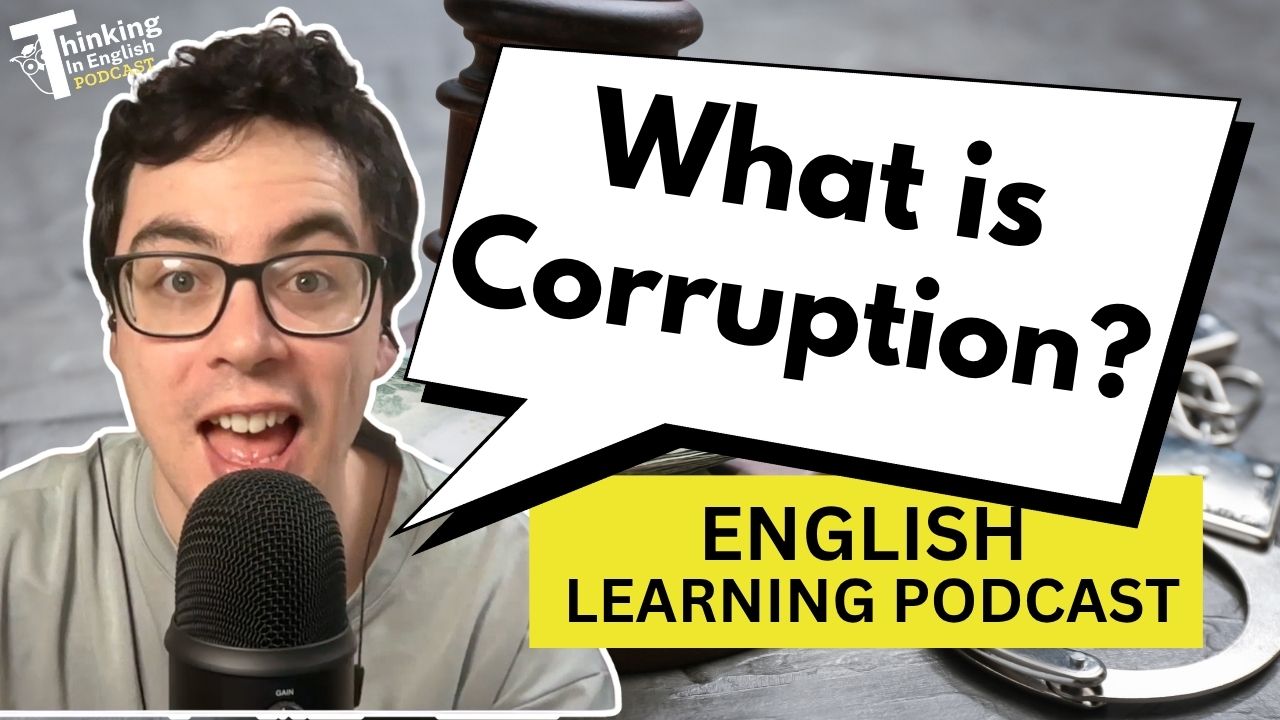
What is corruption?
Corruption or corrupt are words that I use quite often in my episodes… but what is corruption? What forms does it take? Why does corruption happen, what damage does it cause, and why can it be so difficult to stop?
In this episode, we are going to look at different types of corruption, the political and economic conditions that allow it to develop, and some of the consequences for ordinary people and society. We’ll also look at three famous corruption scandals: the 1MDB scandal in Malaysia, the Siemens bribery scandal, and the huge corruption scandal that shook FIFA in 2015.
So, let’s understand corruption while improving our English listening comprehension and learning some new vocabulary!
Listen Here!
 Apple Podcasts
 Spotify
 YouTube
Interactive Transcript!
You Can Now Read and Listen at the Same Time With an Interactive Transcript!

Vocabulary
- corruption (n.): dishonest or illegal behaviour involving the abuse of power for personal gain
- Corruption can prevent governments from spending public money effectively.
- abuse of power (phr.): using authority or influence in an unfair or improper way
- Using your political position to help your own business is an abuse of power.
- bribery (n.): giving or receiving something valuable to influence someone’s actions
- The company was accused of bribery after paying a government official to win a contract.
- embezzlement (n.): illegally taking money or property that you have been trusted to manage
- The accountant was arrested for embezzlement after stealing money from the company’s accounts.
- nepotism (n.): giving jobs or advantages to family members because of their relationship
- The politician was criticised for nepotism after giving his brother a senior government position.
- transparency (n.): openness about decisions, actions, and the use of money or information
- Greater transparency would make it easier for the public to see how the government spends its money.
- accountability (n.): responsibility for your actions and their consequences
- Strong accountability is essential if governments want to prevent corruption.
Defining Corruption
What exactly is corruption?
The word corruption is a relatively broad term. I think many of you listening might be aware of corruption and have attached your own meanings or your own images to the term.
You might immediately connect corruption to a politician taking a bribe or a government official stealing money. Those are certainly examples of corruption.
A traditional definition of corruption is the abuse of public office for personal gain. Someone is given a position of [00:04:00] responsibility, like being a politician or a judge. They then use this position to benefit themselves. Instead of using their power to serve the public, they benefit themselves.
This is the basic, traditional definition of corruption. But modern definitions tend to be broader.
Corruption can be understood, in general, as the abuse of power or influence for improper gain. It doesn’t necessarily need to involve a government official or someone in public office. It could be in a private company. And it doesn’t necessarily need to involve money either, just any kind of gain.
A business executive might use their position to help a friend get a contract. or a politician might give government jobs to members of their family. An organization might manipulate a political process to protect its own [00:05:00] interests. These are all forms of corruption.
Corruption can involve politicians, government officials, businesses, international organizations, basically anyone with power and influence.
It’s also useful to think about corruption at different levels.
Individual corruption happens when one person abuses their position, when one person is corrupt.
Institutional corruption happens when corrupt behavior becomes common within an organization.
And systemic corruption occurs when corruption becomes deeply embedded in the way an entire political or economic system operates.
That might be a bit confusing, but think about it this way.
One employee at a bank accepting bribes in return for giving out mortgages, that is individual corruption. One employee is [00:06:00] corrupt.
If the entire bank was doing this regularly, accepting bribes and then giving out money, that would be institutional corruption.
If all of the banks in a country were doing the same thing, that is systemic corruption.


Forms of Corruption
Now that we have, a general definition of corruption, let’s look at some of the different forms of corruption. Perhaps the most famous type, a type I’ve mentioned a few times already, is bribery: to bribe someone, or to receive a bribe, to take a bribe.
This is when someone offers, gives, receives, or asks for something valuable in order to influence a decision. For example, a business will sometimes pay a government official secretly to win a contract.
The company might pay the government official $50,000. That government official can put that money in his [00:07:00] own personal bank account. He then awards the business the contract to build a bridge or a road. The government then pays the business millions of dollars. That is an example of bribery.
You pay someone to influence a decision that’s even more valuable than the money you’re paying.
Bribery is only one type of corruption, though.
Another example is embezzlement. This happens when someone takes money or property that they have been trusted to manage.
I will give an example of embezzlement later in the episode with the 1MDB scandal. In that scandal, the 1MDB scandal, money that was supposed to be managed by a Malaysian government investment fund was instead spent on things like luxury real estate and a superyacht.
Then there is nepotism. Nepotism means giving jobs or [00:08:00] other opportunities to family members because of your personal relationship with them, rather than because they are the best person for the job.
This often happens with politicians and also in businesses when people give their children or their siblings jobs just because they are family.
A related idea to nepotism is cronyism. Cronyism is when someone gives jobs or opportunities to their friends or their political allies, their cronies.
So nepotism is for family members. Cronyism is for friends or people not related to you. Both of these can be forms of corruption.
We can also talk about conflicts of interest. A conflict of interest happens when someone’s personal interests interfere with their professional job, their professional responsibilities. Interests can mean things like investments business [00:09:00] ownings or things that they are connected to.
I can give you an example from the UK.
During the COVID-19 pandemic in the UK, a senior politician called Michelle Mone, recommended a company called PPE Medpro to the UK government. This company was chosen to provide protective equipment, PPE, and received two government contracts from the Conservative government worth about £203 million pounds.
Michelle Mone and her husband were later found to have had financial connections to PPE Medpro. She had recommended a company that her husband was invested in to the UK government.
The government supposedly didn’t know about her interests. They trusted her recommendation and gave the contracts out. The best company probably didn’t get the contracts, but the one that Michelle Mone recommended did.
[00:10:00] Another form of corruption is called influence peddling.
Peddling is a word meaning to sell something by traveling from place to place. You peddle your wares, you peddle things. It means to sell things.
In this case, “influence peddling” is when people are selling their influence and connections. It’s a little bit like bribery, I guess, but instead of money, you’re selling your influence. People use their connections or their influence to get an advantage.
A powerful business person, for example, might use their relationship with a politician to influence a government decision. They use their friendships, their relationships, their connections to have real influence.
Corruption can sometimes involve fraud or manipulation as well. Companies or financial institutions might lie and commit crimes, might commit fraud, in order to gain an advantage.
The most common feature among all of the forms [00:11:00] of corruption I’ve just mentioned is that someone is using a position of power or influence to improperly gain an advantage.

Case Study 1MDB
Corruption can sound quite abstract when we’re talking about definitions and systems, so I think it would be useful to introduce a few examples of corruption: the 1MDB scandal in Malaysia, the Siemens bribery scandal, and the FIFA corruption scandal.
Let’s start with 1MDB or 1Malaysia Development Berhad.
1MDB was a Malaysian government investment fund. It was created to raise money and invest in projects that would help Malaysia’s economic development and growth. But between 2009 and 2015, over $4.5 billion was embezzled from the fund, taken from the fund, through a [00:12:00] complicated network of transactions and companies.
Some of this money ended up being used to purchase luxury properties in New York and London, paintings by Monet and Picasso, and a $250 million superyacht. In fact, $100 million of the embezzled money was used to help finance Hollywood movies, including The Wolf of Wall Street.
The scandal involved Malaysian politicians, businessmen, financial institutions like JP Morgan. The Prime Minister, Najib Razak, was directly implicated after roughly $700 million was traced to his personal bank accounts. I think he’s still in prison right now.

Case Study Siemens
The second example I’ll talk about is the Siemens bribery scandal.
Siemens is a huge German multinational company that operates around the world. In the 2000s, it was revealed, or [00:13:00] investigators discovered, that Siemens used secret payments and bribes to help win contracts in different countries.
Investigators identified over $1.4 billion in bribes paid by Siemens between 2001 and 2007. These bribes were paid so that Siemens would then be given contracts for infrastructure projects. The bribes resulted in Siemens getting contracts for telecommunications networks in Nigeria, power grids in Israel, transit systems in Venezuela, and medical equipment in Russia.
The company had systems for making these payments and also hiding these payments, because they knew what they were doing was wrong.
In December 2008, Siemens agreed to pay roughly $1.6 billion in fines and penalties, about £800 million to the US government and a similar amount to the [00:14:00] German government.

Case Study FIFA
And we should also talk about FIFA, the international organization that governs football. In 2015, US and Swiss authorities launched a major investigation into FIFA and into FIFA officials. Several of FIFA’s main officials were accused of accepting bribes and kickbacks connected to things such as television rights, sponsorship deals, and major football tournaments.
Kickbacks is when you award someone a contract and you get a bit of the money back as a thank you payment. A kickback is a bit like a bribe, but it’s paid after you make your decision, not before you make your decision.
Executives from FIFA and also its regional federations, most notably CONCACAF, which is the North Central American Football Association, and CONMEBOL, which is the South American Football Association, accepted over $200 million in bribes and [00:15:00] kickbacks from sports marketing firms.
They would take money in exchange for the commercial rights to major tournaments, the ability to show those tournaments on TV or to use the video footage or to use the name of the tournaments.
Investigations also revealed corruption in the selection process for the 2018 and the 2022 World Cups. Those World Cups ultimately went to Russia and Qatar.
Furthermore, longtime FIFA president Sepp Blatter and also UEFA president Michel Platini were kicked out of FIFA and UEFA and banned from football after it was discovered that they were sending multi-million dollar amounts of money between themselves.
Again, what connects these three scandals, in Malaysia, in Germany, and internationally with FIFA, is that it’s people in positions of power abusing their power, abusing their positions.

Why Corruption Happens
But why? Why does [00:16:00] corruption exist?
Corruption usually appears when people have lots of power and they have the opportunity to abuse that power. It also occurs in places where the systems that are supposed to stop corruption are weak.
One important factor is a lack of transparency. In other words, it is easier to hide corrupt behavior when decisions and deals happen behind closed doors. Behind closed doors means happening in private or in secret.
Making business deals or political decisions completely in private, completely secretly, with no public knowledge, means that most people will never know who makes the decision or why those decisions were made.
Another factor is weak institutions. Institutions are organizations and systems in a country. For example, banks are financial institutions, the military is a government [00:17:00] institution, schools are educational institutions, and things like marriage are social institutions.
Institutions like independent courts, regulators police forces, journalists, and organizations that investigate wrongdoing, like watchdogs, are really important to help prevent corruption.
Journalists can investigate and report corruption in the media. The police can prosecute crimes. Regulators or watchdogs can launch investigations.
But if these institutions are weak or nonexistent, if the journalists are not free to report the news, or if the police are also corrupt, and if there’s no regulator in a country, it kind of means that corrupt individuals can act without any consequences.
It’s hard to find corruption when you’re not looking for it.
Another important factor is a lack of accountability. [00:18:00] Accountability means being responsible for your actions. People are much more likely to abuse their power if they know they will not be punished for it, right?
If you know you’re probably not going to be caught because there is weak institutions, and even if you were caught, you’re not going to be punished because there’s a lack of accountability, it makes it a bit easier to be corrupt, I guess.
Government officials have the power to decide which company receives a contract worth millions of dollars. It’s a lot of power, a lot of money they can use. And without strong rules governing the process or people overseeing the process, and the decision needing to be publicly justified, the official has the opportunity to do what they want.
Maybe they just give the contract to build a new bridge to their friend, or they give the contract to build a new hospital to their political donor, the person who gave them money during their campaign.
Culture and expectations can [00:19:00] also matter. There are parts of the world today where bribery and nepotism and favoritism are normal. I found some statistics online from Transparency International. Admittedly, they’re a bit out of date now, they’re from 2013. But they reported that 84% of people in Sierra Leone had paid someone a bribe in their lifetime.
It’s become expected. You need to pay bribes to get things done in your personal life. You might need to pay bribes to the police, or pay bribes while you’re driving on the road, or pay bribes to get government documents.
It’s not just Sierra Leone either. There were lots of countries where over 50% of people had paid bribes in their lifetime.
In places like that, where corruption is common, corruption can become self-reinforcing. Everyone is corrupt because everyone expects everyone else to be corrupt.

Consequences
In a place like Sierra Leone where corruption is widespread, [00:20:00] what happens? What are the consequences of corruption?
The most obvious consequence is that money is lost. Enormous amounts of money can go missing through embezzlement or other corrupt practices.
Corruption can damage economic growth as well. Countries need to build things like roads or bridges or hospitals. In corrupt places, the government might choose a company that has paid a bribe to build the infrastructure instead of choosing the best company. This means that the project might become more expensive. It’ll probably take longer or produce a lower quality building.
I think Venezuela is an example of this. They have massive reserves of oil, but they’re not particularly efficient at extracting that oil. There are many reasons for this. Lack of investment is one, and institutional problems, but corruption is an issue as well.
In the past, the government gave maintenance [00:21:00] contracts to their political allies, people who paid them bribes. And this meant that Venezuela’s oil fields and the infrastructure was not maintained well because the contract was given to the wrong company. And so sometimes it can really affect your economic development.
Businesses are also less likely to invest somewhere if they believe they need to pay a bribe.
Money intended for public services can disappear in corrupt countries. And corruption can make it harder for normal people to access services. In some places, people may be expected to pay bribes to receive services that should be free.
Corruption destroys trust, basically. Corruption is a trust destroyer. Corruption could mean that the government is stealing from you, or that it is impossible for a small business to succeed without paying bribes, or that the police will just ignore crimes committed by some people because they’re corrupt as well.
Once [00:22:00] you believe that everything is corrupt, once your trust disappears, corruption is harder to fight. It creates a cycle.
Corruption produces distrust. Distrust weakens institutions. Weak institutions make corruption easier. People just get used to corruption.
Modern corruption often crosses borders as well. It’s not just stuck in one country. Stolen money can be moved through foreign bank accounts and into foreign property markets.
Sani Abacha was the military dictator of Nigeria from 1993 to 1998. He is considered perhaps the most corrupt person ever, definitely one of the most corrupt leaders of the entire 20th century.
He reportedly personally embezzled up to $5 billion of Nigerian government money. The way he did it was simple, I guess.
His friend was the national security advisor of Nigeria. The national [00:23:00] security advisor would request funding from the government for a security emergency. The president would then approve that funding, and the government would send cash or a check to the national security advisor. The advisor would then take the cash, that was supposed to be for national security, and deliver it to President Abacha’s house.
Money would then be moved overseas. Most of Abacha’s stolen money ended up in Swiss bank accounts and also in the UK and US financial systems.
But it wasn’t just a small amount of money. $5 billion worth of government money, that could’ve been spent helping the Nigerian economy to develop, providing social benefits to the people of Nigeria. Instead, it was used to buy property in New York and London and sit in Swiss bank accounts.

How to Fight Corruption
So how can we fight corruption? Is it possible to end corruption?
There needs to be more [00:24:00] transparency. Governments and organizations need to make information about the decisions they’re making, or the spending they’re committing to, available to the public. If you can see where money is going and who is benefiting from the money, it becomes quite hard to hide corruption.
There also needs to be accountability. There must be strong institutions capable of investigating and punishing corruption. This is why strong and independent courts and police forces and journalists and auditors, regulators, anti-corruption organizations are needed. They need to be able to investigate powerful people without being controlled or threatened by them.
Whistleblowers are similarly important. A whistleblower is a person who reports illegal or unethical behavior. They need to be protected as well.
We also need clear rules about conflicts of interest. People in positions of power should not be able to make [00:25:00] decisions that directly benefit themselves or their families.
Donald Trump, for example, the current president of the USA recently, relatively recently, launched a cryptocurrency that made him millions of dollars while he was about to become president. And I think his wife also launched a cryptocurrency as well.
That’s a conflict of interest. Should a president be able to launch a cryptocurrency that makes them lots of money personally?
There needs to be meaningful penalties and punishments for corruption. Corruption is quite profitable. Being corrupt can make you a lot of money.
When the chance of being caught is really small, and if you are caught you’re not punished very severely, it makes corruption seem quite a good option. You’re probably not going to be caught, and even if you are caught, you won’t go to prison.
I think harsher punishments and increasing the chances of someone being caught by having stronger institutions can make corruption less [00:26:00] profitable and less common.
There is also an important international dimension. As with cases like the 1MDB scandal or FIFA, corrupt money can move across borders quickly. Fighting corruption requires countries to work together and share information.
In some places, the biggest challenge is changing the culture around corruption. When corruption is expected, when corruption is normal, it makes it really hard to end corruption.

Final Thought
Corruption is the abuse of power or influence for personal or improper gain, and it can happen in governments, businesses, and organizations around the world. In this episode, we’ve seen how corruption can take many forms, why it happens, and how it damages economies, democracies, public services, people’s trust. It kind of damages everything.
I gave [00:27:00] examples including the 1MDB scandal, Siemens bribery scandal, and FIFA corruption. These examples show that corruption can be complex and international.
In the end, I think fighting corruption requires transparency, accountability, strong institutions, and meaningful consequences.
But what do you think? How is corruption in your country? Are there any famous corruption scandals in your country that you could tell us about? Have you ever had to pay a bribe for something?
Extended Vocabulary List
Become a Patreon Subscriber to Access the Extended Vocabulary List!

Vocabulary Games and Activities!
Learn and practice vocabulary from this Thinking in English episode.
Practice using 5 different study games and activities – including writing, listening, and memorisation techniques!
Flashcards
Matching Game
Learning Game
Test Yourself
Listening and Spelling
Do you want to Think in English?
I’m so excited that you found my blog and podcast!! If you don’t want to miss an article or an episode, you can subscribe to my page!
