

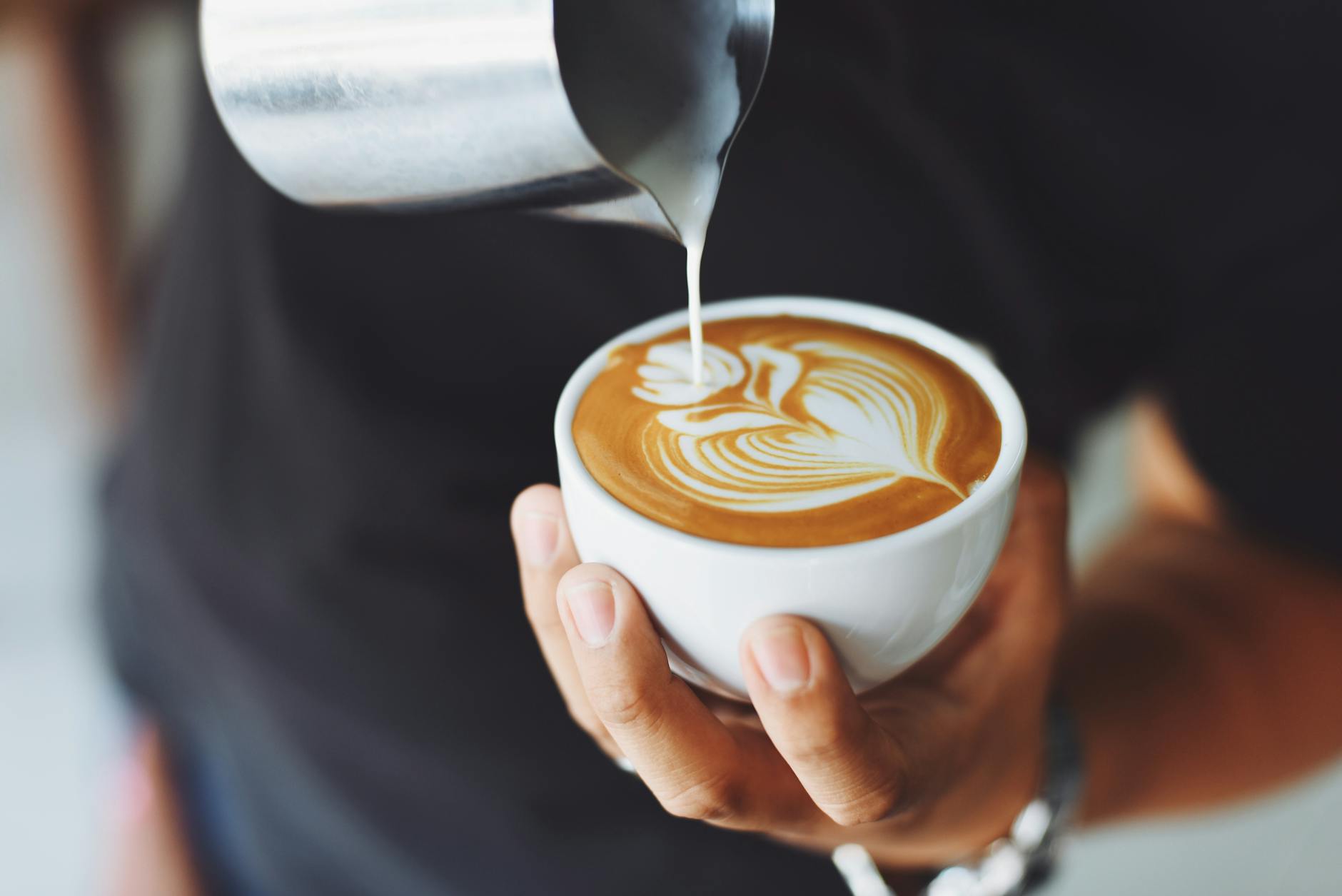
What is coffee? Who was the first person to think of creating a drink from coffee beans?
How did coffee spread from the forests of East Africa to almost every town on earth? And what is the future of the coffee industry?
Let’s discuss these questions and more on today’s episode of Thinking in English!
Listen Here!
Interactive Transcript!
You Can Now Read and Listen at the Same Time With an Interactive Transcript!

Vocabulary
- Brew (Verb): To prepare a beverage by extracting flavours from a substance through the use of hot water.
- Every morning, I brew a fresh pot of coffee to start my day.
- Coffee Beans (Noun): The seeds of the coffee plant, often roasted and ground to make coffee.
- I prefer to grind my own coffee beans for a fresher taste.
- Roast (Verb): To heat coffee beans at a high temperature, typically in an oven or over an open flame, in order to enhance flavour and aroma.
- The coffee beans were carefully roasted to achieve a rich, dark flavour profile.
- Aroma (Noun): A distinctive, usually pleasant smell, often associated with food or beverages.
- The aroma of freshly brewed coffee filled the room.
- Consume (Verb): Eating food and drinking beverages.
- After brewing a pot of coffee, I like to consume it slowly.
- Spread (Verb): To extend something over an area or among a group of people, often referring to the distribution of information, products, or practices.
- The popularity of coffee spread rapidly throughout Europe.
What is Coffee?
Definition of Coffee
Let’s start with a basic question: What is coffee?
In English, we use the word coffee to refer to a few different things.
First, coffee refers to the seeds or beans of the Coffea plant. These beans are harvested, processed, and then roasted.
Coffee, in the form of raw or unroasted or green beans, is a major economic commodity. It is one of the most traded, exported, and imported commodities in the world, and is bought, sold, and traded in major financial centres.
Farming coffee is also a major industry in places including South America, and parts of Africa and Asia. And there is an entire economy surrounding coffee: including distributions, sales, equipment, and more.
Second, coffee is one of the most popular beverages, or drinks, in the world. Coffee is a brewed beverage prepared from roasted coffee beans.
It is typically served hot, although it can also be enjoyed cold or iced, and may be consumed black or with additions such as milk, cream, sugar, or flavourings.


What Does Coffee Taste Like?
There is no one single description of how coffee tastes. Depending on factors like the variety of bean, growing conditions, roasting method, and how the beverage is made, the flavour of coffee can change dramatically.
One of my favourite cafes in Tokyo offers something on their menu called the “Three Peaks.” They take the same coffee beans but prepare them in three different ways: I think as an espresso shot, a pour over coffee, and macchiato (coffee with milk).
Despite being made from the same beans and the same water, each cup tastes completely different. It really blew my mind the first time I tried it!
Three terms often used to measure or describe the taste of coffee are acidity, body, and flavours or flavour notes.
Coffee can vary from vibrant and fruity to mellow and balanced. It can range from light and delicate to full-bodied and creamy. Coffee can exhibit a wide array of flavour notes, including fruity, floral, nutty, chocolatey, spicy, earthy, and herbal nuances.

Varieties of Coffee Beans
There are over 100 distinct types of coffee beans, however the vast majority of coffee drunk around the world is made from just two varieties: Arabica and Robusta.
Arabica beans are the most common type of coffee in most places. Arabica is known for smooth and nuanced flavours, low acidity, and aroma.
Arabica is usually grown in places high above sea level where there is a lot of rain, such as Brazil (which exports the most Arabica beans).
The other popular variety is Robusta. Robusta beans are more robust – hence the name. They are known for a strong taste, sometimes harsh flavour, and very high levels of caffeine.
Sometimes Robusta coffees can be bitter and earthy, or even taste a little burnt. Therefore, it is not as popular as arabica coffee, and is usually found in cultures that love strong coffee or used in cheaper instant coffees.
Both Arabica and Robusta beans undergo a series of processing steps after harvesting, including drying and roasting, which significantly influence the final flavour and aroma of the brewed coffee.

Basic Coffee Preparation Methods
I don’t want to talk too much on how to prepare coffee, but there are three steps.
First is roasting. This is where the raw coffee is roasted to reduce the moisture in the beans and enhance the flavours. Roasting levels vary from light to dark, with each level completely changing the character of the coffee.
Next is brewing – this is how the flavours are extracted from the beans using water. Common brewing methods include drip brewing, espresso extraction, French press, pour-over, and AeroPress.
Once brewed the coffee has to be served. Coffee is often enjoyed black or with additions such as milk and sugar. It can be served hot, cold, or even blended into specialty beverages like lattes, cappuccinos, and frappes.

The History of Coffee
Now we know a little about coffee, I think we should discuss the history of this world-famous beverage.
The Legend of Coffee’s Discovery
The Coffea plant is native to the forests of Ethiopia.
According to legend, a goat herder in Ethiopia named Kaldi noticed his goats became lively and energetic after eating the red berries from Coffea trees. Intrigued by this, Kaldi tried the berries himself and experienced a surge of energy.
Kaldi apparently mentioned his discovery that these berries could give you energy to a local monk. The monk threw the berries in the fire, then after realising they smelled nice took the roasted beans (the inside of the berry) out. They further experimented, using the beans to make a drink of some kind which could keep them awake at night.
There is another version of the myth, which suggests that Yemen had a role in the discovery of coffee.
This version suggest a Yemeni person was travelling through Ethiopia, tried the berries from the Coffea plant, and realised it gave him energy.
However, it is more likely that Ethiopians discovered the uses of the Coffea berries first.

The Spread of Coffee
It is thought that coffee spread first through Ethiopia, where the practice of roasting the beans and brewing them with water was developed.
The beans spread around the region and became especially popular across the red sea in the region of Yemen. This was probably around the 15th century.
And by the 16th century, coffee was being grown in Arabia. The popularity of coffee in the region soon caught the attention of travellers and traders from neighbouring regions, who introduced coffee to Persia, Turkey, and North Africa.
By the 15th century, coffee had become popular across the region and became an important part of Arabian and Middle Eastern culture.
Coffee houses began to be founded (the first in the city of Constantinople, now known as Istanbul), and became places where people gathered to engage in discussions and enjoy the company of friends.

Coffee Around the World?
Europeans, travelling through the Ottoman Empire in particular, were intrigued by coffee. They were curious about its effects and began to import it to western Europe.
Traders from Venice were the first to bring coffee to Italy, and the first European coffee house opened in 1645 in Venice.
Initially the drink was met with scepticism and suspicion due to its unfamiliarity, but coffee gradually gained acceptance as coffee houses were established in major European cities.
England, for example, quickly developed a liking for coffee. This might surprise you, as England is known as a tea drinking culture. But coffee was popular way before tea.
Coffee houses popped up in university towns like Oxford as well as across London. They became places of academic discussion and meetings. Scientists and intellectuals would gather at coffee houses, debate each other, share their research, and learn new things. It allowed people from different background to share knowledge.
In fact, one of the most important scientific books ever written, Isaac Newton’s Principia, was apparently conceived in a coffeehouse.
The story goes that in a London coffeehouse, three respected intellectuals, including Edmond Halley (the astronomer who gave his name to Halley’s comet) and Christopher Wren (the architect who designed many of London’s most famous buildings) were discussing planets.
They were talking about the shape of a planet’s orbit (or journey) around the sun under specific conditions and were unconvinced by certain theories and pieces of research.
After discussions in the coffee house, Edmund Halley decided to travel to Cambridge University to talk with a young mathematician called Isaac Newton. After hearing the problem, Newton immediately answered the question and revealed that he had proved this complex problem in his spare time already but never bothered to tell anyone.
Newton wrote a short paper about this problem, which eventually led him to writing The Mathematical Principles of Natural Philosophy, or Principia, which includes Newton’s laws of motion and theory of gravity.
Coffee also spread across the rest of Europe – to France, Austria, Spain, and the German states.
As Europeans began to love coffee, and want to drink it more often, they needed regular supplies. Coffee can’t be grown in Europe as it needs a tropical climate, so the Europeans took coffee to their colonies to grow.
The climate and soil conditions in parts of South America, such as Brazil, Colombia, and Central America, meant these areas became massive coffee producers. The Dutch also took coffee to their colonies in Asia, including Indonesia.

Coffee Today
Today, coffee is more than just a beverage. It is a cultural phenomenon with a global reach. From specialty coffee shops and mass-market chains to the offices and living rooms, coffee can be found in nearly every aspect of modern society.
Coffee production is a multi-billion-dollar industry, with millions of farmers around the world growing coffee on small family farms or large plantations.
Coffee is a major driver of economic development in many coffee-producing countries, providing livelihoods and careers for millions of people.
And coffee consumption is on the rise globally. Consumers are enjoying drinking coffee in more ways, people are living in urban centres like cities full of coffee shops, and coffee culture is growing. It is enjoyed as a morning ritual, a midday pick-me-up, or a social activity, and is part of many people’s daily lives.
I usually start my day by grinding some coffee beans I buy from a local coffee shop, and then use a pour over kit to make myself some delicious coffee. And I write a lot of Thinking in English episodes in coffee shops!
The past few decades have also witnessed the development of the specialty coffee movement. This is a coffee movement which prioritizes quality and sustainability in coffee.
Specialty coffee roasters and cafes focus on sourcing high-quality beans, promoting direct trade relationships with farmers, and creating beverages with unique flavours.
I never liked coffee when I was young. I grew up only knowing about instant coffee in the UK which always tasted burnt and bitter.
It was only during the pandemic years, when I started watching a creator on YouTube called James Hoffman, that I learned how delicious and complex coffee can be!
And coffee culture is still developing. New ways to brew coffee are constantly being developed and new equipment invented to allow individuals to make delicious drinks at home. The flavours of coffee are also being used in foods and sweets, and attracting whole new audiences to coffee!

The Future of Coffee
What is the future of coffee?
The honest answer is that coffee drinking as we know it today is at risk. There are two big challenges facing the coffee industry: climate change and sustainability.
Climate change is threatening to disrupt coffee-growing regions with rising temperatures, strange rainfall patterns, and increasing risks of disease and insects. Coffee can’t be grown everywhere – it needs specific climates. As the climate changes, the places growing coffee today may struggle to continue.
And if the coffee industry is to continue growing, it needs to deal with sustainability issues. Problems like deforestation (cutting down trees), lack of water, poor quality soil, and badly treated workers means that the industry may be at risk in the future.
However, there are some promising innovations.
Advances in genetic research could help to develop coffee varieties that are more resilient to climate change, diseases, and are capable of producing high-quality beans under all environmental conditions.
Sustainable farming practices are also being developed. These include organic farming and regenerative agriculture, which aim to make sure the ecosystem is healthy and can continue to grow coffee long term.
There will also be developments in how coffee is drunk or enjoyed.
In recent years alternative brewing methods have become common. Traditional ways to make coffee include using espresso machines, moka pots, or pour over or drip coffee systems. Today, things like cold brew, nitro coffee, or coffee pods have also become wildly popular.
I also think that the future will see new ways to flavour coffee and create new beverages including coffee. I like black coffee – made using high quality beans through a pour over (which is very popular here in Japan).
But I didn’t always. I first started drinking coffee at university when I had to study late at night. My university library had a Starbucks inside, so I would order a vanilla or caramel latte and add sugar. It was incredibly sweet… but it masked the coffee flavour.
Over time, I began to like the coffee flavour. I no longer needed the sweet flavourings, and eventually I no longer needed milk either. Instead, I wanted high quality beans to provide flavours.
I think millions more people will have similar journeys to me and will begin with the sweet and creative coffees being served by chains like Starbucks.

Final Thought
Coffee is more than just a beverage. It’s a global phenomenon with deep connections to different cultures, economies, and our personal lives.
From its origins in Ethiopia’s forests to its widespread popularity today, coffee has developed into a multi-billion-dollar industry driving economic development worldwide.
However, the future of coffee faces significant challenges, particularly from climate change and sustainability issues.
Hopefully, promising innovations in fields like genetics could help save coffee. And as new brewing methods and ways of drinking coffee emerge, the beverage will continue to be a popular and important drink worldwide.
What do you think? Do you like coffee? How do you drink coffee? Is there a special way of making coffee in your country, region, or culture?
Extended Vocabulary List
Become a Patreon Subscriber to Access the Extended Vocabulary List!


Vocabulary Games and Activities!
Learn and practice vocabulary from this Thinking in English episode.
Practice using 5 different study games and activities – including writing, listening, and memorisation techniques!
Flashcards
Matching Game
Learning Game
Test Yourself
Listening and Spelling
Do you want to Think in English?
I’m so excited that you found my blog and podcast!! If you don’t want to miss an article or an episode, you can subscribe to my page!
