

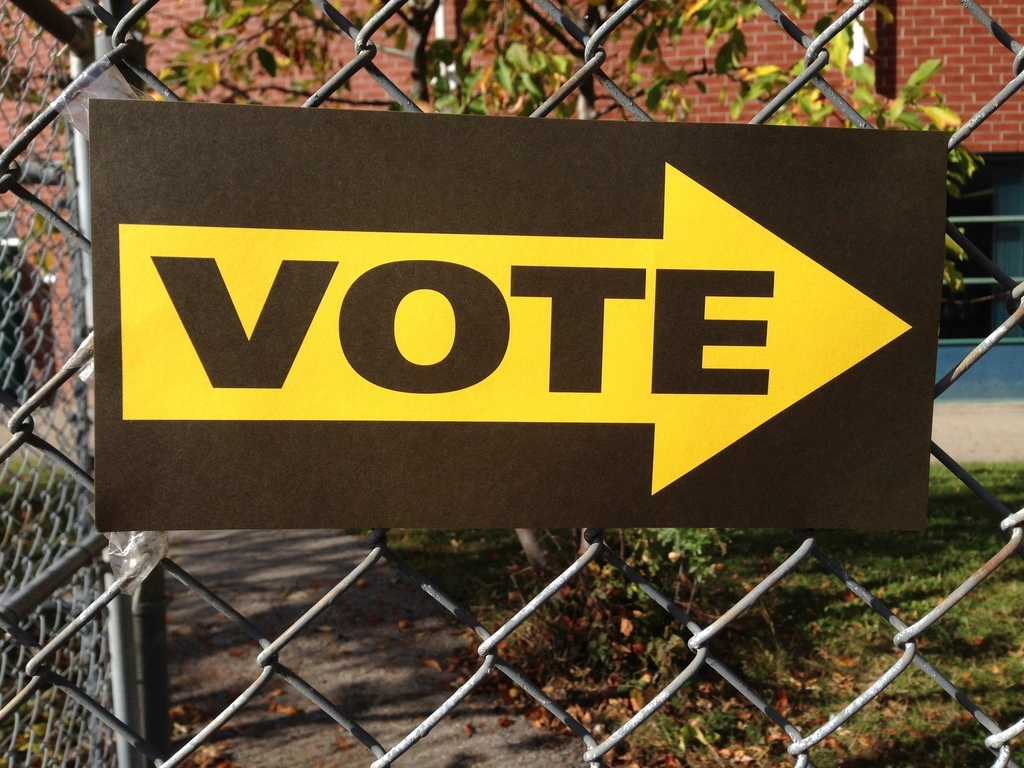
Should voting be compulsory? Is voting a right or a privilege? Should there be a maximum voting age? Who should be allowed to vote?
Let’s discuss some of these major questions and debates in today’s episode of Thinking in English!
Listen Here!
 Apple Podcasts
 Spotify
 YouTube
Interactive Transcript!
You Can Now Read and Listen at the Same Time With an Interactive Transcript!

Vocabulary
- Ballot (Noun): A process of voting, in writing and typically in secret.
- In the national election, every citizen over the age of 18 is given a ballot to cast their vote for their preferred candidate.
- Referendum (Noun): A general vote on a single political question which has been referred to them for a direct decision.
- The government held a referendum to decide whether the country should adopt a new constitution.
- Representative (Noun): A person chosen or appointed to act or speak for others, in particular in a legislative assembly.
- The citizens elected a new representative to voice their concerns in the national parliament.
- Suffrage (Noun): The right to vote in political elections.
- The suffrage movement fought to secure voting rights for women in the early 20th century.
- Privilege (Noun): A special right or advantage granted or available only to a particular person or group.
- Voting was once considered a privilege reserved only for wealthy, property-owning men.
- Duty (Noun): A moral or legal obligation; a responsibility.
- Many believe that voting is not just a right but a duty that every eligible citizen should fulfil.
- Compulsory (Adjective): Required by law or a rule; obligatory.
- In Australia, voting is compulsory, and citizens can be fined if they fail to participate in elections.
Introduction
2024 is a year of many elections. Billions of people around the world have already, or will soon be, voting for politicians, mayors, leaders, prime ministers, and presidents.
All these elections have made me think about the action of voting, whether voting is a right or a privilege, and some of the major debates ongoing today about voting.
Voting is a method of making decisions or expressing choices and preferences. In group situations, when there are too many people to come to a easy agreement, voting is an efficient way of reaching a decision.
In small groups, we can vote by raising our hands or voting with our voices. For bigger votes, like voting in national elections or referendums, we “cast ballots” (vote on paper or using electronic devices) to indicate our choices.
Voting is a fundamental part democracy, both in direct democracy (where you vote directly for a choice or policy – like when the UK voted to leave the European Union) and in representative democracy (when you vote for a person or political party to represent you in future votes on policies – like voting in your national election).


History of Voting
In the context of this episode, I’m interested in the process of voting in elections.
Voting is not exactly a modern invention.
Some elections were held in the ancient societies of Greece and Rome. Holy Roman Emperors and Catholic Popes were also selected through elections and votes. Of course, the number of people allowed to vote in these elections was tiny compared to people they controlled, but they were still elected through voting.
By the 13th century, the English Parliament began to evolve, with elected representatives. These representatives had limited power compared to the modern parliament, and voting rights were restricted to property-owning males.
Modern voting and elections developed more recently. There was a change in the entire concept of representation.
For example, in most of Europe, early parliaments and councils were seen as representing properties, land, interests, or groups, rather than actual people. This is why only people who owned land were allowed to vote in UK elections – they were not voting as people but as landowners.
The UK parliament still has an element of this today in the unelected House of Lords – there are a number of “Lords” who are not appointed by governments but instead inherit their position as politicians due to their family’s history. The Lords also contains representatives of the churches and religions in the UK – they represent the interests of the church not individual people.
The big change in voting and elections was the idea that individual people are important. Individual people should be represented in politics.
Governments should represent their people, and should be chosen by those people regularly, rather than just representing elites or estates or powerful institutions.
This idea led to the gradual (and it was a slow, gradual process) extension of suffrage. Suffrage means the right to vote, so the expansion of suffrage meant more people could vote.
First in Western Europe and North America, and later around the world, more and more men were allowed to vote in elections and choose their leaders. Universal adult male suffrage (meaning all adult men could vote) was established in most democracies by the 1920s.
Women’s suffrage followed later in the 20th century (in some place like Switzerland it wasn’t until the 1970s).
An important point is that while elections are an important part of modern democracy, just because we have elections doesn’t mean democracy is working well or successfully. Illiberal democracies and dictatorships can hold elections too – just not free and fair elections,
Some countries limit the people allowed to vote (for example in the USA there are laws against allowing prisoners or convicted criminals voting rights) and in many countries thousands of people choose not to vote in elections.
With the spread of voting, different forms of elections were developed – I released a Patreon exclusive episode introducing different electoral systems a few weeks ago, you should all check it out!

Privilege Vs Right Vs Duty
The title of this episode is “Who Should Be Allowed to vote?”
While we like to say that most democracies now have “universal” suffrage (meaning everyone can vote), this is not technically true.
We limit who can vote in every election, and I’ll discuss this in more detail in a few minutes.
First, I think we need to discuss whether voting is a right, a privilege, or maybe even a duty!
Some people see voting as a “right.”
A “right” is a fundamental entitlement or freedom that is guaranteed and protected by law or moral principles. For example, the right to free speech or the right to a name are basic human rights (according to the Universal Declaration of Human Rights).
If voting is seen as a right, it means that all citizens of a country should have the inherent and permanent ability to vote in elections. Each person should have an equal opportunity to shape the decisions that affect their lives and communities.
When voting is seen as a right, voting needs to be protected and governments must make sure that voting is accessible.
Another perspective is that voting is privilege, not a right.
If voting is a privilege, it is a benefit or advantage given by the country to certain people, instead of a right everyone is entitled to.
In other words, the ability to vote should be dependent on certain criteria or qualifications, such as citizenship, residency, or even based on something like knowledge.
People who support this perspective argue that voting should be reserved for those who meet specific standards.
Defining voting as a privilege would mean very different things to defining voting as a right. The government would need to set the rules that qualify a person for voting and make sure only eligible people vote.
A third perspective is that voting is not just a right but a duty. It not just something you are entitled to do, but something you should and have to do.
It suggests that active participation in elections is not just good for democracy but essential for democracy.
In countries that view voting as a duty, they have laws that make voting mandatory or compulsory.
While I’ve identified three different perspectives on voting, in practice most countries mix the perspectives. Even in countries that see voting as a right or duty, it is usually limited to people who are citizens, residents, or meet age criteria (suggesting that it is a privilege given to all adult citizens).

Debates Around Voting
As I mentioned earlier, voting is not necessarily or technically universal in most countries. People are excluded from voting even in the most democratic elections.
Sometimes this is accepted (and even a good thing) and other times there is a debate. In fact, some people want there to be more restrictions and limits on who can vote.
In the final part of this episode, I want to quickly introduce and summarise a few of the most important debates on voting rights today.
Should Voting be Compulsory?
First, should voting be compulsory?
I mentioned this debate earlier in the episode. At the moment, around 23 countries have some form of compulsory or mandatory voting. This means that eligible voters have to vote by law.
These laws can be enforced or unenforced.
Australia is a great example of compulsory voting. Some elections in the country have had compulsory voting since 1915 and in all elections since 1974. If you don’t vote in Australia, you can be fined between $20 and $180 Australian dollars, and this is a regularly enforced policy. Australia also has one of the highest average voter turnouts in the world!
Some places are much more serious with their penalties for not voting. If you fail to vote in Bolivia, and don’t have a good reason, you will not be able to receive your salary from your bank for 3 months.
Before the year 2000, not voting in Greece meant you could not receive a passport or driving license. Still today in Uruguay, not voting can limit your chances at getting a loan, buying certain properties, or even travelling internationally!
People in favour of mandatory voting argue that it ensures high voter turnout and more accurate representation in elections. The Netherlands, for example, ended compulsory voting and their average turnout has dropped from 95% to 80%.
More votes means a more representative and democratic election. Requiring people to vote makes them more engaged and aware of political issues.
It also stops the paradox of voting.
The paradox of voting is that for the average voter, voting in an election has more costs than benefits – your vote, in the grand scheme of everything, is insignificant but the voting process takes time out of your day. Making voting compulsory means that voting is now more beneficial than not voting, because you may get fined!
On the other hand, people against mandatory voting say it violates individual freedom, as people should have the choice to vote or not.
Forcing people to vote could be unfair (because not voting is sometimes a choice) and might result in uninformed or uninterested voters. We want informed people to vote, rather than uniformed people who will vote randomly or without thinking about their votes.
Additionally, making people vote can be difficult and might unfairly penalize disadvantaged groups.
In the end, the debate is about whether the advantages of having everyone vote are worth the potential downsides of making it compulsory.
What do you think?

Citizens Vs Residents Vs Resident Citizens
The next debate is one that I often consider. Should voting be exclusively for citizens, or for residents as well, or should it be limited to citizens who are also residents.
A citizen is a legally recognized member of a country. Citizenship is often acquired by birth within the country, descent from a citizen parent, or through a process of naturalization. Citizens usually can vote in elections, get a passport from that country, use that country’s embassies overseas, and have full access to national institutions.
A resident is someone who lives in a country but may not have the full legal status of a citizen.
Individuals who have been granted the right to live indefinitely within a country but are not citizens are often called permanent residents. They often have many of the same rights as citizens, such as working and accessing public services, but may not be able to vote in national elections or hold certain public offices.
Individuals who live in a country for a specific period, often for work, study, or other purposes, under a visa, are considered temporary residents. Their rights and responsibilities are typically more limited.
A citizen can also be a resident or a non-resident. I am a UK citizen, but I am not a UK resident anymore – I don’t live there.
At the moment, I have a temporary visa status (although I can stay here indefinitely) in Japan which hopefully in the next few years will become permanent.
Out of these different groups, who should be allowed to vote in elections?
Some people argue that residents, regardless of citizenship, should be allowed to vote as these individuals contribute to the community and economy, pay taxes, and are affected by government decisions. Therefore, they should have a say in the political process. Excluding non-citizen residents from voting can lead to a significant portion of the population being disenfranchised and unrepresented.
It is quite common in Europe to allow non-citizens to vote in certain local elections, especially in EU countries.
The UK, in a more limited way, let’s commonwealth citizens (citizens of 56 different countries that used to be part of the British Empire) vote in UK elections as long as they are living in the UK at the time of the election.
More common around the world is to limit voting to citizens only. Supporters of restricting voting to citizens argue that citizenship represents a legal and social contract with the nation, and therefore, only citizens should have the right to influence the government of the country.
They believe that voting is a privilege tied to the rights and responsibilities of citizenship, which includes allegiance to the country and a commitment to its laws and values.
Others argue that only citizens who actually live in the country permanently should be allowed to vote. People like me, who live overseas in a different country, are not always directly impacted by the policies of government.
What do you think? Should voting be open to residents or restricted to citizens?

Lower Voting Age? Maximum Voting Age?
Finally, I want briefly to mention the debate around age and voting.
In the recent UK election, one of the Labour party’s policies was reducing the voting age from 18 to 16. This is because 16-year-olds are allowed to leave education, get jobs, leave their homes, and pay taxes – if they pay taxes they should be allowed to vote.
I’ve recorded an entire episode on this topic in the past – I’ll link it in the transcript!
To end this episode, however, I want to talk about the opposite end of the age spectrum. Should there be a maximum voting age?
We have a minimum voting age, so a maximum voting age would not be impossible.
The argument here is that older people are able to impact the future of a country that they will not experience. Older voters tend to be much shorter sighted in their voting preferences, and in most countries vote in much larger numbers to younger voters.
This argument appeared a lot after the Brexit referendum in the UK in 2016. As you all know, the UK left the EU after a national vote.
Here is an example of a headline from Time Magazine in 2016 – “The U.K.’s Old Decided for the Young in the Brexit Vote.”
Only 19% of people under 24 voted for the UK to leave the EU, while 59% of people receiving old age pensions voted to leave. The old of the UK made a long-term decision that will impact young people significantly more.
If we had a maximum voting age, this wouldn’t happen.
What do you think?

Final Thought
Today I’ve looked at voting and who should be allowed to vote.
We’ve discussed whether voting is a right, a duty, or a privilege.
We’ve considered if voting should be compulsory, whether residents should also be entitled to vote, and whether there should be a maximum voting age.
There are many other debates surrounding voting I didn’t have time to mention. Should prisoners be allowed to vote? Which electoral systems should we use? Should you need ID to vote? Should voting by post or proxy be allowed?
Maybe in the future I’ll record more about this!
What do you think?
Extended Vocabulary List
Become a Patreon Subscriber to Access the Extended Vocabulary List!


Vocabulary Games and Activities!
Learn and practice vocabulary from this Thinking in English episode.
Practice using 5 different study games and activities – including writing, listening, and memorisation techniques!
Flashcards
Matching Game
Learning Game
Test Yourself
Listening and Spelling
Do you want to Think in English?
I’m so excited that you found my blog and podcast!! If you don’t want to miss an article or an episode, you can subscribe to my page!
